Hispania: The Roman Conquest and Evolution of the Iberian Peninsula
Hispania was the Roman name for the territory comprising the majority of the modern-day Iberian Peninsula. Spanning from the initial Roman invasions in 218 BC to the collapse of Western Roman authority in 472 AD, this region served as a vital frontier and a powerhouse of the Roman Empire. Its history is a complex narrative of military conquest, cultural assimilation known as Romanization, and eventual fragmentation under Germanic migrations.
The legacy of Hispania extends beyond ancient borders, providing the etymological root for the modern names of Spain and the Spanish language. While the boundaries of the Roman province do not align perfectly with modern nation-states, the administrative and linguistic foundations laid during this era shaped the future of both Spain and Portugal.
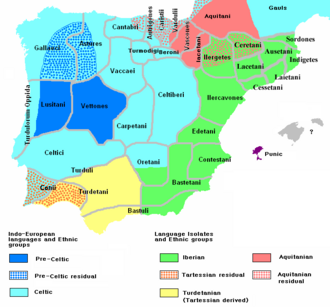
Key Facts
- Timeline: Roman presence lasted from 218 BC to 472 AD.
- Population: Estimated at 5,000,000 or more.
- Imperial Influence: Three Roman emperors—Trajan, Hadrian, and Theodosius I—were born in Hispania.
- Administrative Shift: Evolved from two initial provinces to as many as nine by the 4th century.
- Successor States: Following the Roman collapse, the region was succeeded by the Visigothic Kingdom and the Kingdom of the Suebi.
The Roman Conquest and Romanization
Roman armies first entered the Iberian Peninsula in 218 BC. For nearly two centuries, the region functioned as a proving ground for Roman military tactics and a training site for officers. The Romans faced fierce resistance from various indigenous groups, including the Carthaginians, Iberians, Lusitanians, Gallaecians, and various Celtic tribes.
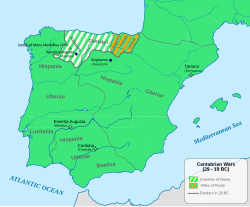
Full control of the peninsula was not achieved until 19 BC, when the Emperor Augustus concluded the Cantabrian Wars. Once stability was established, Romanization—the process by which indigenous populations adopted Roman culture, law, and language—spread across the region. This process varied in speed; some areas became togati (Latin-speaking, toga-wearing citizens) quickly, while others remained resistant for longer.
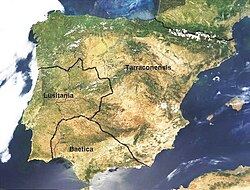
Administrative Organization
To manage the vast territory, Rome implemented several administrative shifts. Initially, in 197 BC, the region was split into two provinces: Hispania Citerior ("Hither Hispania") and Hispania Ulterior ("Farther Hispania").
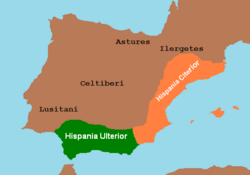
In 27 BC, Marcus Vipsanius Agrippa reorganized the territory into three distinct provinces under Augustus:
- Baetica: Roughly corresponding to modern Andalusia.
- Lusitania: Including Gallaecia and Asturias.
- Tarraconensis: The northeastern quadrant.
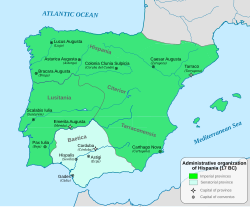
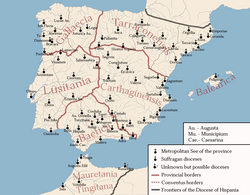
By the 4th century, the administrative structure became more granular, expanding to nine provinces to improve governance and tax collection.
Religion and Society
Early Hispania practiced a blend of traditional indigenous beliefs and Roman polytheism. Christianity arrived in the 1st century and gained a foothold in urban centers by the 2nd century. However, the rural countryside remained largely pagan until the late 4th century, when Christianity became the official religion of the Roman Empire.
Despite the rise of some heretical movements, such as Priscillianism, the local church remained largely aligned with the Pope. As civil government began to crumble in the 5th century, bishops often stepped in to provide administrative stability and maintain social order.
The Germanic Conquest and the Fall of Rome
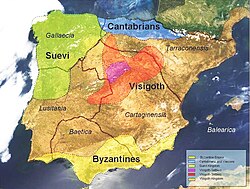
The decline of Roman Hispania began in 406 AD when Germanic tribes crossed the Rhine. By 409 AD, the Buri, Suevi, Vandals, and Sarmatian Alans entered Iberia. This led to a fragmented landscape of small kingdoms: the Suevi in Gallaecia, the Alans in Lusitania, and the Vandals in Baetica.
The Western Roman Empire attempted to reclaim the territory by employing the Visigoths. While the Visigoths successfully eliminated the Alans and Silingi Vandals, Roman authority remained precarious. The Vandals and Alans eventually migrated to North Africa in 429 AD, which temporarily allowed Rome to recover much of the peninsula.
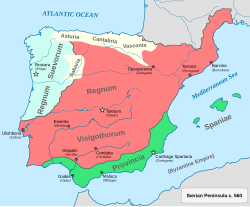
However, by 461 AD, Roman authority collapsed everywhere except in the northeast. In 472 AD, the Visigoths occupied Tarragona, marking the end of Western Roman rule. The Visigoths eventually established their capital at Toledo in 484 AD and consolidated power, conquering the Suebic Kingdom by 585 AD.
Climate and Environment
Historical records and scientific data indicate that Roman Spain experienced significant climatic fluctuations. The Iberian–Roman Humid Period saw high precipitation levels, specifically between 550–190 BC and again from 150–350 AD. Conversely, an arid interval occurred between 190 BC and 150 AD, characterized by extreme heat that occasionally hindered military movements.
| Category | Details |
|---|---|
| Time Period | 218 BC – 472 AD |
| Major Capitals | Tarraco, Corduba, Emerita Augusta |
| Primary Languages | Latin, Paleohispanic languages |
| Government | Autocracy (Roman Empire) |
| Key Provinces | Baetica, Lusitania, Tarraconensis |
| Successor States | Visigothic Kingdom, Kingdom of the Suebi |
Frequently Asked Questions
What does the name "Hispania" mean today?
Hispania is the Latin root for the modern name Spain. Over centuries, it evolved into the Castilian "España," Catalan "Espanya," and Old French "Espaigne." While it originally referred to the Roman province, the term eventually shifted to describe the modern nation-state of Spain.
Which Roman emperors were from Hispania?
Three significant Roman emperors were born in the region: Trajan (r. 98–117), Hadrian (r. 117–138), and Theodosius I (r. 379–395).
How did the Visigoths take over the region?
The Visigoths were initially brought in by the Western Roman Empire to fight other Germanic invaders. After Roman authority collapsed in the mid-5th century, the Visigoths seized the province of Tarraconensis in 472 AD and eventually established a kingdom with its capital at Toledo.
What were the main provinces of Roman Spain?
Under the reorganization by Augustus in 27 BC, the region was divided into Baetica, Lusitania, and Tarraconensis. Later, in the 4th century, this was further subdivided into smaller provinces including Gallaecia and Carthaginiensis.
What was the role of Christianity in Hispania?
Christianity arrived in the 1st century and became an urban phenomenon in the 2nd century. It became the official state religion in the late 4th century. During the transition to Visigothic rule, the church and its bishops provided essential social and administrative stability.