Roc: The Legendary Giant Bird of Middle Eastern Mythology
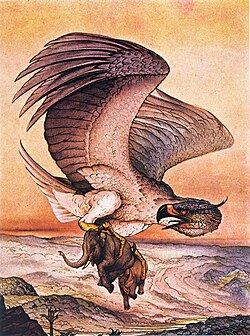
In the vast tapestry of global folklore, few creatures capture the imagination quite like the Roc (also known as the Rukh). A legendary bird of prey from Middle Eastern mythology, the Roc is defined by its staggering scale and immense strength, famously depicted as being large enough to lift elephants into the sky with minimal effort.
From the seafaring tales of the Arabian Peninsula to the travelogues of Venetian explorers, the Roc has transitioned from a creature of natural history and geography into a staple of fantasy literature and modern gaming.
Key Facts
- Origin: Middle Eastern folklore, appearing in Arabic and Persian traditions.
- Primary Ability: Capable of seizing and carrying elephants in its talons.
- Famous Appearances: Featured prominently in One Thousand and One Nights, specifically in the stories of Sinbad the Sailor.
- Etymology: Derived from the Arabic ruḵḵ and Persian ruḵ.
- Scientific Theory: May be based on misidentified eggs of the extinct Aepyornis (elephant bird).
Origins and Etymology
The English term "roc" entered the language via French translations by Antoine Galland, originating from the Arabic ruḵḵ and Persian ruḵ. In both languages, the word is written as رخ in the Arabic script.
Mythological Inspirations
Scholars debate the exact roots of the Roc myth. Art historian Rudolf Wittkower suggests the creature may have evolved from the Indian solar bird Garuda, who is depicted in the Mahabharata and Ramayana carrying off an elephant. Similarly, Sri Lankan mythology speaks of a giant bird that cast shadows as large as clouds.
Other scholars argue the Roc is more closely linked to the Anqā, a pre-Islamic giant bird with a human face and four wings, mentioned in the early works of Abu Muhammed Abdullah ibn Hamid.
The Roc in Literature and History
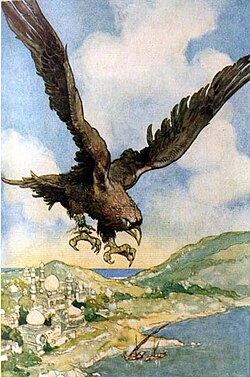
The Roc is not merely a fairy tale creature; it appeared in early accounts of natural history and geography, often blurring the line between myth and observation.
Marco Polo's Account
In 1298, the explorer Marco Polo described a bird resembling a giant eagle with quills twelve paces long. He claimed the bird was strong enough to seize an elephant, carry it high into the air, and drop it to smash it to pieces before eating it. Polo believed these birds flew to Mogadishu from southern regions.
The Arabian Nights
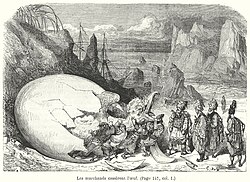
The Roc is a central element in the voyages of Sinbad the Sailor. In one tale, Sinbad discovers a massive dome 50 paces in circumference, which he realizes is a Roc's egg. He eventually escapes a tropical island by tying himself to the bird's leg with his turban, hitching a ride as the creature takes flight.
Cultural Depictions and Traditions
The image of the Roc has evolved through various cultural lenses over the centuries.
- Ethiopian Tradition: In the Kebra Negast, the Rukh is credited with delivering a blessed piece of wood to King Solomon for the construction of his Temple. This wood is later linked to the cross of Jesus.
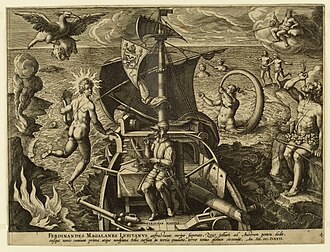
- European Art: By the 16th century, artists like Stradanus and Theodor de Bry illustrated the Roc destroying ships or hunting elephants, reflecting the European fascination with the "exotic" East.
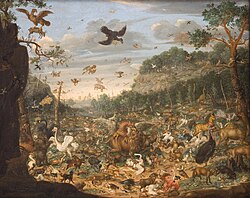
- Early Modern Belief: In 1604, poet Michael Drayton wrote of the "huge Rucke" being among the animals taken aboard Noah's Ark, showing that the creature was accepted as a real entity by some Europeans of the era.
Scientific Rationalization
As the scientific era progressed, researchers sought natural explanations for the Roc legend. Some suggested that the myth grew from exaggerated sightings of eagles carrying newborn lambs.
The Elephant Bird Connection
The most compelling theory involves the Aepyornis, an extinct, flightless "elephant bird" from Madagascar. Standing three meters tall, its massive eggs were discovered by sailors as early as 1420. While the Aepyornis was a ratite (flightless bird) and looked nothing like a giant eagle, the discovery of its enormous eggs likely fueled the belief in a giant flying predator.

Summary of the Roc Myth
| Context | Description/Role | Key Source |
|---|---|---|
| Mythology | Giant bird of prey that hunts elephants | Arabian Folklore |
| Literature | Creature encountered by Sinbad the Sailor | One Thousand and One Nights |
| Travelogue | Eagle-like bird with 12-pace quills | Marco Polo |
| Science | Misidentified flightless Aepyornis | 19th Century Paleontology |
| Modern | Fantasy monster / Aircraft nickname | D&D / Stratolaunch |
Frequently Asked Questions
What is a Roc?
A Roc is a legendary giant bird of prey from Middle Eastern mythology, known for its immense size and ability to carry off large animals, including elephants.
Is the Roc based on a real animal?
While the Roc is mythical, scientists believe the legend may have been inspired by the discovery of eggs from the Aepyornis, an extinct flightless bird from Madagascar, or exaggerated accounts of large eagles.
Where does the Roc appear in literature?
The Roc is most famous for its appearances in the stories of Sinbad the Sailor within the collection One Thousand and One Nights, as well as in the writings of Marco Polo.
How does the Roc differ from a Griffin?
Unlike the Griffin, which is a hybrid creature with the body of a lion and the head and wings of an eagle, the Roc is consistently depicted as a giant bird of prey.
Does the Roc appear in modern culture?
Yes, the Roc appears in fantasy role-playing games like Dungeons & Dragons and has served as a nickname for the Stratolaunch, one of the largest aircraft ever built.