Right of Abode in Hong Kong
The Right of Abode (ROA) is a legal status that grants individuals the unrestricted right to live, work, and enter Hong Kong without the risk of deportation. As a Special Administrative Region (SAR) of China, Hong Kong operates under a unique immigration framework. While natural-born residents are generally Chinese citizens, the region maintains separate immigration controls from mainland China and Macau.
This means that Chinese citizenship does not automatically grant residence rights across these three jurisdictions; a resident of mainland China or Macau must still meet specific legal criteria to acquire the right of abode in Hong Kong, and vice versa.
Key Facts
- Right of Abode allows a person to live and work in Hong Kong without being subject to deportation.
- Right to Land is a lesser status that allows unrestricted entry and work but does not protect against deportation.
- Non-Chinese permanent residents may lose their ROA if they are absent from the territory for more than 36 consecutive months.
- Public servants in the HKSAR government must generally be permanent residents.
- The Basic Law (the region's mini-constitution) defines the current eligibility requirements under Article 24.
Historical Evolution of Residence Rights
The Colonial Era (1842–1997)
During British rule, residence rights were tied to British nationality law. Initially, all British subjects had unrestricted access to the colony. However, between 1962 and 1971, the UK and Hong Kong introduced stricter immigration controls. Those born in the colony were granted belonger status, signifying their right of abode. By 1981, most belongers were reclassified as British Dependent Territories citizens (BDTCs).
Border controls with mainland China were only established in 1950. For years, the government was lenient with illegal immigrants to fill unskilled labor shortages. This changed in 1971, when residents of seven years were granted the right to land. In 1974, the "Touch Base Policy" was introduced: illegal immigrants caught by police were deported, but those who reached urban areas and found housing were granted legal status. This policy ended in 1980.
The Transition to Chinese Sovereignty
The 1984 Sino-British Joint Declaration set the stage for the 1997 handover. Under Article 24 of the Basic Law, belonger status was renamed permanent resident status in 1987. On July 1, 1997, most BDTCs lost that status unless they had connections to other British territories. Ethnic Chinese BDTCs became Chinese nationals, while non-ethnic Chinese who would have otherwise been stateless became British Overseas citizens.
Acquiring and Losing Permanent Residency
How Right of Abode is Acquired
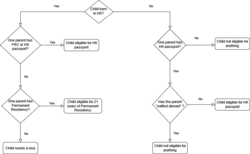
Historically, ROA was tied to British nationality. Post-1997, it is governed by the Basic Law. Individuals born overseas to Hong Kong-connected BDTCs were permanent residents by descent, though those who did not acquire Chinese nationality or return to Hong Kong within three years of the handover were downgraded to the right to land.
Conditions for Loss of Status
The rules for losing permanent residency differ based on nationality:
- Non-Chinese Nationals: They automatically lose their right of abode if they are absent from Hong Kong for more than 36 months after they cease to ordinarily reside there. They are then downgraded to the right to land.
- Children with Foreign Nationality: Those born in Hong Kong with residency by descent automatically lose ROA at age 21 and receive the right to land. They can reapply after a seven-year residence period.
- Chinese Nationals: They can only be deprived of the right of abode if they lose their Chinese nationality.
Foreign permanent residents can avoid automatic loss by naturalizing as Chinese nationals, which requires renouncing their original nationality.
Legal Challenges and Eligibility Controversies
Children Born in Mainland China
In 1999, the Court of Final Appeal (CFA) ruled that children born in mainland China could have ROA if at least one parent held it. Fearing a massive population surge (estimated at 1.67 million people), the government sought an interpretation from the Standing Committee of the National People's Congress (NPCSC). The NPCSC restricted eligibility, reinforcing the need for mainland exit procedures and reverting to pre-ruling criteria.
Birth Tourism and the 2001 Ruling
A 2001 CFA ruling established that all Chinese nationals born in Hong Kong have the right of abode, regardless of their parents' status. This led to a surge in birth tourism, where expectant mothers from the mainland traveled to Hong Kong to secure permanent residency for their children, causing significant overcrowding in maternity wards.
Summary of Residence Statuses
| Status | Right to Live/Work | Protection from Deportation | Nationality Requirement |
|---|---|---|---|
| Right of Abode | Yes | Yes | None (but loss rules vary) |
| Right to Land | Yes | No | None |
| Non-Permanent Resident | Conditional | No | None |
Frequently Asked Questions
What is the difference between Right of Abode and Right to Land?
The Right of Abode allows a person to live and work in Hong Kong and guarantees they cannot be deported. The Right to Land allows a person to enter, live, and work in Hong Kong, but they can still be deported if they commit serious crimes or meet other legal deportation criteria.
Can a non-Chinese permanent resident lose their status?
Yes. If a non-Chinese permanent resident is absent from Hong Kong for more than 36 months after they have ceased to ordinarily reside in the territory, they automatically lose their Right of Abode and are granted the Right to Land instead.
Do children born in Hong Kong automatically get the Right of Abode?
Yes, according to a 2001 Court of Final Appeal ruling, all Chinese nationals born in Hong Kong have the right of abode, even if neither parent is a permanent resident.
Is permanent residency required to work for the HKSAR government?
According to Article 99 of the Basic Law, public servants in all government departments must be permanent residents of the HKSAR, unless otherwise provided for in Article 101. However, there is no specific requirement regarding their nationality or passport.
How can a foreign permanent resident avoid losing their Right of Abode?
They can apply to naturalize as a Chinese national. Upon successful application, they are exempt from the automatic loss of status associated with long absences, though they must renounce their previous nationality.