Republican Era Coinage: The Evolution of Roman Currency
Before the Roman Republic established its own distinct monetary system, the region relied heavily on Greek coins. The transition toward a native currency began with the use of bronze ingots, which eventually evolved into irregular bronze disks known as aes rude. This shift marked the beginning of a sophisticated financial evolution that would support the expansion of the Roman state.
The Rise of the As
Around 280 BC, the Roman Republic introduced the as, a large cast bronze coin that served as the foundation of their monetary system. The as was not a standalone unit; it existed within a complex hierarchy of fractions and multiples to facilitate trade and daily transactions.
The fractions of the as included the bes (2/3), semis (1/2), quincunx (5/12), triens (1/3), quadrans (1/4), sextans (1/6), uncia (1/12, which also served as a common weight unit), and the semuncia (1/24). For larger transactions, the Romans utilized multiples of the as, such as the dupondius (2), sestertius (2 1/2), and tressis (3).
Transition to Struck Coinage and the Denarius
For approximately seventy years, the as was produced as a cast coin. Over time, its weight was reduced in several stages, eventually leading to the introduction of the sextantal as, which weighed one-sixth of a pound. This period of weight reduction coincided with a fundamental change in production: the Republic switched from casting bronze coins to striking them.
Parallel to these changes in bronze, the Romans introduced the denarius, a silver coin. While earlier Roman silver had followed Greek weight standards to ease trade in southern Italy and across the Adriatic, the denarius established a strictly Roman weight standard.
The Retariffing of the Denarius
The denarius, often referred to as the "tenner," was initially valued at ten assēs. However, around 140 BC, its value was retariffed to sixteen assēs. Historical accounts suggest this adjustment was a result of the financial pressures involved in funding the Punic Wars.
Key Facts
- Initial Currency: Romans moved from Greek coins to bronze ingots and aes rude before creating the as.
- The As: Introduced ca. 280 BC as a cast bronze coin.
- Denarius: A silver coin that shifted Roman currency from Greek to Roman weight standards.
- Value Shift: The denarius was retariffed from 10 to 16 assēs around 140 BC.
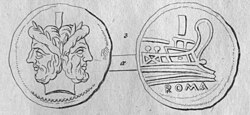
- Iconography: The as typically featured the bust of Janus on the obverse and a galley prow on the reverse.
Summary of Republican Coinage Units
| Coin Name | Value Relative to As | Type/Material |
|---|---|---|
| Semuncia | 1/24 | Bronze |
| Uncia | 1/12 | Bronze |
| Sextans | 1/6 | Bronze |
| Quadrans | 1/4 | Bronze |
| Triens | 1/3 | Bronze |
| Quincunx | 5/12 | Bronze |
| Semis | 1/2 | Bronze |
| Bes | 2/3 | Bronze |
| As | 1 | Bronze |
| Dupondius | 2 | Bronze |
| Sestertius | 2 1/2 | Bronze |
| Tressis | 3 | Bronze |
| Denarius | 10 (later 16) | Silver |
Frequently Asked Questions
What was the aes rude?
The aes rude were irregular bronze disks used by the Romans as a precursor to the formal coinage system, replacing the use of Greek coins and bronze ingots.
How did the production of the as change over time?
The as began as a cast bronze coin. As its weight was reduced from the libral and reduced libral standards, the production method switched to striking the coins.
What imagery appeared on the Republican as?
The obverse of the as featured the bust of Janus, while the reverse depicted the prow of a galley.
Why was the value of the denarius changed in 140 BC?
The denarius was retariffed from ten assēs to sixteen assēs, a move believed to be linked to the financing of the Punic Wars.
What is the difference between the as and the denarius?
The as was a bronze coin used for smaller denominations and fractions, while the denarius was a silver coin used for higher values and established the Roman weight standard.