Republic of Venice: The Rise and Fall of the Most Serene Republic
Known as the Serenissima (the Most Serene Republic), the Republic of Venice was a dominant maritime power that spanned over a millennium, from 697 to 1797. Emerging from the marshes of the Venetian Lagoon, it evolved from a Byzantine province into a sovereign oligarchy that controlled the trade routes between Europe and the East, blending political cunning with naval supremacy.
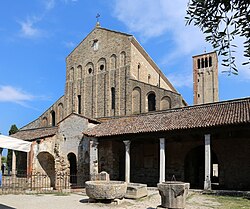
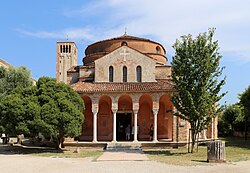
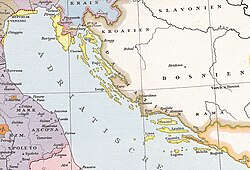
The Republic's early identity was forged in the 7th century when the islands of the lagoon were organized into Maritime Venice, a duchy dependent on the Exarchate of Ravenna. As Byzantine influence waned, Venice established its center on the island of Rialto, led by a Doge (the chief magistrate). By the 9th and 11th centuries, the city had secured total dominion over the Adriatic Sea to protect its vital commercial interests.
Key Facts
- Duration: 697–1797 (over 1,100 years).
- Government: A classical republic governed by an oligarchy of patricians.
- Economic Engine: Maritime trade, specifically the mude (state-sanctioned convoys) reaching India, China, and Flanders.
- Currency: The gold ducat (or sequin), renowned for its purity and stability.
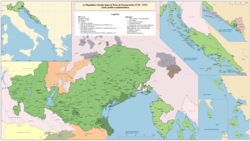
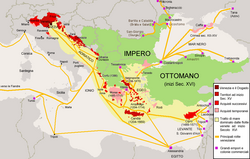
- Territories: Divided into the Stato da Mar (overseas empire) and Stato da Terra (mainland possessions).
- Fall: Dissolved in 1797 by Napoleon Bonaparte via the Treaty of Campo Formio.
The Golden Age of Trade and Expansion
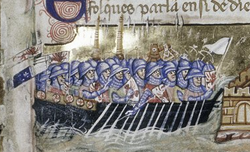
Venice's ascent was fueled by its privileged relationship with the Byzantine Empire. The Golden Bull of 1082 granted Venetian merchants tax-free trade and a dedicated quarter in Constantinople, cementing the city's role as the primary middleman of the Mediterranean.
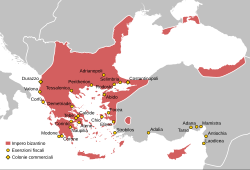
During the Crusades, Venice expanded its reach, acquiring numerous eastern emporiums and ports. This expansion led to a fierce rivalry with Genoa, culminating in the War of Chioggia. Despite nearly collapsing, Venice recovered and began expanding its Stato da Terra (Mainland State), absorbing cities like Verona and Padua by the 15th century.
Naval Might and the Ottoman Conflict
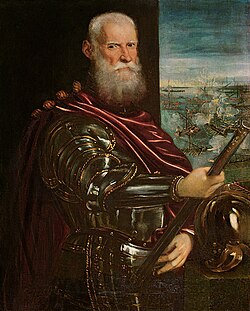
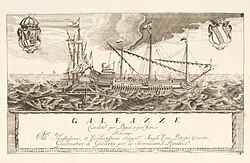
At its peak between 1420 and 1450, the Venetian fleet was a behemoth, consisting of approximately 3,345 ships and 36,000 men. However, this power brought them into direct conflict with the rising Ottoman Empire. For centuries, the two powers fought for control of the Aegean and Ionian seas.
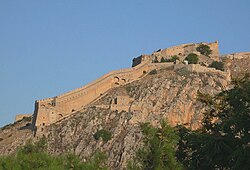
One of the most significant naval victories occurred at the Battle of Lepanto in 1571, where a coalition including Venice halted Ottoman naval expansion. Despite such victories, the Republic suffered long-term losses, including the island of Crete after a grueling 21-year siege during the Cretan War (1645–1669).
Governance and Social Structure
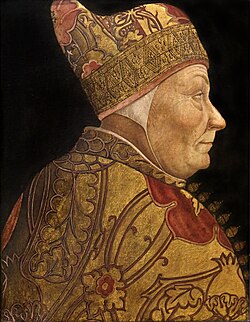
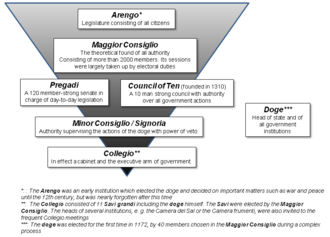
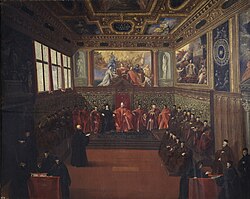
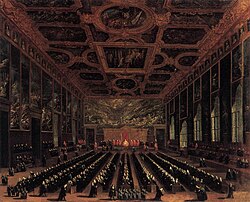
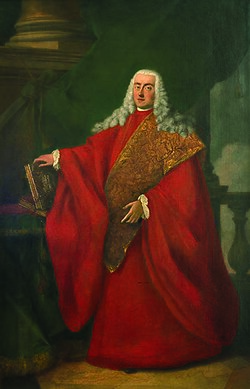
The Venetian government was a complex system of checks and balances designed to prevent any single individual from seizing absolute power. While the Doge served as the symbolic head of state, actual power resided within a series of councils.
The Legislative Bodies
- Great Council: The primary assembly of the patrician class.
- Senate: The legislative heart, managing financial, commercial, and foreign policy.
- Council of Ten: A secretive body tasked with maintaining state security and preventing conspiracies.
Society and Diversity
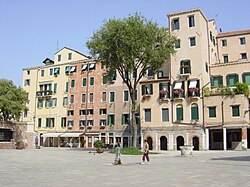
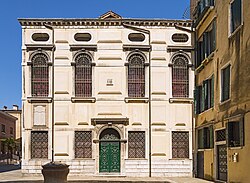
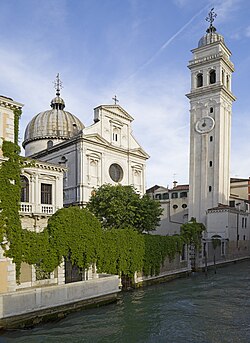
Venetian society was strictly stratified into patricians and citizens. Despite this, the city was remarkably cosmopolitan. The Republic hosted a significant Greek Orthodox community and a Jewish population. The latter were permitted to reside in the Ghetto, where they could maintain their traditions and synagogues despite restrictive laws.
Cultural Legacy and the Venetian Renaissance
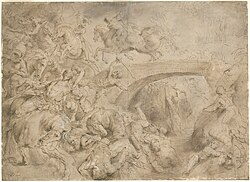
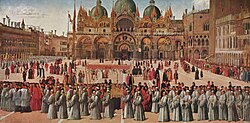
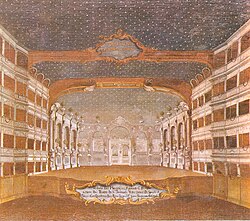
The wealth generated by trade funded a cultural explosion. The Venetian Renaissance was characterized by a focus on color and light, diverging from the more linear style of Florence. Masters such as Giovanni Bellini, Titian, Tintoretto, and Veronese revolutionized European art.
Beyond art, Venice was a center for publishing and scholarship. Its influence extended to political philosophy; for instance, Jean-Jacques Rousseau's time as a secretary to the French ambassador in Venice in 1743 helped spark his interest in the political theories that led to The Social Contract.
The Decline and Fall
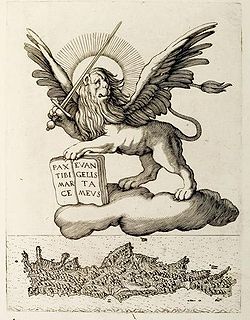
By the 18th century, the Republic entered a period of gradual decline. The shift of global trade toward the Atlantic and the continued pressure from the Ottoman Empire eroded its economic base. By 1792, the once-mighty merchant fleet had dwindled to just 309 ships.
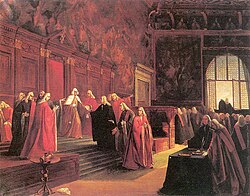
The end came swiftly in 1797. Napoleon Bonaparte's French troops occupied the city, and the last Doge, Ludovico Manin, was forced to abdicate. The Republic's territories were subsequently divided between France and the Habsburg monarchy.
| Category | Details |
|---|---|
| Capital Cities | Eraclea → Malamocco → Venice |
| Official Languages | Italian, Venetian, Latin |
| Key Conflicts | War of Chioggia, League of Cambrai, Battle of Lepanto, Cretan War |
| Major Exports/Trade | Spices, Silk, Luxury goods from the East |
| Last Doge | Ludovico Manin (1789–1797) |
Frequently Asked Questions
Who was the Doge of Venice?
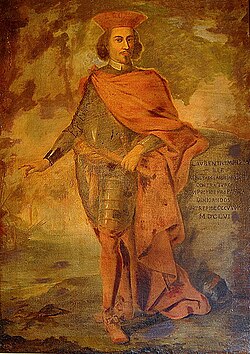
The Doge was the elected chief magistrate and head of state of the Republic of Venice. While the position carried immense prestige and symbolic power, the Doge's actual authority was limited by the Great Council and the Senate to prevent the establishment of a hereditary monarchy.
What was the 'Stato da Mar'?
The Stato da Mar (State of the Sea) referred to Venice's overseas empire, consisting of strategic ports, islands, and coastal territories across the Adriatic and Eastern Mediterranean, which secured the Republic's trade routes to Asia.
Why was the Venetian ducat important?
The gold ducat was one of the most stable and trusted currencies in the medieval and early modern world. Its consistent purity made it the standard for international trade across Europe and the Levant for centuries.
How did the Republic of Venice finally end?
The Republic fell in 1797 following the invasion of Napoleon Bonaparte. The last Doge, Ludovico Manin, abdicated his position, and the Treaty of Campo Formio formally divided Venetian territories between the French First Republic and the Habsburg monarchy.
What was the role of the Council of Ten?
The Council of Ten was a powerful and secretive governing body established in 1310. It was primarily responsible for state security, intelligence, and the suppression of treason or conspiracies against the Republic.