Our Lady of the Rosary
Our Lady of the Rosary (Latin: Beatae Mariae Virginis a Rosario), also known as Our Lady of the Holy Rosary, is a significant Marian title venerated primarily within the Catholic Church and the Antiochian Orthodox Church. This title represents a deep spiritual connection between the Blessed Virgin Mary and the prayer of the Rosary, serving as a symbol of victory, protection, and faith for millions of believers worldwide.
The devotion is characterized by specific attributes in art and liturgy, typically depicting the Blessed Virgin Mary with the Infant Jesus, often adorned with a crown and holding a rosary.
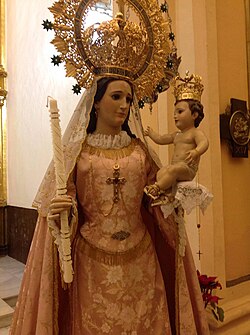
Key Facts
- Feast Day: Celebrated on 7 October in the General Roman Calendar.
- Historical Origin: Closely linked to the victory of the Holy League at the Battle of Lepanto in 1571.
- Traditional Founder: Dominican tradition attributes the Rosary to Saint Dominic de Guzmán in 1206.
- Major Shrines: Includes the Basilica of Notre-Dame-des-Victoires in Paris and the Basilica of Our Lady of the Rosary in Fátima, Portugal.
- Alternative Title: Often referred to as Our Lady of Victory.
The Origins of the Rosary
The history of the Rosary is steeped in tradition, most notably within the Dominican Order. According to tradition, in 1206, Dominic de Guzmán was working at the Monastery of Our Lady of Prouille in France, attempting to convert the Albigensians—a dualist sect—back to the Catholic faith. Tradition holds that after struggling to make progress, Dominic received a vision of the Blessed Virgin Mary, who provided him with the Rosary as a spiritual tool to combat heresy.
This account was recorded in the 15th century by Alanus de Rupe, a Dominican friar who helped popularize the prayer across Europe. While 17th-century scholars known as the Bollandists suggested the story emerged two centuries after Dominic's death, several subsequent popes, including Leo XIII and Pius XI, continued to officially attribute the Rosary's origin to Saint Dominic in their encyclicals.
Our Lady of Victory and the Battle of Lepanto
The title Our Lady of Victory predates the specific Feast of the Rosary. In the West, it was used as early as the 13th century, with shrines built by figures such as Simon de Montfort (after the Battle of Muret in 1213) and Philip Augustus of France (after the Battle of Bouvines in 1214). In the East, the title is even older, with a feast on February 25 commemorating the deliverance of Constantinople from siege in 621 AD.
The most pivotal moment linking this title to the Rosary occurred in 1571. Pope Pius V organized the Holy League, a coalition of Catholic maritime states including Spain and Venice, to halt the advance of the Ottoman Navy. Facing a material disadvantage, Pope Pius V called upon all of Europe to pray the Rosary and led a procession in Rome.
On 7 October 1571, the Holy League achieved a decisive victory at the Battle of Lepanto in the Gulf of Corinth. This victory stopped the Ottoman advance toward the west, preventing a potential invasion of Italy and confining Turkish naval power to the eastern Mediterranean. Pope Pius V attributed this victory to the intercession of the Blessed Virgin Mary and instituted the feast of Our Lady of Victory to commemorate the event.
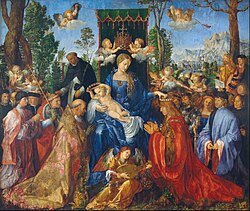
Evolution of the Feast Day
The celebration evolved over several centuries through various papal decrees:
- 1572: Pope Pius V formalized the Mysteries of the Rosary.
- 1573: Pope Gregory XIII renamed the celebration the Feast of the Most Holy Rosary of the Bl. Virgin Mary, moving it to the first Sunday of October.
- 1671 & 1716: The feast was extended to Spain and eventually to the universal church by Clement X and Clement XI.
- 1913: Pope Pius X fixed the date to 7 October to restore Sunday liturgical celebrations.
- 1969: Under Pope Paul VI, it became a mandatory memorial.
Global Devotion and Patronage
Our Lady of the Rosary serves as the patron saint for various regions, including the Diocese of Malaga, and the Spanish cities of Melilla and Trujillo.
Notable Shrines and Churches
The devotion has inspired the construction of numerous cathedrals and basilicas globally. Some of the most prominent include:
- Europe: The Basilica of Notre-Dame-des-Victoires (Paris), the Basilica of Our Lady of the Rosary (Fátima, Portugal), and the Pontifical Shrine of the Blessed Virgin of the Rosary (Pompei).
- The Americas: The Chapel of the Rosario (Puebla, Mexico), the Cathedral of Our Lady of the Rosary (Duluth, Minnesota), and the Basilica of Our Lady of the Rosary (Buenos Aires, Argentina).
- Asia: The Cathedral of Our Lady of the Rosary in Jashpur, India (one of Asia's largest churches), and the Shuangshu Church in Tianjin, China.
| Title | Key Event/Origin | Primary Date | Significance |
|---|---|---|---|
| Our Lady of Victory | Battle of Lepanto / Constantinople Deliverance | Feb 25 / Oct 7 | Military and spiritual triumph |
| Our Lady of the Rosary | Vision of St. Dominic / Papal Formalization | 7 October | Devotional prayer and intercession |
Frequently Asked Questions
Why is the Feast of Our Lady of the Rosary celebrated on October 7?
The date commemorates the anniversary of the Battle of Lepanto in 1571, where the Holy League defeated the Ottoman Navy. Pope Pius V attributed this victory to the collective praying of the Rosary across Europe.
Who is credited with starting the Rosary devotion?
Dominican tradition credits Saint Dominic de Guzmán, who is said to have received the Rosary from the Blessed Virgin Mary in 1206 as a tool to convert the Albigensians.
What is the difference between Our Lady of Victory and Our Lady of the Rosary?
While closely related, "Our Lady of Victory" is a title often associated with specific military triumphs and deliverance, whereas "Our Lady of the Rosary" focuses on the devotional practice of the prayer. Over time, the latter has largely superseded the former in official liturgical use.
Where can I find the most famous shrines dedicated to this title?
Major shrines include the Basilica of Notre-Dame-des-Victoires in Paris, the Sanctuary of Fátima in Portugal, and the Pontifical Shrine of the Blessed Virgin of the Rosary in Pompei, Italy.