Ren Bishi: A Key Architect of the Chinese Communist Party
Ren Bishi was a pivotal figure in the early development of the Chinese Communist Party (CCP), serving as a high-ranking political leader, an organizational strategist, and a dedicated revolutionary. From his early academic collaborations with Mao Zedong to his role in the Politburo Standing Committee, Ren's career spanned the most turbulent decades of 20th-century China, including the Long March and the struggle against Japanese occupation.
Early Life and Academic Foundations
Born into a teacher's family in rural Hunan, Ren Bishi's journey into revolutionary politics began at Hunan First Normal University in 1915. In 1920, he collaborated with Mao Zedong to establish the school's Russian Research Center. That same year, he joined the youth wing of what would soon become the CCP in Shanghai.
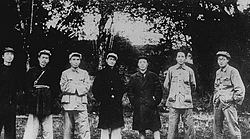
In May 1921, Ren embarked on a challenging journey to the Soviet Union with five others, including Liu Shaoqi and Xiao Jinguang. They navigated a route through Nagasaki and Vladivostok to bypass the White movement blockade. Upon arrival in August 1921, Ren entered the Communist University of the Toilers of the East. He officially joined the CCP in 1922, where he served as a translator for the history of Western revolutionary movements.
Returning to Shanghai in August 1924, Ren became a lecturer of the Russian language at Shanghai University. He also took on significant editorial roles, managing publications such as China Youth, Mission Journal, and Friends of Civilians.
Rise Within the Communist Youth League
Ren Bishi played a defining role in shaping the youth movement in China. In January 1925, during the Socialist Youth League of China's Third National People's Congress, he helped rename the organization to the Chinese Communist Youth League. By May 1925, he was appointed First Secretary of the League, leading the May Thirtieth Movement. Despite the movement's failure, Ren successfully utilized the organization to expand its membership significantly.
Following the 1927 White Terror—a period of violent suppression of communists—Ren was elected to the Central Committee. During the collapse of the First United Front, he aligned with Mao Zedong against Chen Duxiu, supporting the strategic shift toward a peasant-based revolution. This alignment helped him secure temporary membership in the Politburo.
The First Chinese Civil War and the Long March
Ren's resilience was tested during the late 1920s. In 1928, he was arrested by a local warlord in Anhui Province; while he was eventually released, the period was marked by personal tragedy when his son died of pneumonia. By 1929, he was appointed head of propaganda in the Jiangxi Soviet, where he established several news publications. He faced further imprisonment and torture in late 1929, refusing to confess under electrocution until Zhou Enlai negotiated his release.
During the Fourth Encirclement Campaign, Ren initially clashed with Mao Zedong, favoring direct assaults over guerrilla warfare. However, he later admitted these views were a result of "sectarian activity." Later, as party secretary in the Hunan–Jiangxi Soviet, he worked to rebuild party elements and expand the Red Sixth Army.
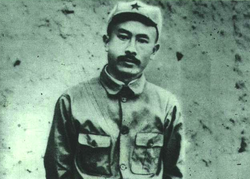
In August 1934, Ren organized a westward retreat with commanders Xiao Ke and Wang Zhen. This movement eventually merged with the Red Third Army to form the Red Second Army Group under He Long. By November, Ren and his comrades broke through a military blockade in Sangzhi, Hunan, officially joining the Long March—the massive strategic retreat of the Red Army to avoid annihilation.
The Second Sino-Japanese War and Yan'an
As the conflict with Japan intensified, Ren's role shifted toward military and diplomatic coordination. He helped plan defenses in Xi'an and later became the head of the Political Department of the Eighth Route Army. Between 1938 and 1940, he served as the CCP representative to the Comintern (the Communist International) in Moscow.
Upon returning to Yan'an in 1940, Ren became a central figure in the Yan'an Rectification Movement, a campaign aimed at ideological unification within the party. He worked closely with Mao and Liu Shaoqi to organize the northwest regions and resolve leadership disputes stemming from the Zunyi Conference.
Final Years and the Founding of the PRC
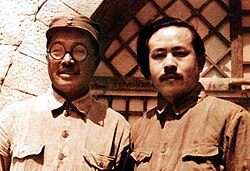
At the Seventh National Congress in 1945, Ren reached the pinnacle of party power, being elected as the party's Central Secretary-General and a member of the Politburo Standing Committee. He was ranked behind only Mao Zedong, Liu Shaoqi, Zhou Enlai, and Zhu De.
Despite battling severe high blood pressure and illness, Ren remained active in land reform. In 1948, he advocated for a more moderate approach to land redistribution, urging the party to reduce violence against landlords and shift from economic struggle to political struggle.
Ren assisted in the command of the Liaoshen, Huaihai, and Pingjin Campaigns during the final stages of the civil war. In 1949, he headed the Preparatory Committee for the Communist Youth League of China. After a period of medical treatment in Moscow, he returned to China to attend the first anniversary of the People's Republic of China (PRC) at Tiananmen on October 1, 1950.
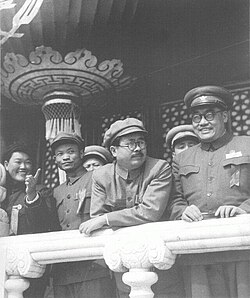
Exhausted by his work studying the Korean War, Ren suffered a stroke shortly after the celebrations. He passed away in Beijing on October 27, 1950.
Key Facts
- Early Education: Studied at Hunan First Normal University and the Communist University of the Toilers of the East in the Soviet Union.
- Youth Leadership: Served as the First Secretary of the Chinese Communist Youth League.
- Military Contribution: Political Commissar of the Red Second Army during the Long March.
- High Rank: Member of the Politburo Standing Committee, ranking fifth in the party hierarchy by 1945.
- Policy Influence: Moderated the land reform movement in 1948 to reduce violence against landlords.
| Period | Key Role/Event | Primary Contribution |
|---|---|---|
| 1920-1924 | Student/Translator | Established Russian Research Center; studied in USSR. |
| 1925 | First Secretary, Youth League | Renamed and expanded the Chinese Communist Youth League. |
| 1934-1936 | Political Commissar | Led the Red Second Army Group during the Long March. |
| 1938-1940 | Comintern Representative | Negotiated with the Soviet Union in Moscow. |
| 1945-1950 | Central Secretary-General | Managed party organization and moderated land reforms. |
Frequently Asked Questions
What was Ren Bishi's role in the Communist Youth League?
Ren Bishi was instrumental in the league's early years, serving as First Secretary and renaming the organization from the Socialist Youth League to the Chinese Communist Youth League in 1925.
How did Ren Bishi contribute to the Long March?
He served as the political commissar of the Red Second Army, helping to organize the westward retreat from the Hunan-Jiangxi Soviet and breaking through military blockades to reach Shaanxi.
What was Ren Bishi's stance on land reform?
In 1948, Ren criticized the surge of violence against landlords. He pushed for a policy shift that allowed targets of the movement to keep a share of their property and prohibited torture and beatings.
What was Ren Bishi's rank within the CCP?
By the Seventh National Congress in 1945, he was a member of the Politburo Standing Committee and the Central Secretary-General, placing him among the top five leaders of the party.
When and how did Ren Bishi die?
Ren Bishi died on October 27, 1950, in Beijing, following a stroke caused by fatigue while studying the situation of the Korean War.