Guan Xiangying: A Revolutionary Journey Through the Chinese Communist Party
Guan Xiangying was a pivotal figure in the early history of the Chinese Communist Party (CCP), serving as a military leader, political commissar, and strategic organizer. His career spanned the most tumultuous decades of the early 20th century, from the intellectual ferment of Shanghai and Moscow to the grueling hardships of the Long March and the fight against Japanese occupation.
Early Activism and Education
Guan's revolutionary path began in April 1924 when he joined the Chinese Socialist Youth League. Shortly after, he moved to Shanghai to enroll at Shanghai University, where he balanced his studies with covert operations at the First District Party Department of the Kuomintang (the Nationalist Party).
Seeking deeper ideological training, Guan traveled to the Soviet Union in December 1924 to study at the Moscow Sun Yat-sen University. It was here, in 1925, that he officially joined the Chinese Communist Party under the introduction of Chen Qiaonian. Following the outbreak of the May Thirtieth Movement—a pro-independence and anti-imperialist uprising—Guan returned to China to apply his training in Shanghai, Jinan, and Qingdao.
The late 1920s were marked by volatility. After the April 12 Incident of 1927, a violent purge of communists in Shanghai, Guan fled to Wuhan. He was subsequently dispatched to Henan, where he served as the Secretary of the CCP Henan Provincial Committee.
Rise to Central Leadership
By 1928, Guan's influence within the party grew significantly. During the 6th National Congress of the CCP in Moscow, he was elected to several high-ranking positions, including alternate member of the CCP Central Political Bureau, member of the CCP Central Military Commission, and Secretary of the Central Committee of the Chinese Communist Youth League.
His leadership responsibilities expanded in March 1930 when he was appointed Secretary of the Central Military Commission, placing him in charge of the party's military affairs. By the winter of that year, he transitioned to the role of Secretary of the CCP Central Yangtze Bureau, operating primarily out of Shanghai.
The Revolutionary Base Areas and the Long March
In January 1932, Guan shifted his focus to the field, becoming the Political Commissar of the Red Third Army and Chairman of the Hunan-Hubei-West Revolutionary Base Military Committee. Working alongside He Long, he was instrumental in developing the Hunan-Hubei-West Revolutionary Base and expanding the Chinese Red Army.
As the conflict with Nationalist forces intensified, Guan served as Vice Political Commissar of the Red Second Army Corps in the Hunan-Hubei-Sichuan-Guizhou Revolutionary Base Area. In November 1935, facing a divide-and-encircle offensive led by Chiang Kai-shek, Guan, He Long, and Ren Bishi directed the breakout of the Red Second and Sixth Army Corps from Sangzhi County, Hunan, marking their entry into the Long March (the strategic retreat of the Red Army to avoid annihilation).
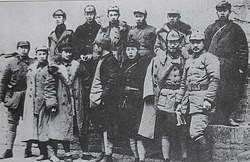
Throughout 1936, Guan led maneuvers against the National Revolutionary Army in the Wumeng Mountains. In July, the Red Second and Sixth Corps joined forces with the Red Fourth Front Army in Ganzi, Sichuan, forming the Red Second Front Army. Guan served as its deputy political commissar during a period of internal struggle against Zhang Guotao. The Long March concluded in October 1936 when the Red Second Front Army met the Red First Front Army at Jiangtaibao, Ningxia.
The Second Sino-Japanese War and Final Years
Following the Luochuan Conference in August 1937, the Red Second Front Army was reorganized into the 120th Division of the Eighth Route Army. Guan was appointed Director of the Political Training Department. He and He Long led the division in the Second Sino-Japanese War, notably commanding the Jin-Xi Seven Cities Campaign in February 1938, which saw the recapture of seven county seats.
Guan continued to lead in the Ji-Zhong and Jin-Sui regions, eventually serving as the Political Commissar of the Jin-Xi Military Region and participating in the Hundred Regiments Offensive, a major campaign against Japanese forces.
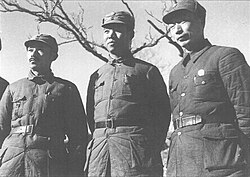
In 1941, Guan's health declined due to tuberculosis, necessitating a return to Yan'an for recuperation. Despite his illness, he remained active, serving as Secretary of the CCP Jin-Sui Sub-Bureau and Political Commissar of the Shaan-Gan-Ning Jin-Sui Joint Defense Army. He was elected as a Central Committee member during the 7th National Congress of the CCP in 1945.
Guan Xiangying passed away in Yan'an on July 21, 1946. In his final days, he urged Peng Dehuai to avoid factionalism and maintain unity with Mao Zedong.
Key Facts
- Education: Studied at Shanghai University and Moscow Sun Yat-sen University.
- Military Roles: Political Commissar of the Red Third Army and the Red Second Front Army.
- Key Alliances: Worked closely with He Long and Ren Bishi.
- Major Campaigns: Participated in the Long March, the Jin-Xi Seven Cities Campaign, and the Hundred Regiments Offensive.
- Final Rank: Elected as a CCP Central Committee member in 1945.
| Period | Primary Role/Location | Key Achievement/Event |
|---|---|---|
| 1924–1927 | Student/Agent (Shanghai, Moscow) | Joined CCP; studied in Soviet Union |
| 1928–1930 | Central Leadership (Moscow, Shanghai) | Secretary of the Central Military Commission |
| 1932–1935 | Base Area Leadership (Hunan-Hubei-West) | Developed revolutionary base areas |
| 1935–1936 | Long March Participant | Led breakout from Sangzhi County |
| 1937–1941 | Eighth Route Army (Jin-Xi/Ji-Zhong) | Jin-Xi Seven Cities Campaign |
| 1942–1946 | Senior Party Official (Yan'an) | Elected to CCP Central Committee (1945) |
Frequently Asked Questions
When did Guan Xiangying join the Chinese Communist Party?
Guan Xiangying joined the CCP in 1925 while studying at the Moscow Sun Yat-sen University in the Soviet Union, introduced by Chen Qiaonian.
What was Guan's role during the Long March?
Guan directed the breakout of the Red Second and Sixth Army Corps from the Nationalist blockade in Sangzhi County and later served as the deputy political commissar (and eventually Political Commissar) of the Red Second Front Army.
Which military units did Guan Xiangying lead?
He held leadership positions in the Red Third Army, the Red Second Army Corps, the Red Second Front Army, and the 120th Division of the Eighth Route Army.
What was the significance of the Jin-Xi Seven Cities Campaign?
Commanded by Guan Xiangying and He Long in February 1938, this campaign resulted in the successful recapture of seven county seats in northwestern Shanxi.
What caused the end of Guan Xiangying's active field service?
In 1941, Guan's tuberculosis worsened, forcing him to step down from his frontline duties and return to Yan'an for medical recuperation.