Reichskriegsflagge: The History and Evolution of the German Imperial War Flag
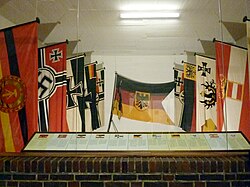
The Reichskriegsflagge (German for "Imperial War Flag") refers to a series of war flags and ensigns used by German armed forces throughout various historical eras. Between 1848 and 1945, eight distinct designs were adopted, reflecting the shifting political landscape of the German state. While the term can apply to several versions, it most commonly refers to the war flag of Imperial Germany used from 1867 to 1918.
The evolution of these flags tracks Germany's transition from a collection of sovereign states to a unified empire and, eventually, to the totalitarian regime of the Third Reich. Each design change signaled a shift in power, ideology, and national identity.
Key Facts
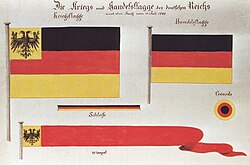
- Total Designs: Eight different versions were used between 1848 and 1945.
- Prussian Influence: The dominant black and white colors and the Prussian eagle were central to the Imperial designs.
- Key Symbols: The Iron Cross and the Nordic cross are recurring visual elements.
- Legal Status: Displaying the Nazi-era version is illegal in modern Germany under Strafgesetzbuch section 86a.
- Designers: Prince Adalbert of Prussia designed early versions; Adolf Hitler personally designed the 1935 version.
The North German Confederation and the Rise of Prussia
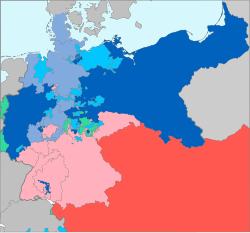
The roots of the Imperial war flag lie in the aftermath of the 1866 victory of Prussia over Austria. Following this conflict, Prussia established the North German Confederation to replace the former German Confederation. As Prussia became the leading German state, King Wilhelm I sought to distance the new national symbols from the black-red-gold color scheme, which was then associated with the 1848 revolutions and pan-Germanism (the idea of a Germany including Austria).
Consequently, the new flags emphasized Prussian identity, utilizing black and white colors, the Prussian eagle, and the Iron Cross (a military decoration). Because Prussia controlled nearly the entire German coastline after 1866, these symbols became the standard for German naval power.
Prince Adalbert of Prussia, commander-in-chief of the North German Navy, was tasked with the design. He drew upon concepts he had developed as early as 1850, refining them with the King's input to create the final North German war ensign.
The victory in 1866 ensured that Prussian naval dominance would dictate the visual identity of the fleet for decades to come.
The German Empire (1871–1918)
While a commercial and war flag using the black-red-gold colors was briefly introduced by law in November 1848 for the Imperial Fleet, it saw very little action, most notably during a short battle near Heligoland in 1849. However, after the founding of the German Empire, the Prussian-inspired designs became the official standard.
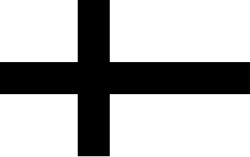
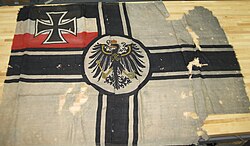
The war flag used during the Wilhelmine Period and World War I featured the Prussian national colors of black and white, a Nordic cross, and the imperial black-white-red tricolour in the upper canton, accompanied by an Iron Cross. This design remained in use until 1919, when it was replaced by the black-red-gold tricolour of the Weimar Republic.
Following the collapse of the Empire, the old flags became symbols of protest. German nationalists and paramilitary groups, such as the Freikorps, flew the Imperial flag during the 1920s and 1930s to signal their opposition to the Weimar government, most notably during the Kapp Putsch of 1920.
![Imperial flag being used during the Kapp Putsch of 1920[4]](/images/63/28/632839301d65387f5a398d290ccf48e6efb02b937771559d8e68020be52e080c.jpg)
The Third Reich and Nazi Germany
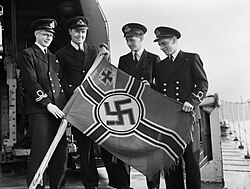
In 1935, a new Reichskriegsflagge was introduced, designed personally by Adolf Hitler. This version served as the war flag for the Heer (Army) and the Luftwaffe (Air Force), and as the war ensign for the Kriegsmarine (Navy).
The design fused elements of the Nazi party flag—specifically the swastika and red background—with the layout of the old Imperial flag, including the off-center circle and the Iron Cross in the canton. The flag was a central part of military ritual; it was hoisted and lowered daily with strict ceremonial parades and served as the focal point for the swearing-in of new recruits late in World War II.
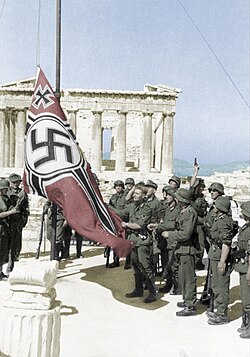
The flag was first raised at the Wehrmacht Headquarters in Berlin on November 7, 1935, and was finally lowered by British forces on May 23, 1945, following the arrest of the Dönitz Government.
![The World War II Reich war flag and the flag of the Kingdom of Italy in Rome, June 1943[4]](/images/3e/1d/3e1daa39b6c87655799cc9750da5cd03fb613966905957bb8b1460a2e3b21576.png)
The flag's presence often marked the extent of German occupation, from the Acropolis in Athens to naval vessels across the Atlantic.
Post-War Legal Status and Modern Usage
In modern Germany, the legal status of these flags is strictly regulated. Under Strafgesetzbuch section 86a, the sale or public display of Nazi symbols, including the 1935-1945 Reichskriegsflagge, is illegal and punishable by up to three years in prison, except for educational or scientific purposes.
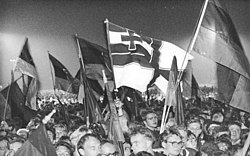
The status of the 1871–1918 black-white-red tricolour is more complex. While not banned outright, its use can be considered a "breach of public order" or an administrative offense if used provocatively. Since 2020, several German states, including Bremen, have implemented stricter prohibitions on all versions of the Imperial war flags. This was triggered by right-wing demonstrations in August 2020, where the Imperial colors were used as a legal substitute for the banned swastika flag.
In contrast, in the United States, the display of these flags is protected by the First Amendment. Consequently, the Reichskriegsflagge has occasionally been used by white supremacist groups alongside the Confederate battle flag.
Summary of German War Flag Eras
| Period | Primary Influence/Regime | Key Visual Elements | Legal Status (Modern Germany) |
|---|---|---|---|
| 1848–1852 | Early Federal State | Black, red, and gold colors | Generally permitted |
| 1867–1918 | North German Confed. / Empire | Black/white, Prussian eagle, Iron Cross | Restricted if provocative |
| 1935–1945 | Nazi Germany | Swastika, red field, Iron Cross | Illegal (StGB § 86a) |
Frequently Asked Questions
What does the term Reichskriegsflagge actually mean?
The term is German for "Imperial War Flag" and refers to the various war ensigns used by the German military across different historical periods, most notably during the German Empire and the Third Reich.
Why did the Imperial flag use black and white instead of black, red, and gold?
King Wilhelm I insisted on the Prussian colors (black and white) because the black-red-gold scheme was associated with the 1848 revolutions and a version of Germany that included Austria, which Prussia sought to exclude.
Who designed the Nazi-era war flag?
The 1935 version of the Reichskriegsflagge was designed personally by Adolf Hitler, who reportedly gave the design as much care as he did the architecture of his Obersalzberg house.
Is it illegal to fly the Imperial flag in Germany today?
The Nazi-era flag is strictly illegal. The 1871–1918 Imperial flag is not banned nationwide, but it can be confiscated or result in fines if used in a provocative context or in specific states like Bremen.
How was the flag used in Nazi military barracks?
The flag was hoisted every morning and lowered every evening through formal parades. In the later stages of World War II, it also served as the flag upon which new recruits took their oath of loyalty.