Reggae Music: History, Cultural Roots, and Global Influence
Reggae is more than just a musical genre; it is a powerful cultural expression that emerged from the heart of Jamaica. Characterized by its distinct rhythmic patterns and deep social consciousness, reggae has evolved from local Kingston streets to become a globally recognized symbol of peace, resistance, and spirituality. In 2018, its significance was formally recognized when it was inscribed as a UNESCO Intangible Cultural Heritage.
Key Facts
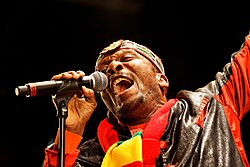
- Origin: Emerged in late-1960s Jamaica, specifically Kingston.
- Direct Precursors: Ska and rocksteady.
- Cultural Influence: Deeply intertwined with the Rastafari movement.
- Global Reach: Significant scenes in Africa, Europe, the Americas, and Asia.
- Key Elements: Heavy emphasis on bass lines and the "skank" guitar rhythm.
Origins and Stylistic Influences
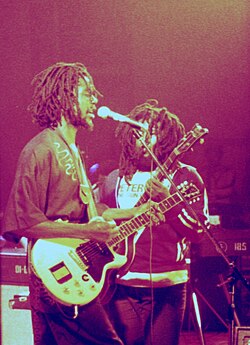
Reggae did not appear in a vacuum; it was the result of a rich blending of traditional Jamaican sounds and foreign influences. Its direct ancestors are ska and rocksteady, both of which were popular in 1960s Jamaica. Ska, which dominated from 1961 to 1967, grew out of Jamaican R&B, which itself was heavily influenced by American doo-wop and jazz.
Traditional mento (often conflated with calypso) also provided a foundational layer. Furthermore, the Rastafari movement played a pivotal role in shaping the genre's spiritual and social identity. This influence is most evident in the Nyabinghi rhythm, a ritual drumming style used in communal meditative practices within Rastafarian culture.
The development of the industry was closely tied to technology. In the early 1950s, Jamaican entrepreneurs began issuing 78 rpm records, which were soon replaced by the 7-inch single. These records allowed local sound system operators to play covers of American R&B hits at public dances, while Jamaican expatriates in the United Kingdom helped spread the music via small independent labels.
Musical Characteristics
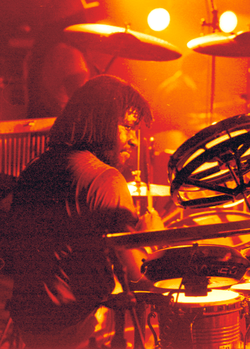
Reggae is instantly recognizable due to its unique approach to rhythm and instrumentation. One of its most defining features is the skank, a guitar rhythm that emphasizes the off-beat.
![Skank guitar rhythm often considered "'the' reggae beat"[48]Play straightⓘ or Play shuffleⓘ.](/images/94/ac/94acf97480763d24e293724c686edd72028dab4b0daa29a36be0d683d5dda1c4.png)
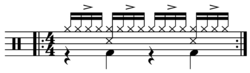
The percussion often utilizes the "one drop" sixteenth-note drum pattern, which differs from standard Western pop drumming by emphasizing the third beat of the bar.
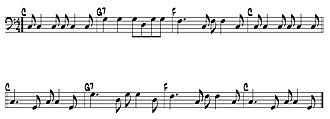
The bass guitar serves as the melodic anchor of the song. Typical reggae bass lines emphasize the roots of the chords, often moving from the root down to the fifth of the chord using a repeated dotted quarter note and eighth note rhythm.
Core Instrumentation
- Drums: Often featuring the one-drop style.
- Bass: Heavy, melodic lines that drive the track.
- Guitars: Primarily used for the rhythmic "skank."
- Keyboards and Horns: Used to add melodic layers and harmonic depth.
Global Spread and Regional Scenes
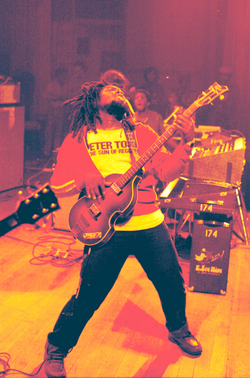
While rooted in Jamaica, reggae found massive success internationally. Between 1968 and 1972, sales in the United Kingdom actually exceeded those in Jamaica, with labels like Trojan/B&C releasing hundreds of singles.
In Europe, the genre continues to thrive through massive festivals. Summerjam in Cologne, Germany, attracts over 25,000 attendees, while Rototom Sunsplash in Spain can gather up to 150,000 visitors annually.
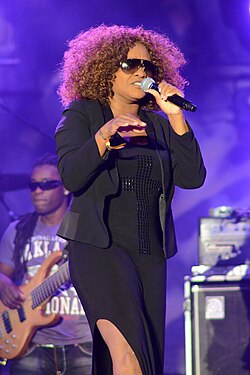
In Africa, the music gained immense momentum following Bob Marley's visit to Zimbabwe on Independence Day in 1980. In South Africa, reggae served as a unifying force during the Apartheid era, bonding people across different demographic groups. Artists like Lucky Dube further evolved the sound by fusing reggae with Mbaqanga.
The Americas have also seen a burgeoning movement of newer reggae bands, particularly in the United States, expanding the genre's reach into the 21st century.

Reggae Summary Table
| Category | Details |
|---|---|
| Direct Precursors | Ska, Rocksteady, Mento |
| Derivative Forms | Dancehall, Dub, Ragga, Jungle, Drum and Bass |
| Subgenres | Roots Reggae, Lovers Rock, Reggae en Español |
| Fusion Genres | Reggaeton, 2 Tone, Reggae Rock, Samba Reggae |
| Key Cultural Link | Rastafari Movement |
Frequently Asked Questions
What is the difference between ska and reggae?
Ska was a precursor to reggae, emerging earlier in the 1960s with a faster tempo and a stronger influence from American R&B. Reggae evolved from ska and rocksteady, generally featuring a slower pace and a more pronounced emphasis on the bass and off-beat rhythms.
How did the Rastafari movement influence reggae?
Rastafari provided much of the spiritual and lyrical foundation for reggae, particularly in the "roots" subgenre. The Nyabinghi ritual drumming style was a direct precursor to reggae drumming, and the movement's themes of social justice and spirituality became central to the music's lyrics.
What is the "one drop" rhythm?
The "one drop" is a classic reggae drum pattern where the emphasis is placed on the third beat of the bar, leaving the first beat empty (or "dropped"), which creates the genre's characteristic floating feel.
Which countries have significant reggae scenes outside of Jamaica?
Reggae has established strong regional scenes in the United Kingdom, the United States, Nigeria, South Africa, Japan, and Brazil, among others, often blending with local musical traditions to create fusion genres.