Reformation Day
Observed annually on October 31, Reformation Day commemorates the pivotal events of 1517 that sparked the Protestant Reformation. This day marks a fundamental shift in Western Christianity, originating from a scholarly dispute over church practices that evolved into a global religious and cultural movement.
Key Facts
- Date: October 31.
- Origin: Martin Luther's protest against the sale of indulgences in 1517.
- Primary Event: The writing and sending of the Ninety-five Theses to the Archbishop of Mainz.
- Legal Status: A civic holiday in several German states, Chile, Peru, and Slovenia.
- Core Conflict: Disagreement over the power and efficacy of indulgences (payments made to the church for the remission of temporal punishment for sins).
The Origins of the Reformation
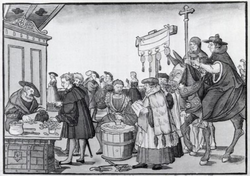
The catalyst for the Reformation occurred between 1516 and 1517, when Johann Tetzel, a Dominican friar and papal commissioner, traveled through Germany to raise funds for the rebuilding of St. Peter's Basilica in Rome. Tetzel's aggressive sale of indulgences—certificates believed to reduce punishment for sins—provoked a strong reaction from Martin Luther.
On October 31, 1517, Luther wrote to Albrecht, the Archbishop of Mainz and Magdeburg, to protest these practices. He included his "Disputation of Martin Luther on the Power and Efficacy of Indulgences," better known as the Ninety-five Theses. While some historians suggest Luther intended this as a scholarly objection rather than a direct confrontation with the church, the text contained sharp challenges, specifically questioning why the pope used the money of poor believers to build a basilica instead of using his own vast wealth.
The Debate Over the Church Door
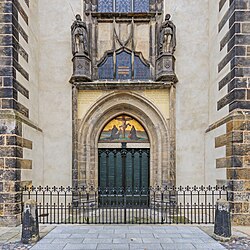
A long-standing tradition, cited by Philip Melanchthon in 1546, claims that Luther nailed his theses to the door of the All Saints' Church (the Castle Church) in Wittenberg. While some scholars question this account due to a lack of contemporaneous evidence, others argue it was standard practice at Wittenberg University to post theses on the church door to advertise a scholarly disputation.
Evolution of the Observance
The formalization of Reformation Day as an annual event took centuries. Early observations varied; for example, the New Church in Regensburg observed it the first Sunday after October 15, while Pomerania observed it on St. Martin's Day (November 11). It was not until 1667 that John George II, Elector of Saxony, instituted it as an official holiday in his domains.
Over time, the meaning of the anniversary shifted based on the political climate:
- 1617: Focused on Lutheran orthodoxy.
- 1717: Emphasized liberation from papal rule.
- 1817: Took on a nationalistic German tone following the victory over Napoleon.
- 1917: Combined nationalist themes of World War I with serious theological research.
Modern Political and Social Contexts
In the 20th century, the holiday reflected the divide in Germany. In 1967, West Germany held local church celebrations, while East Germany attempted to secularize the event, framing it as an "early bourgeois revolution" to marginalize the church's influence.
Ecumenical Relations and Catholic Attitudes
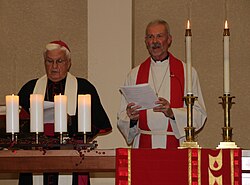
In recent decades, the relationship between the Roman Catholic Church and Protestant communities has moved toward reconciliation. A landmark moment occurred on October 31, 1999, when the Lutheran World Federation and the Pontifical Council for Promoting Christian Unity signed the Joint Declaration on the Doctrine of Justification, resolving several doctrinal disagreements.
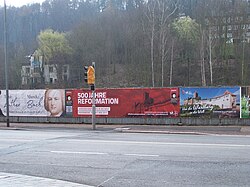
This spirit of cooperation culminated in 2017 with the "common commemoration" of the 500th anniversary of the Reformation, a year-long remembrance that sought to move from conflict to communion.
Global Impact and Legal Status
Reformation Day is recognized as a civic holiday in several German states, including Brandenburg, Hamburg, Bremen, Lower Saxony, Mecklenburg-Vorpommern, Saxony, Saxony-Anhalt, Schleswig-Holstein, and Thuringia. Internationally, it is recognized in Slovenia for its cultural contributions, and as a national holiday in Chile (since 2009) and Peru (since 2017), reflecting the growth of Evangelical and Pentecostal movements in Latin America.
Influence on Other Protestant Traditions
While centered on Luther, the day is also significant for Reformed theology. Huldrych Zwingli in Switzerland and later John Calvin in France were influenced by the European-wide discussion sparked by the events of 1517. Zwingli emphasized a return to scriptural authority and rejected religious images, while Calvin's 1536 Institutes of the Christian Religion further shaped the movement.
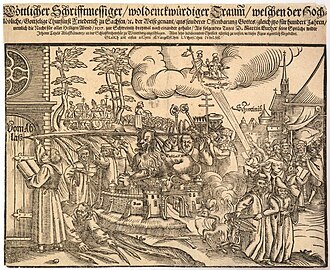
!["I saw another angel fly in the midst of heaven, having the everlasting gospel to preach" (Revelation 14:6). This passage is interpreted by some Lutherans as referring to Luther.[54][55]](/images/da/39/da39d1fa23644a59a39523af61efa3f27fcf883cb05b77e1c1bf86c6def0067e.webp)
| Category | Details |
|---|---|
| Primary Date | October 31 |
| Key Figure | Martin Luther |
| Core Document | Ninety-five Theses |
| Key Locations | Wittenberg (Germany), Switzerland, France |
| Modern Status | Civic holiday in parts of Germany, Chile, Peru, and Slovenia |
Frequently Asked Questions
Did Martin Luther actually nail the theses to the church door?
This is a subject of historical debate. While Philip Melanchthon's 1546 account claims he did, some scholars argue there is no contemporaneous evidence. However, others note that posting theses on the Castle Church door was a common way to announce academic debates at the time.
What were the Ninety-five Theses protesting?
The theses primarily protested the sale of indulgences, which were payments made to the church to reduce the temporal punishment for sins, specifically to fund the rebuilding of St. Peter's Basilica in Rome.
Is Reformation Day only for Lutherans?
No. While it commemorates Luther's actions, it is observed by various Protestant communities, including Reformed (Calvinist) and Methodist churches, as it marks the beginning of the broader movement toward scriptural authority.
How does the Catholic Church view Reformation Day today?
The Catholic Church has moved toward reconciliation, notably through the 1999 Joint Declaration on the Doctrine of Justification and the joint 500th-anniversary commemorations in 2017.
Where is Reformation Day a legal holiday?
It is a civic holiday in several German states (such as Saxony and Hamburg), as well as a national holiday in Chile and Peru, and is observed in Slovenia.