Red List Index: Monitoring Global Biodiversity and Extinction Risk
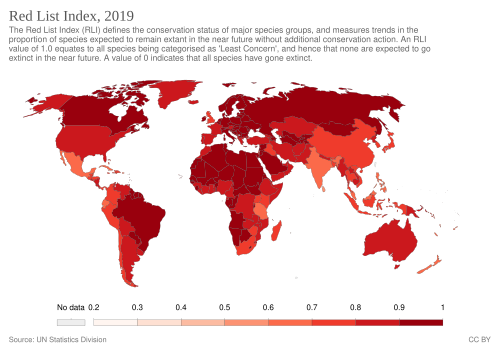
The Red List Index (RLI) serves as a critical indicator for tracking the changing state of global biodiversity. Derived from the IUCN Red List of Threatened Species, the RLI defines the conservation status of major species groups and measures trends in extinction risk over time. By conducting regular conservation assessments, scientists can monitor how the threat status of species within a specific taxonomic group evolves, providing a data-driven look at the health of our planet's wildlife.
While often applied to broad taxonomic groups—such as birds and amphibians—the RLI is versatile. It can also reveal extinction risk trends based on habitat type, dominant threat processes, and biogeographic realms.
Key Facts
- Global Scope: The RLI provides a vast representation of species worldwide, enabling immediate conservation action for those nearing extinction.
- Versatility: It tracks trends across taxonomic groups, biogeographic realms, and specific habitats.
- Policy Impact: The Convention on Biological Diversity (CBD) uses the RLI to measure progress toward reducing biodiversity loss.
- Sampled Approach: The SRLI allows for the monitoring of lesser-known groups like fungi and insects without needing to assess every single species.
- Real-world Example: Overfishing caused the shark and ray RLI to diminish by 19% since the 1970s.
The Impact of Human Activity and Utilization
The RLI is an essential tool for monitoring biodiversity pressures, particularly within Marine Protected Areas (MPAs). These areas are designated to protect biodiversity, allocate resources away from purely economic growth, and increase the utilization of environmental programs at coastal and archaeological sites.
History demonstrates that unregulated human activity can cause massive population swings. For instance, research on sharks and rays shows that their Red List Index has decreased by 19% since the 1970s. This decline is primarily attributed to unchecked overfishing, which effectively cut shark populations in half during that period, even before accounting for the subsequent erosion of coastal and river waters.
The Sampled Red List Index (SRLI)
Comprehensive assessments of entire species groups are feasible for well-studied groups with few species. However, this is impractical for the majority of the world's biodiversity, including plants, fungi, and invertebrates (especially insects). To address this, the Sampled Red List Index (SRLI) was developed.
The SRLI is a collaborative effort between IUCN members, coordinated through the Institute of Zoology (IoZ) of the Zoological Society of London (ZSL). Instead of scanning every species—which would be overwhelming for groups like plants, where 15,000 species may be referenced—the SRLI uses a representative sample of species from plants, fungi, and both vertebrate and invertebrate animals.
By assessing these selected species, researchers establish a baseline of current biodiversity. Regular reassessments then identify changes in threat status, providing a representative picture of biodiversity change across the broader group.
Practical Applications of the Index
The primary goal of the SRLI is to create a global biodiversity indicator that can determine if the rate of biodiversity loss is slowing. This helps scientists and policymakers understand which ecosystems or taxonomic groups are deteriorating most rapidly, why they are threatened, and what specific conservation actions are required.
Habitat and Ecosystem Monitoring
The RLI also helps in understanding natural trends in habitat development. For example, research indicates that certain species, such as beetles, show a positive trend in rural and forest areas because those habitats have remained largely unchanged compared to other environments where they show a negative trend.
International Policy and Targets
In April 2002, 188 nations at the Convention on Biological Diversity (CBD) committed to significantly reducing the rate of biodiversity loss by 2010. The CBD adopted the RLI as a primary indicator to monitor changes in species threat status and measure progress toward this global target.
| Feature | Standard RLI | Sampled RLI (SRLI) |
|---|---|---|
| Scope | Comprehensive assessment of whole groups | Representative sample of species |
| Best For | Well-studied groups with fewer species | Lesser-known or massive groups (e.g., insects, fungi) |
| Primary Goal | Measure extinction risk trends over time | Provide representative biodiversity snapshots |
| Coordination | IUCN | IUCN members & Institute of Zoology (ZSL) |
Frequently Asked Questions
What is the main purpose of the Red List Index?
The RLI is used to monitor the changing state of global biodiversity by measuring trends in the extinction risk of species groups over time.
How does the Sampled Red List Index (SRLI) differ from the standard RLI?
While the standard RLI assesses entire species groups, the SRLI uses a representative sample. This makes it practical to monitor biodiversity in massive or lesser-known groups, such as fungi and invertebrates, without needing to assess every single species.
How is the RLI used in Marine Protected Areas (MPAs)?
In MPAs, the RLI is used to consolidate various data points into a single conservation status for a species within that specific area, rather than tracking the individual extinction risk trend of a single species.
What role does the RLI play in international law?
The Convention on Biological Diversity (CBD) adopted the RLI as a key indicator to track progress toward the goal of significantly reducing the global rate of biodiversity loss.
Can the RLI show positive trends?
Yes. For example, the RLI can show positive trends for species like beetles in forest and rural areas where the habitat has remained stable.