Red Clover (Trifolium pratense)
Red clover, scientifically known as Trifolium pratense, is a herbaceous flowering plant belonging to the bean family, Fabaceae. Native to the Old World—specifically Europe, Western Asia, and northwest Africa—this versatile perennial has become naturalized across many other regions, including North and South America and New Zealand. Its name is derived from the Latin word prātum, meaning meadow, reflecting its common habitat.
Key Facts
- Conservation Status: Least Concern (IUCN 3.1).
- Primary Benefit: Fixes nitrogen in the soil, increasing fertility.
- Key Pollinators: Primarily visited by bumblebees, including the large garden bumblebee (Bombus ruderatus).
- Edibility: Both flowers and leaves are edible and can be used as garnishes or ground into flour.
- Cultural Significance: The state flower of Vermont and a former national flower of Denmark.
Botanical Description
Red clover is a short-lived perennial that typically grows between 20 and 80 cm tall. One of its most defining features is a deep taproot, which provides the plant with significant drought tolerance and helps improve soil structure.
The plant features alternate, trifoliate leaves (meaning they consist of three leaflets). Each leaflet is generally 15–30 mm long and 8–15 mm broad, characterized by a distinct pale crescent mark on the outer half of the leaf. The petiole, or leaf stalk, ranges from 1 to 4 cm in length and ends in bristle-like basal stipules.
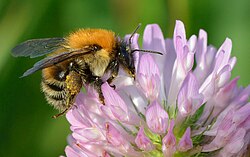
The flowers are a striking dark pink with paler bases, measuring 12–15 mm in length and growing in dense clusters called inflorescences. These flowers possess a hairy calyx tube and five petals (one standard, two wings, and two keel). Of the ten stamens, nine are joined into a tube surrounding the style, while one remains free.
Taxonomy and Distribution
First published by Carl Linnaeus in Species Plantarum (1753), Trifolium pratense is classified under the order Fabales. The species is divided into three known subspecies:
- Trifolium pratense subsp. pratense
- Trifolium pratense subsp. baeticum
- Trifolium pratense subsp. kotulae
While native to Europe, Western Asia, and northwest Africa, it was introduced to Argentina and Chile over a century ago and has since naturalized in various temperate zones across the Americas and Australasia.
Ecology and Environmental Impact
Red clover plays a vital role in its ecosystem through nitrogen fixation, a process where the plant converts atmospheric nitrogen into a form usable by other plants. This capability promotes protein-rich growth, supporting wildlife such as rabbits, turkeys, and deer.
The plant shares a symbiotic relationship with pollinators. In South America and New Zealand, the large garden bumblebee (Bombus ruderatus), also introduced from Europe, serves as a primary pollinator. Because of its high visibility, conservationists sometimes use red clover to help build wildlife bridges that connect fragmented habitats.
However, the species is susceptible to several biological threats, including viruses, parasitic nematodes, and fungal diseases such as red clover rust (Uromyces trifolii-repentis var. fallens) and clover rot.
Agricultural and Practical Uses
Due to its ability to enrich the soil, red clover is widely utilized as a green manure crop and a high-value fodder crop for livestock. In India, the Agriculture Department of Kashmir's Fodder Seed Production Station Aru is a leading producer of red clover seed.
Beyond agriculture, red clover has several diverse applications:
- Culinary: Flowers and leaves are used as garnishes or processed into flour. Flowers are also used to create tisanes (herbal teas) and jellies.
- Aromatherapy: Essential oils are extracted from the flowers for their unique scent.
- Ornamental: It is frequently grown for its aesthetic appeal in gardens.
| Feature | Detail |
|---|---|
| Family | Fabaceae |
| Growth Habit | Short-lived perennial |
| Height | 20–80 cm |
| Key Chemical Components | Isoflavones, Saponins, Coumaric acid |
| Primary Use | Fodder, Green Manure, Ornamental |
Phytochemistry and Folk Medicine
The chemical composition of red clover includes carbohydrates, saponins, and isoflavones. Isoflavones are a type of flavonoid known as phytoestrogens because their structure is similar to human estrogens.
In Indian folk medicine, the plant is traditionally believed to act as a sedative, expectorant, anti-inflammatory, or antispasmodic agent. In alternative medicine, it is sometimes used to treat menopausal hot flashes. However, clinical organizations do not recommend it for menopause treatment, as evidence from small trials remains insufficient.
Caution: Because red clover contains coumarin and flavonoid derivatives, individuals with coagulation disorders or those taking anticoagulation therapy should use it with caution.
Frequently Asked Questions
Is red clover used to treat cancer?
No. There is no scientific evidence that red clover is beneficial for preventing or treating cancer or any other major diseases.
How does red clover benefit the soil?
Red clover performs nitrogen fixation, which increases soil fertility and makes it an excellent choice for green manure crops.
Can you eat red clover?
Yes, the flowers and leaves are edible and can be used as garnishes or ground into a flour.
What is the relationship between red clover and bumblebees?
Red clover provides a vital source of pollen and nectar for bumblebees, and in return, bees like the large garden bumblebee (Bombus ruderatus) act as essential pollinators for the plant.
Why should people with blood clotting issues be careful with red clover?
Red clover contains coumarin and flavonoid derivatives, which may interfere with blood coagulation or interact with anticoagulation medications.