Rayleigh Scattering: The Science Behind the Blue Sky
Have you ever wondered why the sky appears as a brilliant blue during the day, only to shift into deep oranges and reds at sunset? This captivating visual experience is caused by Rayleigh scattering, an optical phenomenon where light or other electromagnetic radiation is deflected by particles significantly smaller than the wavelength of the radiation itself.
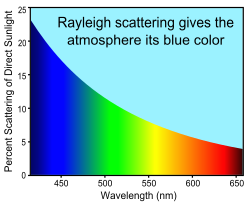
Named after the 19th-century British physicist Lord Rayleigh (John William Strutt), this process explains how light interacts with the gases in our atmosphere. In the normal dispersion regime—where light frequencies are well below the resonance frequency of the medium—the amount of scattering is inversely proportional to the fourth power of the wavelength. In simpler terms, shorter wavelengths (like blue) are scattered far more efficiently than longer wavelengths (like red).
Key Facts
- Wavelength Dependence: Scattering intensity is proportional to 1/λ4, meaning blue light scatters more than red light.
- Particle Size: It occurs when particles are smaller than 1/10th of the light's wavelength.
- Atmospheric Cause: Nitrogen and oxygen molecules in Earth's atmosphere are the primary scatterers of sunlight.
- Visual Effect: This phenomenon is responsible for the blue color of the daytime sky and the red hues of sunsets.
- Polarization: Light that has been scattered via this process becomes polarized.
The Physics of Scattering
Rayleigh scattering is driven by the electric polarizability of particles. When a light wave's oscillating electric field hits a particle, it causes the charges within that particle to move at the same frequency. This transforms the particle into a small radiating dipole, which then emits the light we perceive as scattered radiation.
While this can happen in transparent solids and liquids, it is most prominent in gases. To determine if Rayleigh scattering applies, scientists use a dimensionless size parameter (x), which is the ratio of the particle's radius to the wavelength of light. Rayleigh scattering specifically applies when x ≪ 1. When particles are larger or comparable in size to the wavelength, other models like Mie theory are used instead.
![Rayleigh scattering causes the blue color of the sky at large angles to the direction of solar rays and yellow or orange colors for light from the direction of the Sun.[1]](/images/e4/87/e487c00b708cffabc00852978f3eb517e2f4a4db6c9ee9c09a81c7edd56a84e8.jpg)
Why the Sky Changes Color
The blue color of the daytime sky is the result of three intersecting factors: the blackbody spectrum of sunlight, the scattering of that light by nitrogen and oxygen molecules, and the specific response of the human visual system.
Daytime Blue
Because blue and violet wavelengths are scattered more strongly, they are redirected from all parts of the sky toward our eyes. While violet is scattered even more than blue, our eyes perceive the resulting combination as a bright blue-white light.

Sunsets and Twilights
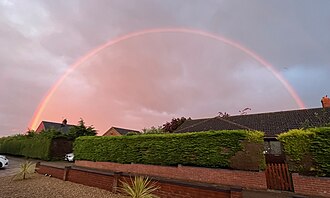
At sunset or sunrise, sunlight must travel through a much thicker slice of the atmosphere to reach the observer. By the time the light arrives, the shorter blue wavelengths have been scattered away entirely, leaving only the longer yellow, orange, and red wavelengths to pass through.
Environmental Influences
Other factors can intensify these colors. For example, sulfate particles following large volcanic eruptions can brighten the blue cast of the sky or create vivid reds, as seen in some works by artist J.M.W. Turner. Additionally, the moonlit night sky is technically blue because moonlight is reflected sunlight; however, the Purkinje effect (the shift in human vision to rod cells in low light) prevents us from perceiving this color.
Applications Beyond the Atmosphere
Rayleigh scattering is not limited to the sky; it plays a critical role in materials science and technology.
Optical Fibers and Glass
In silica optical fibers, microscopic variations in density and refractive index cause Rayleigh scattering. This leads to energy loss as light signals travel through the fiber. Similarly, in amorphous solids like glass, this mechanism is responsible for acoustic and phonon damping at low temperatures.
![Rayleigh scattering in opalescent glass: it appears blue from the side, but orange light shines through.[22]](/images/4f/4b/4f4b5287d98c9a46b1e864a250b20c17e340cf432b1cbdb126f5283fcb54a8e5.jpg)
Porous Materials
Nanoporous materials, such as sintered alumina, exhibit strong Rayleigh-type scattering due to the high contrast in refractive index between the solid parts and the nanopores (typically around 70 nm). This can cause light to completely change direction every five micrometers on average.
Summary of Scattering Types
| Scattering Type | Particle Size Relative to Wavelength (λ) | Key Characteristic | Common Example |
|---|---|---|---|
| Rayleigh | Very Small (x ≪ 1) | Intensity ∝ 1/λ4 | Blue sky, optical fiber loss |
| Mie | Comparable (x ≃ 1) | Interference effects | Clouds, haze |
| Geometric | Large (x ≫ 1) | Based on projected area | Large raindrops, dust |
Frequently Asked Questions
Why isn't the sky violet if violet light scatters more than blue?
Although violet light is scattered more strongly than blue, the human eye is significantly more sensitive to blue. Our visual system processes the mix of scattered wavelengths as a pale blue rather than violet.
Does Rayleigh scattering happen in liquids?
Yes, it can occur in transparent liquids and solids, though it is most visible in gases. An example is opalescent glass, which appears blue from the side but allows orange light to pass through.
How does volcanic activity affect the color of the sky?
Large eruptions release sulfate particles into the stratosphere. These particles increase the scattering of light, which can brighten the blue of the sky or create intense red colors during twilight.
What is the difference between Rayleigh and Mie scattering?
Rayleigh scattering occurs when particles are much smaller than the wavelength of light (like gas molecules), whereas Mie scattering occurs when particles are roughly the same size or larger (like water droplets in a cloud).
How does Rayleigh scattering affect the internet?
It contributes to signal attenuation in fiber-optic cables. Because silica glass has microscopic density fluctuations, some of the light signal is scattered out of the core, limiting how far a signal can travel before needing amplification.