Ravenswood Tunnel: The Engineering History of an East River Landmark
In the late 19th century, Manhattan faced a critical infrastructure challenge. The city was densely populated, making it nearly impossible to build new, large-scale gas plants within the city limits. Furthermore, the shift from coal to naphtha in the manufacturing process made existing plants dangerous and undesirable to residents. To solve this, the East River Gas Company of Long Island City sought a way to transport energy from Queens to Manhattan.
This ambition led to the creation of the Ravenswood Tunnel, a pioneering project that pushed the boundaries of subaqueous engineering—the science of constructing tunnels under bodies of water. Conceived by Emerson McMillin and the firm H. B. Hollins & Co., the project was authorized by the New York State Legislature in April 1892.
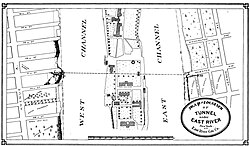
Planning and Preliminary Surveys
To determine if the project was feasible, McMillin hired English engineer Charles M. Jacobs. In May 1892, Jacobs conducted surveys between the company's property at the foot of Webster Avenue (now 37th Avenue) in Ravenswood and a site between East 70th and 71st streets in Manhattan.
The geological investigation revealed that bedrock was present just a few feet below the surface at both ends of the route and on Blackwell's Island (now Roosevelt Island). To map the riverbed, Jacobs utilized nine drill soundings. Because of the East River's powerful currents, these soundings had to be performed within a strict 15-minute window of slack tide—the brief period when the tide is not flowing in or out.
Based on these findings, Jacobs designed a tunnel to be positioned 40 feet (12 m) below the riverbed. The final specifications called for a structure 10 feet (3.0 m) wide and 8.5 feet (2.6 m) high, with a slight 0.5% downward gradient toward Queens to facilitate drainage.
The Challenges of Construction
Construction began on June 28, 1892, with the excavation of shafts in Queens and Manhattan. By November 1892, both shafts were complete, with the Manhattan shaft reaching a depth of 139 feet (42 m) and the Queens shaft reaching 148 feet (45 m). The two shafts were located 2,516.4 feet (767.0 m) apart.
While the team initially expected to bore through solid rock, they encountered a major obstacle in December 1892. A fissure 348 feet (106 m) from the Manhattan shaft revealed a "mixed working face"—a combination of solid rock and soft material saturated with salt water. This caused cavities to form and led to dangerous leaks where salt water rushed into the tunnel, occasionally creating geysers on the river's surface.
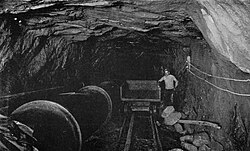
To overcome this, Jacobs employed a tunnelling shield, a protective steel structure that allowed workers to excavate soft ground and immediately line the tunnel with bolted flanged cast iron plates. This section required pneumatic tunneling, using high air pressure to keep water out. The pressure reached 48 pounds per square inch (330 kPa), the highest recorded for workers at the time, limiting their shifts to 90 minutes to prevent health complications.
Overcoming Setbacks
The project faced several non-technical crises:
- Contractual Disputes: Disagreements over the soft ground conditions led the original contractor, McLaughlin, Reilly & Co., to abandon the project. The East River Gas Company took over the work directly.
- Financial Crisis: The Panic of 1893 caused a funding shortage, halting work for three and a half months.
- Fire: On May 16, 1894, a fire at the Jones's Wood picnic ground destroyed the Manhattan shaft's equipment. The resulting loss of boiler pressure caused the heading to flood, delaying the project by three weeks.
Completion and Legacy
Despite these hurdles, the two headings finally met on July 11, 1894. The precision of the surveying was remarkable: the two sides joined with a horizontal gap of only 0.5 inches (13 mm) and a vertical gap of 0.1 feet (3.0 cm). However, the victory came at a cost, as four workers died from caisson disease (decompression sickness), a condition caused by rapid pressure changes.
The tunnel officially began transporting gas to Manhattan on October 15, 1894. It originally housed a 36-inch (910 mm) gas main and a narrow-gauge railway track. Over time, additional pipes were added, including a six-inch main for Blackwell's Island and a four-inch pipe to provide fresh air for maintenance workers.
The success of the Ravenswood Tunnel established Charles M. Jacobs as a premier expert in shield-driven tunnels, leading him to design the Uptown Hudson Tubes and the North River Tunnels for the Pennsylvania Railroad.
Key Facts
- Total Distance: 2,516.4 feet (767.0 m) between shafts.
- Depth: 40 feet (12 m) below the riverbed.
- Max Pressure: 48 psi (330 kPa) during pneumatic tunneling.
- Precision: The headings met with a horizontal error of only 0.5 inches.
- Current Owner: Con Edison.
- Modern Use: Carries electric, gas, steam, and telecommunications conduits.
| Feature | Specification |
|---|---|
| Width | 10 feet (3.0 m) |
| Height | 8.5 feet (2.6 m) |
| Gradient | 0.5% slope toward Queens |
| Primary Lining | Flanged cast iron plates (in soft sections) |
| Main Pipe Diameter | 36 inches (910 mm) |
Frequently Asked Questions
Why was the Ravenswood Tunnel built?
It was built to supply gas and electricity to Manhattan from a plant in Queens, as Manhattan was too densely populated to support new, safe gas manufacturing facilities.
What is a "mixed working face"?
A mixed working face occurs in tunneling when the excavation encounters both solid rock and soft, unstable material (such as mud or silt) simultaneously, requiring different excavation techniques.
What caused the deaths of the workers?
Four workers died from caisson disease, now known as decompression sickness, which occurs when nitrogen bubbles form in the bloodstream due to a rapid decrease in pressure after working in high-pressure environments.
Who was Charles M. Jacobs?
He was the English engineer who surveyed and supervised the construction of the Ravenswood Tunnel and later designed major tunnels under the Hudson River.
Is the tunnel still in use today?
Yes, it is owned by Con Edison and currently carries conduits for gas, electricity, telecommunications, and steam from the Ravenswood Steam Plant.