Railways in Württemberg: A History of Expansion and Innovation
The evolution of rail transport in Württemberg is a story of strategic planning, political negotiation, and industrial ambition. From the first feasibility studies in 1834 to the modern high-speed networks of today, the railway has been the backbone of the region's economic growth, transforming small villages into industrial hubs and connecting the heart of Germany to its neighbors.
Key Facts
- First Section: The line between Cannstatt and Untertürkheim opened on October 22, 1845.
- State Control: The Royal Württemberg State Railways (K.W.St.E.) were established as state-owned to ensure profit and control over transit traffic.
- Industrial Catalyst: The 1843 Railway Law led to the founding of the Maschinenfabrik Esslingen, a pioneer in railway technology.
- Network Peak: By 1920, the network spanned 2,153 kilometers before merging into the Reichsbahn.
- Modern Era: The region is currently undergoing a massive transformation via the Stuttgart 21 project.
From Canals to Iron Rails
At the dawn of the 19th century, the Kingdom of Württemberg focused its transport ambitions on canals to link the Neckar and Danube rivers with Lake Constance. However, as railways gained momentum across Europe, King William I commissioned a study to evaluate if rail was a superior alternative. The resulting report recommended a railway connecting Stuttgart and Ulm via the Rems, Kocher, and Brenz valleys.
By 1835, demand grew for an extended route from Stuttgart through Ulm and along the Fils river to Lake Constance. This shift in strategy marked the end of the canal era and the beginning of the railway age in the region.
The Construction of Main Lines
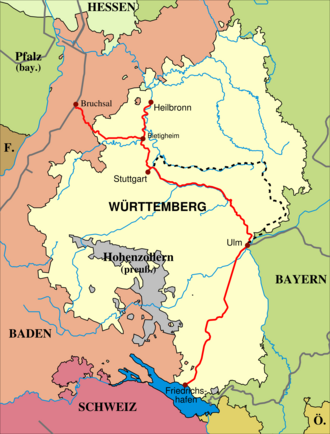
The development of the network was governed by the Railway Law of April 18, 1843. This legislation established the primary arteries of the state: the Ostbahn (Eastern line), the Nordbahn (Northern Railway), and the Südbahn (Southern Railway). To maintain control over profits and international transit rights, the government established the Royal Württemberg State Railways (K.W.St.E.), largely denying licenses to private operators.
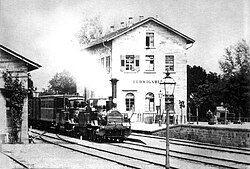
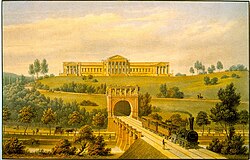
The Zentralbahn (Central line) was the first to break ground in 1844, linking Stuttgart to Ludwigsburg and Esslingen. This was followed by the completion of the Nordbahn in 1848, and the Ostbahn and Südbahn in 1850.
The Westbahn and Diplomatic Compromise
Connecting to the west required delicate negotiations with the state of Baden. Both states sought to maximize transit traffic within their own borders. After competing proposals, a compromise was reached to connect via Bruchsal. The Westbahn was constructed between 1850 and 1853, and by 1854, Württemberg had successfully linked its network to the Bavarian railway system in Ulm.
Internal Expansion and Regional Integration
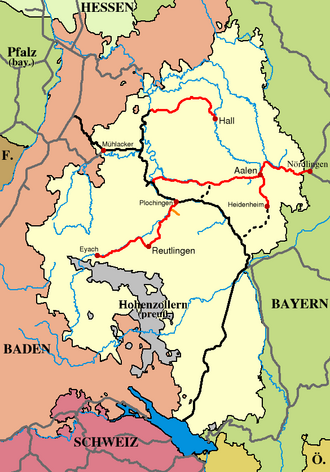
Following the initial success of the main lines, construction slowed until 1857. A key milestone during this lull was the 1854–1856 construction of a steel mill in Wasseralfingen to produce rails locally. Expansion then resumed to serve urgent industrial needs in the Upper Neckar region, the northeast, and the east.
The Upper Neckar Railway reached Reutlingen in 1859 and Eyach by 1864. In the east, the Rems Railway was opened in 1861, connecting Cannstatt to Aalen and Wasseralfingen. Despite political friction with Bavaria, a treaty in 1861 eventually allowed the line to extend to Nördlingen by 1863.
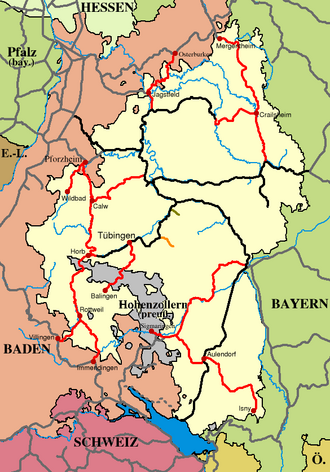
Interstate Connectivity and the German Reich
As the network grew, strategic nodes like Mühlacker, Jagstfeld, and Crailsheim emerged. Negotiations with Baden and Prussia were essential for cross-border traffic. A significant agreement in 1865 facilitated lines through the Black Forest and a connection between Waldshut and Ulm, which was put into service in 1873.
Following the founding of the German Reich in 1871, state railways remained independent but were required by the constitution to operate as an integrated unit for public transport. By 1890, the main line network was largely complete, including the Brenz Railway (connecting Heidenheim and Ulm) and the Kraichgau Railway.
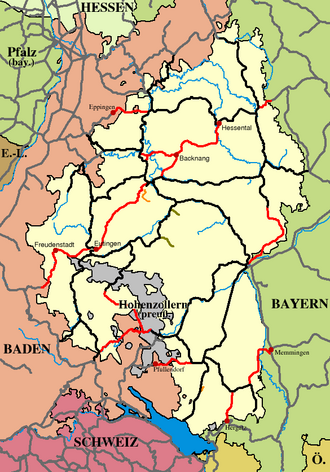
Secondary Lines and Local Access
While main lines drove industrialization, smaller communities pushed for their own connections. The 1843 law allowed private companies to build secondary lines (Sekundärbahn). Notable early examples include the Teck Railway (1864) and the Erms Valley Railway (1873). By the 1920s, a dense web of state and private branch lines served the rural interior.
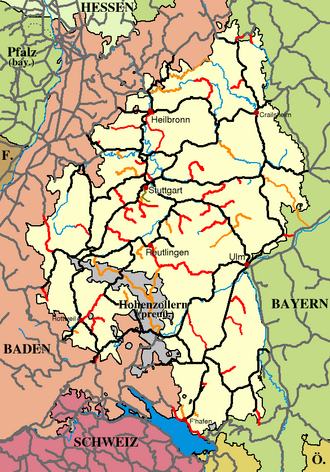
The 20th Century: Transition and Modernization
On April 1, 1920, the independent state railways merged to form the Reichsbahn. The network reached a length of 2,153 kilometers. However, the post-WWII era saw a decline in rail usage as automobiles became the preferred mode of transport, leading to the closure of many secondary branch lines starting in the late 1950s.
Recent decades have seen a shift toward regional revitalization. The 1994 railway reforms encouraged states to reopen closed branch lines, such as the Schönbuch Railway (1996). Additionally, the 1991 Mannheim–Stuttgart high-speed line introduced ICE (Intercity-Express) trains to the region.
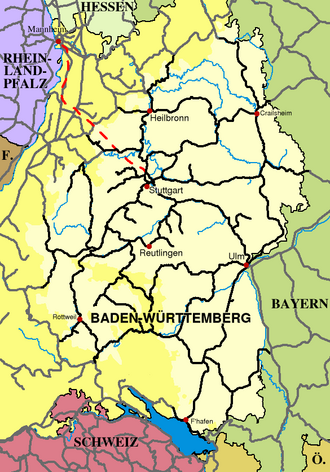
Stuttgart 21
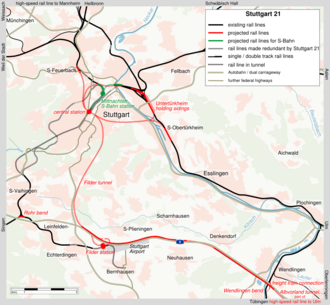
The most significant current development is Stuttgart 21. This project involves a complete redesign of the Stuttgart Hauptbahnhof (main station) and the construction of new high-speed lines between Stuttgart, Wendlingen, and Ulm to replace the older Fils Valley Railway for long-distance traffic.
| Period/Year | Development | Significance |
|---|---|---|
| 1843 | Railway Law passed | Legislated main lines and founded Maschinenfabrik Esslingen |
| 1845 | First section opened | Cannstatt to Untertürkheim begins the rail era |
| 1850-1853 | Westbahn construction | Established critical connection to Baden via Bruchsal |
| 1890 | Main network completion | Completion of the primary state-wide rail infrastructure |
| 1920 | Formation of Reichsbahn | End of independent state railway administration |
| 1991 | Mannheim–Stuttgart line | Introduction of high-speed ICE rail travel |
Frequently Asked Questions
Why did the state insist on owning the railways instead of allowing private companies?
The government and King William I wanted to preserve state rights and ensure that the profits from transit traffic between different states remained in the public treasury.
What was the impact of the railways on Württemberg's towns?
Railways were a primary driver of industrialization. Towns located along the rail network became highly attractive to industry, leading to rapid economic and population growth.
What happened to the secondary branch lines after World War II?
Many secondary lines saw a reduction in service or complete closure starting in the late 1950s due to the increasing popularity of automobiles and government support for road transport.
What is the purpose of the Stuttgart 21 project?
Stuttgart 21 aims to modernize the Stuttgart Hauptbahnhof and implement new high-speed rail connections between Stuttgart and Ulm to improve long-distance efficiency.
How did the relationship with neighboring states affect rail construction?
Construction was often a mix of cooperation and competition. For example, negotiations with Baden and Bavaria were necessary to determine where lines would connect to ensure neither state lost too much transit traffic to the other.