Raga Rock: The Fusion of Indian Classical Music and Western Psychedelia
In the mid-1960s, a sonic revolution emerged across the United Kingdom and the United States as rock musicians began looking toward the East for inspiration. This movement, known as raga rock, blended the energy of Western pop and rock with the intricate melodic modes and spiritual depth of Indian classical music. Emerging as a key component of the psychedelic rock aesthetic, raga rock transformed the landscape of popular music by introducing non-European instruments and unconventional song structures to a global audience.
What is Raga Rock?
At its core, the genre is named after ragas, which are specific melodic modes used in the classical music of the Indian subcontinent. The term "raga rock" first appeared in March 1966 to describe rock music that utilized the styling of the sitar. Over time, it became a broader "catch-all" term for any rock song that evoked an Indian or "Oriental" mood, regardless of whether it used authentic instruments or simply imitated the sound through electronic means.
Musically, raga rock is characterized by several distinct elements:
- Sitar: Often taking the lead role typically reserved for the electric guitar.
- Drone: A continuous low humming sound, traditionally provided by a tambura or harmonium.
- Modal Melodies: Compositions based on Indian scales rather than standard Western chord progressions.
- Additive Rhythms: The use of tal (Indian rhythmic cycles) rather than divisive Western beats.
- Jawab-Sawal: A "question-and-answer" interplay between lead instruments.
The Origins and Early Pioneers
While the 1960s rock explosion brought the sound to the masses, the seeds were sown earlier in the folk scene. As early as 1963, American musician Sandy Bull and English guitarist Davey Graham were incorporating drone-producing tunings and raga-tinged arrangements into their folk music, predating the mainstream rock experimentation by several years.
By 1965, the sound began infiltrating the pop charts. The Kinks' "See My Friends" used open-tuned guitars to imitate the tambura drone, while The Beatles' "Ticket to Ride" featured a melody described as "raga-like." However, the most significant catalyst was the release of "Norwegian Wood (This Bird Has Flown)" in December 1965. This track marked the first time a Western pop song featured the sitar played by a rock musician—George Harrison—triggering what Ravi Shankar called "the great sitar explosion."
Evolution and Peak Popularity
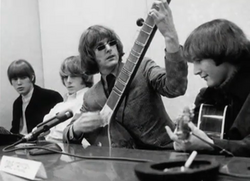
As the genre evolved, artists moved from using Indian sounds as mere "exotic" ornaments to integrating them into the very structure of their compositions. The Byrds' 1966 single "Eight Miles High" was pivotal in this shift, incorporating improvisational techniques inspired by both Ravi Shankar and jazz legend John Coltrane. Interestingly, while listeners heard a sitar, guitarist Roger McGuinn actually achieved the effect using a customized Rickenbacker 12-string electric guitar and amplifier.
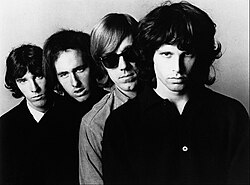
By 1967, the experimentation reached its zenith. George Harrison moved toward authentic Hindustani classical structures in songs like "Love You To" and "Within You Without You," utilizing a full array of instruments including the tabla, dilruba, and swarmandal. Similarly, The Doors explored the darker side of the genre with their 11-minute epic "The End," where guitarist Robby Krieger employed the jhala style—rapid strumming alternating with the melody line—to create a brooding atmosphere.
Key Facts
- Defining Instrument: The sitar is the most iconic instrument of the genre, though electric guitars were often modified to mimic its sound.
- Pivotal Track: The Beatles' "Norwegian Wood" is widely credited with inaugurating the raga rock trend in Western pop.
- Structural Influence: Advanced raga rock adopted the alap, gat, and drut gat sections of Indian classical music.
- Derivative Genres: Raga rock paved the way for Indian rock, psychedelic rock, and Sufi rock.
- 1990s Revival: Bands like Kula Shaker and Cornershop brought raga rock back to the charts in the late 90s.
Summary of Raga Rock Influence
| Era/Artist | Approach | Key Examples |
|---|---|---|
| Early Folk (1963) | Drone tunings and arrangements | Sandy Bull, Davey Graham |
| Early Pop (1965) | Exotic textures and sitar accents | The Beatles ("Norwegian Wood"), The Kinks |
| Psychedelic Peak (1966-67) | Improvisation and classical structures | The Byrds, The Doors, George Harrison |
| Modern Revival (1990s) | Fusion with indie, funk, and hip hop | Kula Shaker, Cornershop |
Consolidation and Later Legacy
By 1968, the initial wave of experimentation began to decline, often replaced by a more formulaic approach. The Moody Blues' In Search of the Lost Chord combined sitar and tabla sounds with themes of Transcendental Meditation, reflecting the era's cultural obsession with gurus like Maharishi Mahesh Yogi. However, the influence persisted through the 1970s with progressive acts like Quintessence and the jazz-fusion work of John McLaughlin's Shakti.
The genre saw a significant resurgence in the 1990s. The British band Kula Shaker achieved top 10 hits with Sanskrit lyrics, while Cornershop fused Indian instruments like the dholki with rock and hip hop, most notably on their 1997 album When I Was Born for the 7th Time.
Frequently Asked Questions
What is the difference between a raga and a scale?
While a scale is a set of notes, a raga is a more complex melodic mode that includes specific rules for ascending and descending, as well as characteristic ornaments and emotional associations.
Did The Byrds actually use a sitar on "Eight Miles High"?
No. Despite the sitar-like sound, Roger McGuinn played a Rickenbacker 12-string electric guitar through a customized amplifier to achieve that specific tone.
Which Beatles song is most famous for starting the raga rock trend?
"Norwegian Wood (This Bird Has Flown)" is generally cited as the first Western pop song to incorporate the sitar, sparking a massive wave of interest in Indian music.
What is a "drone" in the context of raga rock?
A drone is a continuous, unchanging pitch that serves as the harmonic foundation for the melody. In Indian music, this is typically provided by the tambura.
How did raga rock influence later music genres?
Raga rock was a precursor to psychedelic rock and later influenced world music fusion, indie rock in the 1990s, and the development of Sufi rock.