Rafael Bielsa: A Career in Argentine Diplomacy and Politics
Rafael Antonio Bielsa Caldera is a distinguished Argentine politician, lawyer, and writer whose career has spanned the highest levels of national governance and international diplomacy. A member of the Justicialist Party, Bielsa has served in critical roles including Minister of Foreign Affairs and Ambassador to Chile, contributing significantly to Argentina's geopolitical relations.
Key Facts
- Born: February 15, 1953, in Rosario, Argentina.
- Major Roles: Minister of Foreign Affairs (2003–2005) and Ambassador to Chile (2020–2023).
- Political Affiliation: Justicialist Party and Front for Victory (2003–2007).
- Education: Law degree from the National University of Rosario.
- Family: Brother of football coach Marcelo Bielsa and politician María Eugenia Bielsa.
Early Life, Education, and Adversity
Born in Rosario, Santa Fe, Rafael Bielsa spent much of his childhood in Morteros, Córdoba. He pursued a legal education at the Faculty of Law of the National University of Rosario, eventually qualifying as a lawyer. Beyond his legal and political pursuits, Bielsa is an accomplished poet, essayist, and writer.
His early professional life was marked by the turbulence of the Dirty War (a period of state-sponsored violence and human rights abuses in Argentina). In 1977, while working at the Federal Court of Rosario, Bielsa was detained under suspicion of belonging to the Montoneros, a radical guerrilla group. He was held for two months at the "El Castillo" (also known as "El Fortín") illegal detention center, where he was subjected to questioning and torture. Following a period of exile in Spain, he returned to Argentina in 1980, taking various positions within the military government's Ministry of Justice.
Rise in National Politics
With the return of democracy in 1983, Bielsa transitioned into civilian governance, working within the Secretariat of the Ministry of Education. He later served as an adviser to the Office of the President during the early years of Carlos Menem's administration and held roles within the Ministry of Justice and various international projects.
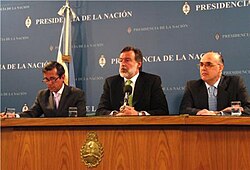
Bielsa's prominence grew significantly under President Néstor Kirchner, who appointed him as the Minister of Foreign Affairs on May 25, 2003. He held this pivotal role until December 2005, managing Argentina's international relations during a transformative era for the country.
Legislative Transition and Controversy
In the 2005 legislative elections, Bielsa won a seat in the Argentine Chamber of Deputies representing the Autonomous City of Buenos Aires. However, his transition to the legislature was marked by public controversy. Just before his inauguration, he initially declined the seat to accept an appointment as Ambassador to France at the President's request. Within a day, he reversed this decision, citing public pressure and moral qualms, and took his seat in Congress. This reversal drew sharp criticism from both political opponents and some government supporters.
Later Career and Public Service
In 2007, Bielsa sought the governorship of Santa Fe. After winning the Justicialist Party primary against Agustín Rossi, he competed in the general election on September 2. He received 38.8% of the vote but was defeated by Hermes Binner, the former mayor of Rosario. Following this loss, Bielsa resigned from his position as a national representative for Buenos Aires.
Between 2011 and 2013, he led SEDRONAR (the Secretariat of Programming for the Prevention of Drug Addiction and the Fight against Drug Trafficking), focusing on national health and security strategies regarding substance abuse.
Most recently, Bielsa returned to the diplomatic stage, serving as the Ambassador of Argentina to Chile from August 5, 2020, until December 10, 2023.
Summary of Professional Tenure
| Role | Period | Key Detail |
|---|---|---|
| Minister of Foreign Affairs | 2003 – 2005 | Appointed by President Néstor Kirchner |
| National Deputy | 2005 – 2007 | Represented Autonomous City of Buenos Aires |
| Secretary of SEDRONAR | 2011 – 2013 | Anti-drug trafficking and prevention |
| Ambassador to Chile | 2020 – 2023 | Diplomatic representative to Chile |
Frequently Asked Questions
Who is Rafael Bielsa's brother?
Rafael Bielsa is the brother of Marcelo Bielsa, the renowned former coach of the Argentina national football team, and María Eugenia Bielsa, a former Vice-Governor of Santa Fe.
What happened to Rafael Bielsa during the Dirty War?
In 1977, he was detained at the "El Castillo" illegal detention center for two months, where he was tortured due to suspected ties to the Montoneros guerrilla group.
Which political party does Rafael Bielsa belong to?
He is a member of the Justicialist Party and was affiliated with the Front for Victory between 2003 and 2007.
Did Rafael Bielsa ever serve as a Governor?
No. While he was the Justicialist Party candidate for the governorship of Santa Fe in 2007, he lost the election to Hermes Binner.
What was Bielsa's most recent diplomatic role?
He served as the Ambassador of Argentina to Chile from August 2020 until December 2023.