RAF Inverness: The History of Longman Airfield
Located by the Moray Firth in the Highlands of Scotland, RAF Inverness—also known as RAF Longman or Longman Airfield—served as a vital aviation hub during one of the most turbulent periods of the 20th century. From its origins as a civilian link to the northern isles to its strategic role during World War II, the site reflects the rapid evolution of military and civil aviation in the United Kingdom.
Key Facts
- Original Purpose: Built in 1933 as a civilian airport for Highland Airways.
- Military Service: Operated as an RAF station from 1940 to 1945.
- Command: Controlled by RAF Fighter Command under No. 13 (Fighter) Group.
- Strategic Luck: Avoided major Luftwaffe bombing because German reconnaissance misidentified it as a seaplane base.
- Current Status: Demolished and now utilized as an industrial estate.
From Civilian Beginnings to Wartime Mobilization
Longman Airfield was established in 1933 by the local council. Its primary goal was to provide Highland Airways with a base to connect Inverness and its rail networks to Wick and Orkney. However, the outbreak of World War II necessitated a shift in purpose. While the site was converted for military use in 1940, it did not officially become a Royal Air Force base until 1941.
Interestingly, the airfield's survival during the war was partly due to a clerical error by the enemy. German reconnaissance units identified the site but incorrectly recorded it as a seaplane base. This mistake likely spared Inverness from significant bombing raids by the Luftwaffe.
Despite the military takeover, civilian aviation persisted. Scottish Airways, the successor to Highland Airways, continued to operate intensive flights from the airfield to support the Shetland and Orkney Isles.
Operational Squadrons and Aircraft
During its tenure as an RAF station, Longman hosted a variety of squadrons and aircraft, ranging from reconnaissance fighters to training planes. The site was particularly active in supporting No. 13 (Fighter) Group and hosted the No. 70 (Signals) Wing Calibration Flight from February 1941 until August 1945.
| Unit | Period | Aircraft | Notes |
|---|---|---|---|
| No. 241 Squadron | Sep 1940 – Apr 1942 | Westland Lysander Mk. II | Formed from 614 Squadron 'A' Flight |
| No. 289 Squadron | May 1939 – Sep 1939 | Avro Anson | Early wartime operations |
| No. 309 Polish Fighter-Reconnaissance Sqn | Various | Supermarine Spitfire Mk. I | Polish forces in the UK |
| No. 526 Squadron | Jun 1943 – May 1945 | Airspeed Oxford Mk. I | Later absorbed into 527 Squadron |
| No. 527 Squadron | May 1945 – Nov 1945 | de Havilland Dominie | Post-war transition |
| No. 598 Squadron | Dec 1943 – Mar 1945 | Airspeed Oxford Mk. II | Training and support |
Specialized Units and Support Flights
Beyond the main squadrons, the base supported several specialized units. These included the No. 14 Group Target Towing Flight (which became No. 1491 Flight), the No. 1 (Coastal) Engine Control Demonstration Unit, and various communication flights for No. 13 and No. 14 Groups. A detachment of the No. 1479 (Anti-Aircraft Cooperation) Flight also operated from the site in 1943.
Post-War Transition and Closure
Following the conclusion of World War II, the site reverted to general use as Longman Airfield. During this period, it was served by British European Airways (BEA), which utilized a fleet of captured ex-Luftwaffe Junkers Ju 52 transport aircraft.
Historical accounts suggest that Hitler's personal Ju 52, registration D-2600, was stored at Longman for a period after the war.
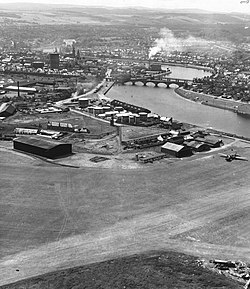
By 1947, Longman was deemed too small for safe modern operations. Consequently, Inverness Airport at Dalcross became the primary aviation hub for the region, leading to the eventual closure and demolition of the Longman site. Today, the land serves as an industrial estate.
Frequently Asked Questions
Why was RAF Inverness not heavily bombed by the Luftwaffe?
German reconnaissance units misidentified the airfield as a seaplane base, which likely led them to overlook it as a primary target for bombing raids.
What happened to the site after the RAF left?
It returned to civilian use as Longman Airfield until 1947, when operations moved to the larger Dalcross site. The airfield was eventually demolished and is now an industrial estate.
Which famous aircraft were associated with the airfield's post-war period?
The airfield was used by British European Airways for captured Junkers Ju 52 aircraft, and it is believed that Adolf Hitler's personal aircraft (D-2600) was stored there.
Who operated the airfield before it became an RAF base?
The airfield was originally built in 1933 by the local council for Highland Airways to connect Inverness with Wick and Orkney.
Which RAF command was responsible for the station?
The station was controlled by RAF Fighter Command and specifically operated under the No. 13 (Fighter) Group.