Radio News and the Publishing Empire of Hugo Gernsback
In the early 20th century, the landscape of technical publishing was dominated by the ambitious vision of Hugo Gernsback and his brother Sydney. Together, they built a sprawling media empire that extended beyond the printed page to include books and two radio stations. At the heart of this empire was the Experimenter Publishing Company Inc., which produced influential magazines that shaped how the public interacted with emerging technology.
One of their most prominent titles, Radio News, served as a cornerstone of their success, prominently featuring Gernsback as the editor on its covers. However, the business model relied heavily on a precarious cycle, using current newsstand sales to settle debts with printers from the previous month.
The Fall and Rise of Gernsback
The financial instability of the empire culminated on February 20, 1929, when an involuntary petition of bankruptcy was filed against the Experimenter Publishing Company. This legal action marked a turning point for Radio News; the April 1929 issue was the final edition to feature Hugo Gernsback as editor.
Undeterred by the bankruptcy, Gernsback rapidly secured new capital to establish a separate publishing venture. In a bold move, he launched a new suite of magazines designed to compete directly with his former titles. By July 1929, Radio-Craft had entered the market as a direct competitor to Radio News.
Evolution of Radio News
Following Gernsback's departure, Radio News transitioned to a new publisher, B. A. MacKinnon, under a company called Experimenter Publications. This entity later evolved into Radio-Science Publications in June 1930. Under the guidance of Arthur H. Lynch, the editorial direction shifted; Lynch moved away from forecasting future inventions to focus on practical technical information regarding the design, service, and operation of radio equipment.
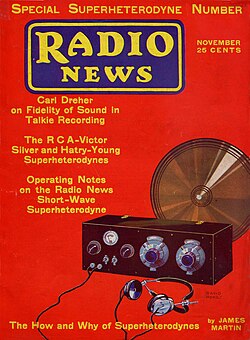
The visual identity of the magazine also underwent a transformation. The dramatic or humorous scenes previously featured on the covers were replaced by a minimalist, solid red design showcasing a single piece of equipment or component.
Ownership Shifts and Expansion
Radio-Science Publications ceased its operations with the August 1931 issues. The publication was then acquired by the Teck Publishing Corporation, a newly formed entity by Bernarr Macfadden, starting with the September 1931 issue. Under the editorship of Laurence Cockaday, the magazine maintained its format but expanded its scope to cover the rapid advancements in both radio and television.
During this era, a staple of all radio-centric magazines was the inclusion of comprehensive lists of broadcast and short-wave stations. The aesthetic of the covers continued to evolve, shifting to black-and-white photography in 1934 before color illustrations returned in 1936.
Additionally, the publisher expanded its reach into the emerging field of television by publishing a sister magazine, Television News, between 1931 and 1932.
Key Facts
- Bankruptcy Date: An involuntary petition was filed against Experimenter Publishing on February 20, 1929.
- Competitive Pivot: Hugo Gernsback launched Radio-Craft in July 1929 to compete with his former publication, Radio News.
- Ownership Chain: Radio News moved from Experimenter Publishing to Experimenter Publications, then to Radio-Science Publications, and finally to Teck Publishing Corporation.
- Content Shift: Arthur H. Lynch pivoted the content from future forecasting to practical technical radio design and operation.
- Sister Publication: Television News was published from 1931 to 1932.
| Period | Publisher/Company | Key Editor/Figure | Notable Change |
|---|---|---|---|
| Pre-April 1929 | Experimenter Publishing Company | Hugo Gernsback | Empire included radio stations and books |
| April 1929 – June 1930 | Experimenter Publications | B. A. MacKinnon | Shift to technical design and red covers |
| June 1930 – Aug 1931 | Radio-Science Publications | Arthur H. Lynch | Focus on equipment service and operation |
| Sept 1931 onwards | Teck Publishing Corporation | Laurence Cockaday | Broadened topics to include television |
Frequently Asked Questions
Why did Hugo Gernsback lose control of Radio News?
An involuntary petition of bankruptcy was filed against his company, Experimenter Publishing Company Inc., on February 20, 1929, due to a business model that relied on current sales to pay previous debts.
What was Radio-Craft?
Radio-Craft was a magazine created by Hugo Gernsback after his bankruptcy to compete directly with his previous publication, Radio News.
How did the content of Radio News change under Arthur H. Lynch?
Lynch stopped the practice of forecasting future developments and instead provided technical data for the design, operation, and servicing of radio equipment.
When did Television News exist?
Television News was published as a sister magazine to Radio News between 1931 and 1932.
How did the cover art of Radio News evolve over time?
The covers moved from dramatic or humorous scenes to solid red covers with single components, then to black-and-white photos in 1934, and finally back to color illustrations in 1936.