Radio Broadcasting: History, Technology, and Evolution
Radio broadcasting is the process of transmitting signals—primarily audio—via radio waves over a wide area to be captured by a broadcast radio receiver. These transmissions are generally categorized as terrestrial, meaning they originate from stations on land, or satellite-based, where the signal originates from an orbiting satellite.
Modern broadcasting relies on two primary technological frameworks: analog and digital. While analog systems use modulation to carry sound, digital systems utilize specific audio standards to ensure higher efficiency and quality. Stations may produce their own unique content or affiliate with larger networks through simulcasting (broadcasting the same content simultaneously) or syndication.
Key Facts
- AM (Amplitude Modulation) was the first widespread broadcasting technology, utilizing the medium-wave band.
- FM (Frequency Modulation) was invented in the 1930s to reduce radio-frequency interference (RFI) and improve audio fidelity.
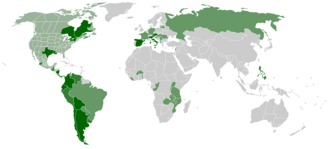
- DAB (Digital Audio Broadcasting) represents the modern shift toward digital terrestrial radio, prominent in Europe and South Africa.
- Satellite Radio provides wide-area coverage but faces high entry costs and strict spectrum licensing.
- The BBC became the world's first national broadcaster after receiving a Royal Charter in 1926.
The Evolution of Radio
The Pre-Audio Era
Before the transmission of voice and music, early stations focused on radiotelegraphy. These broadcasts consisted of Morse code dots-and-dashes used for weather reports and time signals. For example, the U.S. Navy began daily time signals in 1904, and the Eiffel Tower in Paris transmitted signals audible across Europe, allowing listeners to synchronize their watches via a simple "beep."
The Dawn of Audio Broadcasting
The transition to audio began in the early 20th century. On December 21, 1906, Reginald Fessenden demonstrated audio transmissions in Massachusetts. He claimed to have broadcast music and entertainment on Christmas Eve and New Year's Eve of 1906, though contemporary confirmation of these events remains elusive.
![Charles Logwood broadcasting at 2XG in New York City in 1916.[7]](/images/d8/d4/d8d4e3e30b67415037f7e868ec3232e8b4cc40bbdbed21f6e85478f48cca2f43.jpg)
Other pioneers include Charles Herrold, who broadcast "wireless phone concerts" in California starting in 1910, and Lee de Forest, whose New York station 2XG resumed broadcasts in 1919 before relocating to San Francisco as 6XC. By 1920, the medium expanded globally: Radio Argentina began transmissions in Buenos Aires, and the Canadian Marconi facility in Montreal evolved its test transmissions into weekly concerts.
![November 5, 1919 Nieuwe Rotterdamsche Courant advertisement, announcing PCGG's debut broadcast scheduled for the next evening, using narrow-band frequency modulation (FM).[22]](/images/bf/98/bf98c6120754aaf61883ebda104cdf968860609f895b0814a6c83d5bdadd6988.jpg)
The Rise of National Broadcasters
In the United Kingdom, entertainment broadcasts began in 1920, notably featuring soprano Dame Nellie Melba. However, early efforts were often hindered by government restrictions; the UK Post Office briefly banned broadcasts due to military interference. By 1922, the British Broadcasting Company was formed, eventually becoming the first national broadcaster in 1926. Simultaneously, the U.S. Department of Commerce formalized broadcasting regulations in 1921, leading to over 500 licensed stations by the end of 1922.
Transmission Technologies
Amplitude Modulation (AM)
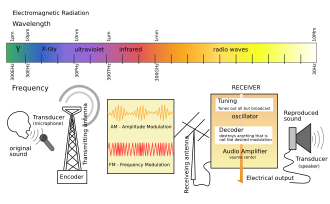
AM works by varying the amplitude of the carrier signal to match the audio signal. It primarily uses the medium-wave band (525 to 1,705 kHz in North America). While AM was the standard for early radio, it is susceptible to interference and generally offers lower audio fidelity, with most receivers reproducing frequencies only up to 5 kHz.
Frequency Modulation (FM)
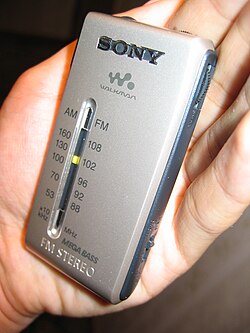
Invented by Edwin Howard Armstrong in the 1930s, FM overcomes the interference issues of AM by varying the frequency rather than the amplitude. FM operates on the VHF (Very High Frequency) band, typically between 88 and 108 MHz. Because FM channels are spaced further apart (200 kHz) than AM channels, they provide significantly higher fidelity and support stereo sound via a 38 kHz subcarrier.
Digital and Satellite Radio
Digital radio, such as DAB, HD Radio, and DRM, transmits audio as digital data, reducing noise and allowing for more stations within the same spectrum. Satellite radio, dominated in North America by Sirius XM, bypasses terrestrial limits but requires expensive space-based infrastructure.
International and Specialized Broadcasting
Governments often fund international broadcasting for strategic reasons. These motivations include promoting a positive national image to encourage tourism and investment, combating negative narratives from dissidents, or promoting specific political ideologies, such as the Cold War-era broadcasts from Radio Moscow.
Summary of Radio Technologies
| Technology | Modulation Method | Primary Band | Key Advantage | Key Limitation |
|---|---|---|---|---|
| AM | Amplitude | Medium Wave | Long range/Rural reach | High interference/Low fidelity |
| FM | Frequency | VHF | High fidelity/Stereo | Shorter range than AM |
| DAB | Digital | Band III / L-Band | Efficient spectrum use | Requires digital receiver |
| Satellite | Digital/Analog | Satellite Orbit | Continental coverage | High infrastructure cost |
Frequently Asked Questions
What is the main difference between AM and FM radio?
AM (Amplitude Modulation) varies the strength of the signal and is better for long-distance transmission but prone to static. FM (Frequency Modulation) varies the speed of the signal, offering much higher sound quality and resistance to interference, making it ideal for music.
Who was the first person to broadcast music over the radio?
Reginald Fessenden is credited with the first audio transmissions of music and entertainment on December 24, 1906, using an alternator transmitter in Massachusetts, although some historians note a lack of contemporary confirmation.
What is DAB radio?
DAB stands for Digital Audio Broadcasting. It is a digital terrestrial radio standard used primarily in Europe and South Africa to provide clearer sound and more station options than traditional analog radio.
Why do governments fund international radio broadcasting?
Governments use international broadcasting for ideological reasons, such as promoting their nation's image to attract investment, countering negative propaganda, or spreading specific political ideologies to a global audience.
How does satellite radio differ from terrestrial radio?
Terrestrial radio transmits from land-based towers and is limited by geography and curvature of the earth. Satellite radio transmits from orbit, allowing a single service to cover entire continents, though it requires a subscription and specialized hardware.