Quantum Entanglement: The Nonlocal Connection of Particle States
Quantum entanglement is a physical phenomenon that occurs when a group of particles is generated or interacts in such a way that the quantum state of each individual particle cannot be described independently of the others. This remains true even when the particles are separated by vast distances. This interconnectedness represents one of the most profound departures from classical physics, serving as a primary feature of quantum mechanics that has no equivalent in the classical world.
In practical terms, measurements of physical properties—such as position, momentum, spin, and polarization—performed on entangled particles can be perfectly correlated. For instance, if a pair of particles is created with a total spin of zero, and one particle is measured to have a clockwise spin on a specific axis, the other particle will invariably be found to have an anticlockwise spin on that same axis.
This behavior leads to a phenomenon known as wave function collapse. When a measurement is performed on one particle, its quantum state changes irreversibly; because the particles are entangled, this measurement affects the entire system instantaneously, regardless of the distance between the components.
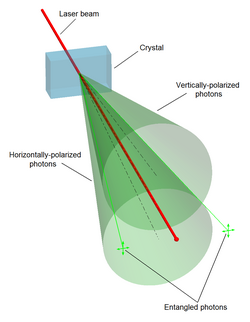
Key Facts
- Non-independence: The state of one entangled particle is intrinsically linked to the state of its partner.
- Instantaneous Correlation: Changes to one particle's state are reflected in the other, regardless of distance.
- Classical Divergence: Entanglement is a uniquely quantum property not found in classical mechanics.
- Measurable Properties: Common correlated properties include spin, polarization, and momentum.
- Wave Function Collapse: Measuring one part of an entangled system affects the state of the whole system.
The EPR Paradox and the History of Nonlocality
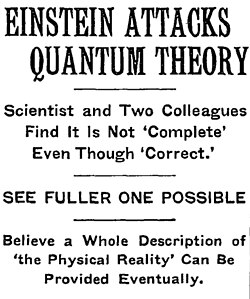
The conceptual challenges of entanglement were famously highlighted in a 1935 paper by Albert Einstein, Boris Podolsky, and Nathan Rosen. This work described what is now known as the EPR paradox. Einstein and his colleagues found the implications of entanglement problematic because it seemed to violate local realism—the principle that physical processes occurring at one location should not have immediate effects on processes at another location.
Einstein argued that because the instantaneous coordination of particles seemed impossible under the laws of causality, the existing formulation of quantum mechanics must be incomplete. He suggested that there might be "hidden variables" that predetermined the outcomes of measurements, rather than the particles communicating instantaneously across space.
Mathematical Foundations and State Classification
In quantum mechanics, the state of a composite system is described mathematically. If one system is in a specific state and a second system is in another, the combined state is a product of the two. However, an entangled state is one that cannot be factored into a simple product of individual states.
Pure States and Bell States
For two qubits (quantum bits), the most famous examples of maximal entanglement are the Bell states. These represent the simplest form of bipartite entanglement. When moving beyond two qubits, more complex states emerge, such as the GHZ state (for M > 2 qubits) and NOON states (used for two bosonic modes).
Entropy and Entanglement Measures
To quantify the degree of entanglement, physicists use various measures. One primary tool is entropy, specifically the von Neumann entropy, which is expressed in terms of the eigenvalues of the density matrix. Other specialized measures include:
- Entanglement Cost: The resources required to create a state.
- Distillable Entanglement: The amount of pure entanglement that can be extracted from a mixed state.
- Concurrence: A measure used specifically for pairs of qubits.
- Logarithmic Negativity: A measure used to quantify entanglement in various quantum systems.
Applications and Experimental Evidence
Once viewed as a theoretical paradox, entanglement is now treated as a critical resource for quantum information science. It enables technologies that would be impossible under classical physics.
Quantum Teleportation and Swapping
Entanglement allows for the transfer of quantum information between particles. Through a process called Bell state measurement, entanglement can be "swapped," allowing two particles that have never interacted to become entangled.
![Entanglement of states from independent sources can be swapped through Bell state measurement.[83]: 341](/images/08/32/083292b0ff2be894bcf562ebedff0836dc7d9a4fb7bea89a1ce08b85c8cb4752.webp)
High-Energy Physics and Macroscopic Objects
Recent experiments have pushed the boundaries of where entanglement is observed. It has been detected in top quarks at the highest energies ever recorded (via CERN's LHC experiments) and has been observed in macroscopic objects, as well as within the quarks and gluons inside protons.
| Concept | Description | Classical Equivalent |
|---|---|---|
| Nonlocality | Instantaneous correlation between distant particles. | None (Limited by speed of light). |
| Bell States | Maximally entangled states of two qubits. | Simple correlated pairs. |
| Wave Function Collapse | The transition from a superposition of states to a single state upon measurement. | Deterministic state change. |
| EPR Paradox | The 1935 challenge to quantum mechanics based on local realism. | Local Causality. |
Frequently Asked Questions
Does quantum entanglement allow for faster-than-light communication?
No. While the correlation between entangled particles is instantaneous, no usable information can be transmitted faster than the speed of light. A classical communication channel is still required to interpret the results of the measurements.
What is the difference between classical correlation and quantum entanglement?
Classical correlation involves properties that were determined at the moment of creation (like two halves of a torn postcard). Quantum entanglement involves properties that remain undetermined (in superposition) until the moment of measurement, at which point they correlate instantaneously.
What is a Bell state?
A Bell state is one of four specific quantum states of two qubits that represent the maximum possible entanglement between them.
Who first proposed the EPR paradox?
The paradox was proposed in 1935 by Albert Einstein, Boris Podolsky, and Nathan Rosen to argue that quantum mechanics was an incomplete theory because it violated local realism.
Where is quantum entanglement observed in nature?
It is observed in photon pairs, electrons, top quarks at high energies, and even in the internal structure of protons (quarks and gluons).