QF 1 Pounder Pom-Pom: The World's First Autocannon
The QF 1 pounder, universally known as the "pom-pom" due to the distinctive sound of its discharge, holds a significant place in military history as the world's first autocannon. A 37 mm British-designed weapon, it bridged the gap between traditional machine guns and heavier artillery, serving various roles from an infantry support gun to an early light anti-aircraft (AA) weapon.
Designed in the late 1880s by Hiram Maxim, the pom-pom was essentially an enlarged version of the famous Maxim machine gun. This increase in scale was not arbitrary; to ensure the weapon could fire exploding projectiles, Maxim had to adhere to the Saint Petersburg Declaration of 1868 and the Hague Convention of 1899, which mandated a minimum shell weight of 400 grams (0.88 lb) for exploding ammunition. This requirement dictated the 1-pound (0.45 kg) shell weight that gave the gun its name.
Initially sold under the Maxim-Nordenfelt label, the weapon later became associated with Vickers, Sons and Maxim (VSM) after Vickers acquired Maxim-Nordenfelt in 1897.
Key Facts
- First of its kind: The first autocannon ever produced.
- Calibre: 37 millimetres (1.457 inches).
- Rate of Fire: Approximately 300 rounds per minute (cyclic).
- Muzzle Velocity: 1,800 feet per second (550 m/s).
- Maximum Range: 4,500 yards (4,110 metres) when on a field carriage.
- Global Use: Employed by the British Empire, German Empire, USA, Finland, Belgium, and several South American nations.
Technical Specifications
The QF 1 pounder was a recoil-operated automatic weapon. While its design allowed for rapid fire, its effectiveness varied depending on the mounting and the ammunition used.
| Feature | Specification |
|---|---|
| Mass (Gun & Breech) | 410 lbs (186.0 kg) |
| Total Length | 6 ft 1 in (1.85 m) |
| Barrel Length (Bore) | 3 ft 7 in (1.09 m) L/29 |
| Shell Type | 37 x 94R Common Shell |
| Filling Weight | 270 grains (17 g) black powder |
| Action | Automatic, recoil |
Global Service History
The British Empire and the Boer War
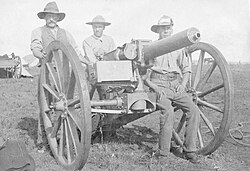
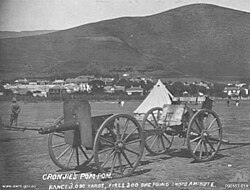
Interestingly, the British government initially rejected the gun. However, the South African Republic (Transvaal) imported 22 units between 1895 and 1899. During the Second Boer War, British forces were surprised to find themselves under fire from these very weapons at battles such as Colenso and Spionkop. The Boers utilized the pom-pom on wheeled field carriages, firing high-explosive and armor-piercing rounds that proved devastating against armored trains and cavalry.
The British Army eventually deployed its own Mk I versions to South Africa starting in February 1900, with estimates of 50 to 57 guns arriving in the theater.
World War I and Anti-Aircraft Evolution
By World War I, the QF 1 pounder was adapted for home defense in Britain. Mounted on high-angle pedestals or motor lorries, it was used to defend London docks and key buildings. While it was the first weapon to open fire in the defense of London, it proved largely ineffective against German Zeppelins because the shells were too small to cause sufficient damage to the airship fabric.
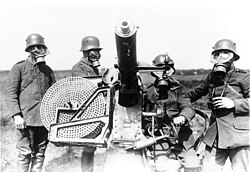
In France, Lieutenant O. F. J. Hogg achieved the first anti-aircraft kill with the weapon on September 23, 1914, using 75 rounds to down an aircraft. Despite this, the British Army did not use it as an infantry weapon during the war, preferring the larger 13-pounder and 18-pounder field guns for anti-personnel roles.
International Use: Germany, USA, and Finland
Germany produced its own version, the Maxim Flak M14, used for anti-aircraft duties in Europe and during the 1915 South West Africa campaign.
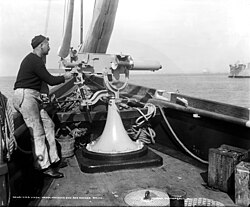
The United States Navy adopted the weapon as the 1-pounder Mark 6 before the Spanish-American War. It served as the US Navy's first dedicated anti-aircraft gun on Sampson-class destroyers. The US Army also used a small number of these pieces as mountain artillery during the Philippine-American War.
Finland's experience was more mixed. Approximately 60 guns were built by Ab H. Ahlberg & Co for the Russian army during WWI. After the Finnish Civil War, these were used in coastal fortifications and armored trains. They were often unreliable and lacked the ballistic range for effective anti-aircraft use, though they remained useful for close-range defense against surface targets until they were scrapped in 1944.
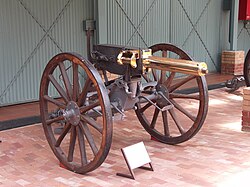
Surviving Examples
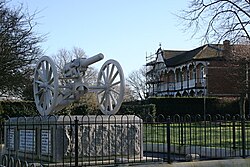
Several examples of the QF 1 pounder are preserved in museums worldwide, showcasing the various mountings used throughout its service life.
- Imperial War Museum, London: A Mk II gun on a Naval pedestal mounting.
- South African National Museum of Military History: Two German-manufactured 1903 guns.
- American Heritage Museum, Massachusetts: An early Maxim-Nordenfelt gun (no. 2024).
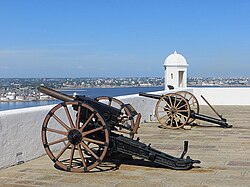
- Other locations: Examples exist in the Canadian War Museum, the Royal Danish Arsenal Museum, and the Fortaleza del Cerro in Uruguay.
Frequently Asked Questions
Why was the gun called the "pom-pom"?
The name is an onomatopoeia referring to the distinctive rhythmic sound the gun made when firing its rapid bursts of shells.
Why was the shell weight exactly one pound?
Hiram Maxim designed the shell to be at least 400 grams to comply with the Saint Petersburg Declaration of 1868 and the Hague Convention of 1899, which set the minimum weight for exploding projectiles.
Was the QF 1 pounder effective against Zeppelins?
No. The British Ministry of Munitions noted that the shells were too small to burst on aeroplane fabric and often fell back to earth as solid projectiles, making them of very little value against high-altitude airships.
Who manufactured the QF 1 pounder?
The gun was produced by Maxim-Nordenfelt, and later by Vickers, Sons & Maxim (VSM) after Vickers acquired the company in 1897. It was also manufactured in Germany by Deutsche Waffen- und Munitionsfabriken (DWM).
How was the gun used in Finland?
Finland used them primarily in coastal artillery forts for close-range defense against surface targets, as they were found to be unreliable and lacked the range for effective anti-aircraft operations.