Punjab Province: A History of British Administration (1849–1947)
The Province of Punjab served as a critical administrative hub of British India for nearly a century. Established following the annexation of the Sikh Empire, the province evolved from a military-led territory into a sophisticated administrative state, eventually becoming a focal point of the geopolitical shifts that led to the Partition of India in 1947.
The region's journey under British rule was marked by significant demographic growth, agricultural expansion, and a complex interplay of religious and linguistic identities. From its early days under the East India Company to its final years as a Governor-led province of the British Raj, Punjab remained one of the most strategically vital regions in South Asia.
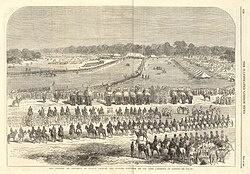
Administrative Evolution
The governance of Punjab underwent several structural transformations between 1849 and 1947, reflecting the changing nature of British control in India.
- Board of Administration (1849–1853): Initially, the province was administered by a Board of Administration and functioned as part of the Bengal Presidency under the East India Company.
- Chief Commissioner's Province (1853–1858): The administration shifted to a Chief Commissioner model during the final years of Company rule.
- Lieutenant Governor's Province (1858–1921): Following the transition to the British Raj, the province was led by a Lieutenant Governor.
- Governor's Province (1921–1947): In its final phase, Punjab was elevated to a Governor-led province.
The administrative center was primarily located in Lahore during the winter. For summer retreats, the government utilized Murree from 1873 to 1876, before moving the summer capital to Simla in 1876, where it remained until 1947.
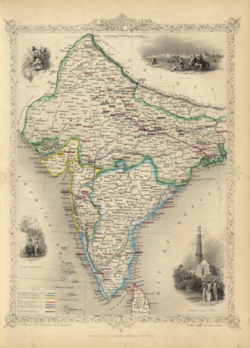
Demographics and Society
Punjab was characterized by a diverse population. By 1931, the linguistic makeup was predominantly Punjabi (76.4%), with other languages making up the remaining 23.6%.
Religious demographics shifted over the decades. According to the 1941 census, the religious distribution was as follows:
- Islam: 53.2%
- Hinduism: 30.1%
- Sikhism: 14.9%
The population grew steadily throughout the British period. In 1855, the population was estimated at 17.6 million, rising to 34,309,861 by the 1941 census. This growth was accompanied by varying literacy rates across different religious communities, with the 1941 data showing a wide range of educational attainment.
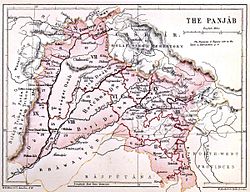
Territorial Changes and Governance
The province's borders were not static. It began with the annexation of the Sikh Empire and the Cis-Sutlej states in 1849. Over time, it absorbed the Delhi Division (1858) and the Delhi Province (1911), while the North-West Frontier Province was carved out in 1901.
Political representation evolved through the establishment of the Punjab Legislative Council (1921–1936) and later the Punjab Provincial Assembly (1937–1947). These bodies provided a framework for local governance and political discourse leading up to independence.
Key Facts
- Total Area: 458,354 km² (176,971 sq mi) at its peak.
- Final Population: 34,309,861 (1941 Census).
- Major Cities: Lahore (Winter Capital), Simla (Summer Capital).
- Annexation Date: 21 February 1849.
- Partition Date: 14–15 August 1947.
- Primary Languages: Standard Punjabi and Lahnda.
| Period | Administrative Head | Key Demographic/Event |
|---|---|---|
| 1849–1853 | Board of Administration | Annexation of Sikh Empire |
| 1853–1858 | Chief Commissioner | East India Company Rule |
| 1858–1921 | Lieutenant Governor | Transition to British Raj |
| 1921–1947 | Governor | Establishment of Provincial Assembly |
| 1941 | N/A | Population: 34.3 Million |
Frequently Asked Questions
When was Punjab annexed by the British?
Punjab was officially annexed on 21 February 1849, following the collapse of the Sikh Empire.
What were the winter and summer capitals of the province?
Lahore served as the winter capital. The summer capital was Murree from 1873 to 1876, and Simla from 1876 until 1947.
What was the religious composition of Punjab in 1941?
According to the 1941 census, the population was 53.2% Muslim, 30.1% Hindu, and 14.9% Sikh.
How did the administrative structure change over time?
It progressed from a Board of Administration (1849–1853) to a Chief Commissioner (1853–1858), then a Lieutenant Governor (1858–1921), and finally a Governor (1921–1947).
What happened to the province in 1947?
The province was partitioned between 14 and 17 August 1947, resulting in the creation of West Punjab (Pakistan) and East Punjab (India).