Proportional Representation in the United States: A Historical Overview
For much of American history, the winner-take-all system—where the candidate with the most votes wins the entire seat—has been the standard. However, the quest for a more representative system, known as proportional representation (PR), has a long and complex history in the U.S. PR is an electoral system designed to ensure that the distribution of seats in a legislative body reflects the overall share of votes received by each party or group.
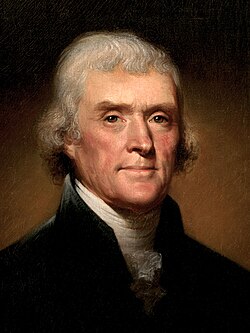
While the founders of the U.S. Constitution were primarily familiar with plurality systems, early intellectual seeds were sown early on. In 1792, Thomas Jefferson developed a formula for apportioning seats that is recognized today as the D'Hondt method, a calculation still widely used in modern PR systems to determine seat remainders.
Early Proposals and the 19th Century
The first formal arguments for PR in the U.S. emerged in the mid-1800s. In 1844, printmaker Thomas Gilpin wrote an essay advocating for "minority representation" in Philadelphia, suggesting a system similar to modern party-list models to allow diverse coalitions, including Native American interests, to gain a voice.
By 1867, the conversation shifted toward legislative structures. Simon Sterne proposed a unique proxy system for the New York state legislature, while Senator Charles Buckalew advocated for cumulative voting—a semi-proportional system where voters can concentrate their votes on a single candidate. Buckalew argued that the plurality system had contributed to the Civil War by leaving Unionists unrepresented and unable to resist secession.
The inefficiency of the plurality system was evident in historical data. For instance, analysis of the 1866-1867 House elections showed that a staggering 41.7% of votes did not contribute to electing a candidate.
![41.7% of votes in the 1866-1867 United States House of Representatives elections did not elect a candidate, according to Salem Dutcher in his 1872 analysis. The 41st and 42nd Congresses had similar percentages.[24]](/images/56/45/5645a0a34f751c0e30270d766ad53252b8b0efa273e045e8090e9054a3e1a47e.png)
The Progressive Era and the Push for Reform
At the turn of the 20th century, the Progressive movement embraced PR as a tool to combat gerrymandering (the manipulation of district boundaries for political gain) and to increase the representation of Black politicians. Reformers like John R. Commons argued that single-member districts were an "historical accident" from feudal times that no longer served a universal suffrage society.
Political momentum grew during this period. In 1898, the Populist party included PR in its platform, and by 1908, Oregon voters passed a ballot initiative allowing the state to implement proportional representation for offices filled by two or more people.
The Pivot to Municipal Governance
Because federal and state changes were difficult, PR advocates shifted their focus to cities. The Proportional Representation League championed the single transferable vote (STV), a ranked-choice system where voters list candidates in order of preference. This was often paired with the "city manager" plan to reduce the power of political machines.
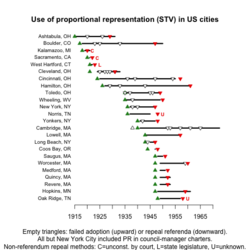
Between 1915 and 1962, 22 U.S. cities adopted STV. Ashtabula, Ohio, became the first in 1915. Other major cities, including Cincinnati and New York City, followed. In New York City, STV was introduced in 1937 to replace gerrymandered districts, using a quota system based on the population of each borough.
![Comic depicting the single-member-district plan (amendment 17) in LA as the "perch" of the gas, alcohol, and railway industries[37]](/images/38/83/3883895c063b2fbe103b449d5fac628d459ed33f8b47ec1b3744c376b7674232.jpg)
Implementing these systems was a manual challenge. Before the advent of computers and spreadsheet software, vote tallies were recorded on blackboards, and second-choice preferences in STV were tabulated by hand.
![During the 1925 Cincinnati City Council election, vote tallies were tabulated on a large blackboard. Spreadsheet software had not yet been invented and computers were not involved in election tabulations.[47]](/images/31/df/31dff19c43cd8cbdf0922b0a2f2b8ee811d716549132646d20926dbe1657e047.jpg)
![Before ranked-choice voting software, second choice tabulation had to be done by hand. This newspaper illustration depicts STV tabulation in Cincinnati Music Hall for the 1925 City Council election.[47]](/images/e7/ba/e7baa0fd7c888ce96feeec8128573c33658fd6a273c9b1a81f8263db2df1a887.jpg)
The results in New York City demonstrated the system's ability to distribute representation across boroughs more accurately than previous methods.
![Results of the 1939 New York City council election by borough using STV.[55]](/images/40/f8/40f85342cb53bf260da375c887627cf4b82cdcd5aecd254c413ef1ddca32125c.png)
The Decline of PR in the Mid-20th Century
The popularity of PR began to wane between the 1940s and 1960s. As racial and political minorities began winning seats under PR, a backlash ensued. Fear of Black political power and the influence of the Second Red Scare led to successful referendums to repeal these systems.
Additionally, STV faced technical criticism regarding "vote leakage," where voters ranked disparate parties too closely. While many cities reverted to plurality voting, Cambridge, Massachusetts, has remained a notable exception, using PR since 1941.
Attempts to Reform the Electoral College
Efforts to bring proportional representation to the presidential level have faced steep constitutional hurdles. Since states have plenary power in appointing electors, most changes require state-level action or constitutional amendments.
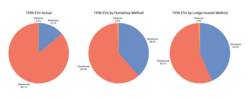
- The Lodge-Gosset Amendment (1950): This proposed that states allocate electoral votes proportionally, requiring a candidate to win 40% of total electoral votes to be elected.
- The Humphrey Proposal (1956): Senator Hubert Humphrey suggested giving two electoral votes to the state winner and allocating the rest based on the nationwide popular vote.
- Colorado Initiative (2004): Voters rejected a proposal to allocate Colorado's electoral votes proportionally, with opponents arguing it would destroy the state's status as a "swing state."
Analysis suggests that such changes could have drastically altered historical outcomes. For example, the Lodge-Gosset method would have given Adlai Stevenson a closer match to his 42% popular vote share in 1956.
Key Facts
- First US City with PR: Ashtabula, Ohio (1915).
- Jefferson's Contribution: Invented the D'Hondt method in 1792 for House apportionment.
- STV Usage: 22 cities used the Single Transferable Vote between 1915 and 1962.
- Longest Continuous Use: Cambridge, Massachusetts, has used PR since 1941.
- Primary Driver of Decline: Political backlash against minority representation and the Second Red Scare.
| System | Mechanism | Historical Context |
|---|---|---|
| D'Hondt Method | Mathematical formula for seat remainders | Invented by Thomas Jefferson (1792) |
| Cumulative Voting | Voters can cast multiple votes for one candidate | Advocated by Sen. Charles Buckalew (1867) |
| STV (Single Transferable Vote) | Ranked-choice voting with quota transfers | Used in 22 cities (1915-1962) |
| Party-List PR | Seats allocated based on party vote percentage | Proposed by Thomas Gilpin (1844) |
Frequently Asked Questions
What is the difference between plurality and proportional representation?
Plurality (winner-take-all) gives the entire seat or district to the candidate with the most votes, regardless of whether they have a majority. Proportional representation ensures that the number of seats a party wins is proportional to the percentage of the total vote they received.
Why did many US cities repeal proportional representation?
Many cities repealed PR because it allowed racial and political minorities to win seats. This led to a backlash driven by fear of minority political power and the political climate of the Second Red Scare.
How does the Single Transferable Vote (STV) work?
STV is a ranked-choice system where voters list candidates in order of preference. If a candidate reaches a certain quota of votes, they are elected, and their surplus votes are transferred to the voters' next choices.
Did Thomas Jefferson advocate for party proportional representation?
No. While Jefferson invented the D'Hondt method, he used it for the apportionment of House seats among states, not for the proportional representation of political parties.
Would proportional allocation in the Electoral College change presidential outcomes?
Yes, potentially. For example, a study indicated that if Colorado had used proportional allocation in 2000, the presidency could have shifted to Al Gore, depending on the actions of specific electors.