Privy Council of the United Kingdom
The Privy Council is a formal advisory body to the British sovereign. While its role has evolved over centuries, it remains a central part of the UK's constitutional framework, facilitating the exercise of executive and judicial powers. Often described as a historical and constitutional accident, the Council provides the legal mechanism through which the Monarch officially conducts state business.
Currently, the Council operates under the leadership of King Charles III, acting as the King-in-Council, supported by the Lord President, Alan Campbell, and the Clerk, Richard Tilbrook.
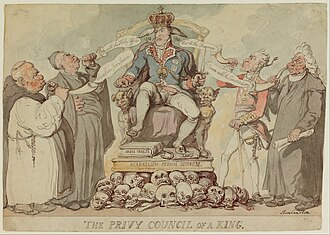
Key Facts
- Formation: Established in its current form on 1 January 1801.
- Legal Status: An advisory body to the Monarch.
- Current Monarch: Charles III.
- Key Officers: Lord President Alan Campbell and Clerk Richard Tilbrook.
- Predecessors: Separate councils for England, Scotland, and Great Britain.
Evolution and History
The origins of the Privy Council are rooted in the early monarchy. In 1659, the Protector's Council was abolished shortly before the restoration of the monarchy. King Charles II subsequently restored the Royal Privy Council, though he and other Stuart monarchs typically relied on a smaller, more intimate circle of advisers.
The structure of the Council shifted significantly with the Acts of Union. In 1707, the Privy Councils of England and Scotland were combined to form the Privy Council of Great Britain, with the Scottish body ending in 1708.
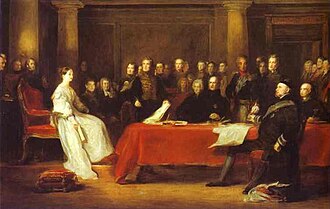
The modern iteration was created on 1 January 1801 upon the formation of the United Kingdom, uniting Great Britain and Ireland. However, the Privy Council of Ireland continued to operate until 1922, when it became defunct following the creation of the Irish Free State. A separate Privy Council of Northern Ireland was established in 1922 but became dormant in 1972 after the closure of the Parliament of Northern Ireland.
Organizational Structure and Committees
The Privy Council operates through various specialized committees to manage its diverse responsibilities. These committees handle everything from academic grants to judicial appeals.
Permanent Committees
- Judicial Committee: The primary legal arm of the Council.
- Executive Committee: Manages core administrative functions.
- Baronetage Committee: Oversees matters related to baronetcies.
- Committee for the Affairs of Jersey and Guernsey: Manages relations with the Channel Islands.
- Universities Committee and Scottish Universities Committee: Handle academic titles and degree-awarding powers.
- Board of Trade: Manages commercial and trade-related advisory matters.
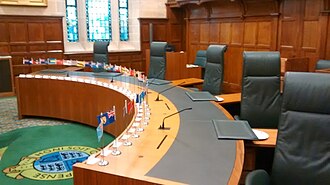
Special and Former Committees
The Council also convenes temporary committees for specific inquiries. Notable examples include the Butler Committee, which examined intelligence services prior to the Iraq intervention, and the Chilcot Committee, which dealt with intercept materials for the Chilcot Inquiry. Historically, the Council included the Court of Star Chamber, which is now defunct.
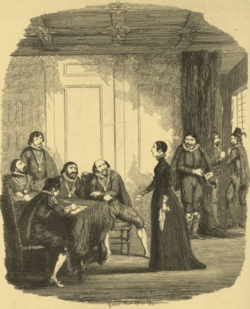
Membership and Privileges
Membership in the Privy Council is a mark of high status and trust. Members are appointed by the Monarch and are required to take a formal oath of secrecy and loyalty. While membership is generally for life, individuals may resign voluntarily. In the 20th century, notable resignations included John Profumo (1963), John Stonehouse (1976), and Jonathan Aitken (1997).
Members are entitled to the prefix "The Right Honourable" (Rt Hon), though peers who are privy counsellors typically use the letters "PC" after their name in social addresses.
Summary of the Privy Council
| Feature | Details |
|---|---|
| Established | 1 January 1801 |
| Primary Role | Advisory body to the Monarch |
| Current Head | King Charles III |
| Lord President | Alan Campbell |
| Key Committees | Judicial, Executive, Baronetage, Universities |
| Preceding Bodies | Privy Councils of England, Scotland, and Great Britain |
Frequently Asked Questions
What is the primary purpose of the Privy Council?
The Privy Council serves as the formal advisory body to the British Monarch, providing the legal mechanism for the sovereign to exercise executive and judicial functions.
Who is the current Lord President of the Privy Council?
The current Lord President is Alan Campbell.
How does the Privy Council differ from the Cabinet?
While the Cabinet is the political executive of the government, the Privy Council is a formal constitutional body. The Council's functions are often more ceremonial or legal, such as issuing Royal Charters or handling judicial appeals.
Can a member be removed from the Privy Council?
While members can be struck off (as happened to Sir Edgar Speyer in 1921), it is more common for disgraced members to resign voluntarily to avoid expulsion.
What happened to the Privy Council of Ireland?
The Privy Council of Ireland became defunct in 1922 with the creation of the Irish Free State, though it was succeeded by the Privy Council of Northern Ireland, which itself became dormant in 1972.