Prisons and the Evolution of Incarceration
A prison—also referred to as a jail, penitentiary, or correctional facility—is a state-authorized institution designed to confine individuals. While primarily used as punishment for crimes, these facilities also serve as remand centers for those awaiting trial (pre-trial detention). In the broader criminal justice system, prisons function to isolate those who have pleaded guilty or been convicted, ensuring they serve their court-mandated sentences.
Beyond criminal justice, prisons have historically been used by authoritarian regimes for political repression, detaining opponents often without due process. Additionally, military prisons and prisoner-of-war camps are utilized during armed conflicts to hold belligerents, while internment camps may be used to imprison civilian populations.
Key Facts
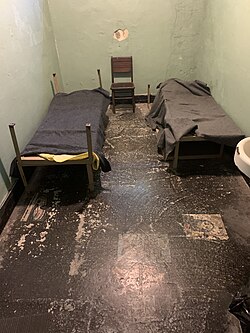
- Primary Functions: Holding pre-trial detainees and confining convicted criminals.
- Security Levels: Range from minimum security to "supermax" (maximum security) units.
- Historical Shifts: Transitioned from corporal punishment and galley slavery to structured architectural surveillance.
- Modern Challenges: Issues include overcrowding, recidivism, and the impact of the "war on drugs" on incarceration rates.
- Alternatives: Common alternatives to prison include fines, community service, and capital punishment.
The History of Incarceration
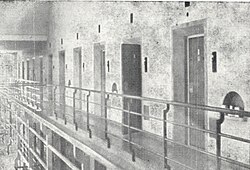
Ancient and Medieval Roots
In early history, confinement was less common than direct physical punishment. In Early Modern Europe, for example, a frequent penalty was being forced into service as a galley slave.
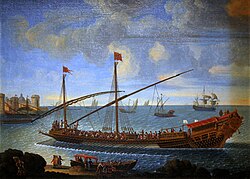
The Modern Era and Adaptation
As society transitioned into the modern era, existing fortified structures were often repurposed. Abbeys and fortresses were converted into prisons to provide secure confinement.
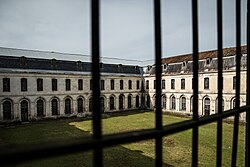
Transportation and Penal Colonies
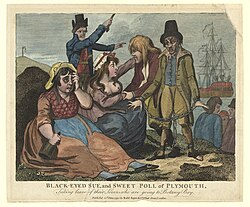
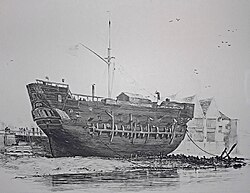
Some nations utilized transportation, sending convicts to distant penal colonies. This often involved long voyages on convict ships, some of which were later used as "hulks" (stationary prison ships) to house inmates.
Development of the Modern Prison
The Prison Reform Movement
The shift toward the modern penitentiary was driven by a desire for social control and rehabilitation. This led to the development of specific architectural philosophies designed to monitor behavior and enforce discipline.
Architectural Models of Control
Jeremy Bentham introduced the panopticon, a circular design where a single guard in a central tower could observe all prisoners in individual cells without the prisoners knowing if they were being watched. This created a state of permanent visibility.
![Jeremy Bentham's "panopticon" prison introduced many of the principles of surveillance and social control that underpin the design of the modern prison. In the panopticon model, prisoners were housed in one-person cells arranged in a circular pattern, all facing towards a central observation tower in such a way that the guards could see into all of the cells from the observation tower, while the prisoners were unable to see the guards.[36][37][f] (architectural drawing by Willey Reveley, 1791)](/images/a9/bd/a9bd8e85d6d4cc34dccb6e7126423526ca62b898df5801c3b8256bc349a8a11e.jpg)
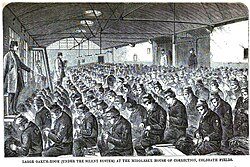
Conversely, the "Auburn System" (or Congregate System) utilized rectangular buildings. This design allowed prisoners to be housed in cells but work together in large groups, facilitating large-scale penal labor.
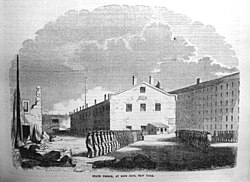
Historically, labor within these walls often involved tedious tasks, such as picking oakum (unravelling old rope).
Prison Design and Security
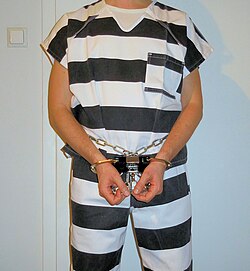
Security Classifications
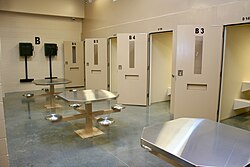
Modern prisons are categorized by their security levels to manage different risk profiles:
- Minimum Security: Facilities with fewer restrictions, often focusing on low-risk offenders.
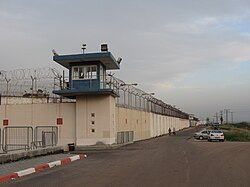
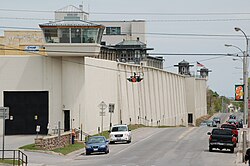
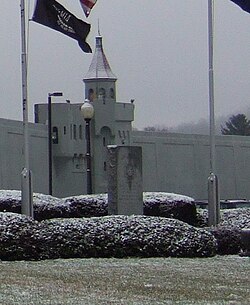
- Maximum Security: High-walled facilities with razor wire, motion sensors, and guard towers to prevent escape.
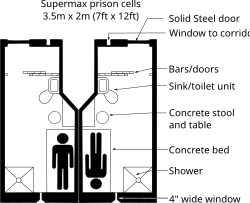
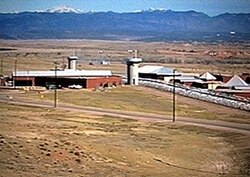
- Supermax: The highest level of security, such as ADX Florence in the U.S., which utilizes extreme isolation and solitary confinement.
Common Facilities and Inmate Life
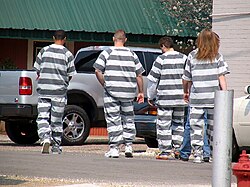
To maintain order and provide basic needs, prisons include kitchens, dining halls, and healthcare units. Many facilities now prioritize literacy programs and educational facilities to reduce recidivism (the tendency of a convicted criminal to reoffend).

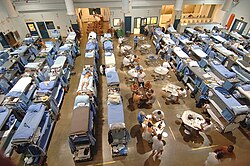
However, overcrowding remains a critical issue. In some regions, such as California, the U.S. Supreme Court has intervened to mandate population reductions due to inhumane living conditions.
Specialized Facilities
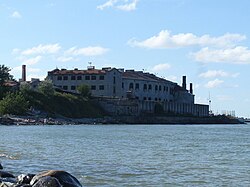
Youth and Women's Prisons
Dedicated facilities exist for juveniles and women. For example, the Mercer Reformatory in Canada was the first dedicated prison for women, though it later closed following abuse scandals.
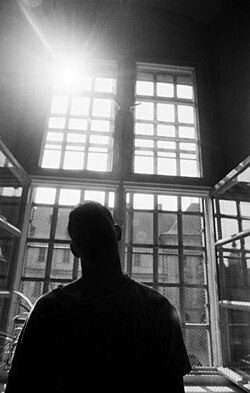
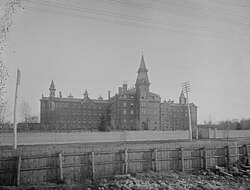
Death Row and Military Detention
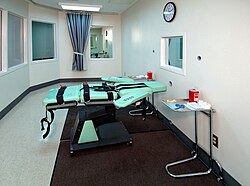
In jurisdictions that practice capital punishment, prisons include a "death row" for those awaiting execution and specialized execution chambers.
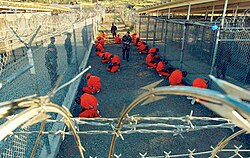
Military prisons, such as Camp X-Ray at Guantanamo Bay, may employ sensory deprivation techniques, including goggles and headphones, to prevent communication among detainees.
Prison Population and Economics
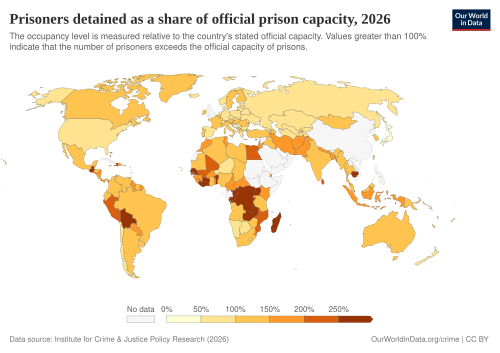
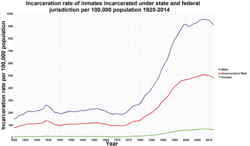
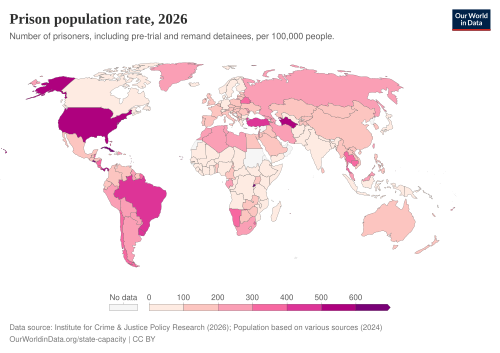
Incarceration rates vary wildly by country and policy. In the United States, there has been a rapid rise in imprisonment linked to the "war on drugs," with nearly half of the incarcerated population sentenced for drug-related offenses.
The economics of prisons involve both internal costs (staffing, food, healthcare) and external factors, including the rise of for-profit prisons.
| Security Level | Primary Goal | Key Features |
|---|---|---|
| Minimum | Reintegration | Low fencing, more freedom of movement |
| Maximum | Containment | High walls, razor wire, guard towers |
| Supermax | Total Control | Solitary confinement, extreme isolation |
Frequently Asked Questions
What is the difference between a jail and a prison?
While often used interchangeably, jails typically hold people awaiting trial or those serving short sentences, whereas prisons are designed for long-term confinement of convicted felons.
What is a panopticon?
A panopticon is an architectural design where prisoners are arranged in a circle around a central observation tower, allowing guards to see every cell while remaining invisible to the inmates.
What is recidivism?
Recidivism refers to the rate at which released prisoners relapse into criminal behavior and are subsequently re-incarcerated.
What are the alternatives to prison sentences?
Depending on the crime and jurisdiction, alternatives include monetary fines, community service, judicial corporal punishment, or capital punishment.
Why are some prisons called "supermax"?
Supermax (super-maximum security) prisons are designed for the most dangerous inmates or those who cannot be managed in maximum security, utilizing near-total isolation to maintain control.