President of Mexico: Powers, History, and the Executive Office
The President of the United Mexican States serves as the head of state, head of government, and commander-in-chief of the Mexican armed forces. Established by the federal Constitution of 1824, the office has evolved from its early foundations to its current form under the Revolutionary Constitution of 1917. Today, the presidency represents the pinnacle of the executive branch of the Mexican government, operating from the historic heart of Mexico City.
As of October 1, 2024, the office is held by Claudia Sheinbaum, who assumed power following a national popular vote. The presidency is defined by a strict adherence to the principle of non-re-election, a legacy of the Mexican Revolution intended to prevent the rise of long-term dictatorships.
Key Facts
- Current Incumbent: Claudia Sheinbaum (since October 1, 2024).
- Term Length: A single six-year term, known as a sexenio, which is non-renewable.
- Residence: The National Palace in Mexico City.
- Selection Method: Popular vote.
- Constitutional Basis: Constitution of Mexico (1917).
- Monthly Salary: MX$ 208,570.92.
The Nature of the Presidency
The Mexican presidency is a presidential system of government. One of its most distinctive features is the absolute ban on re-election; no individual who has held the post, even in a caretaker capacity, may ever run for or serve as president again. This ensures a mandatory rotation of power every six years.
Requirements and Academic Backgrounds
The Constitution of Mexico does not mandate specific academic qualifications for the presidency. Historically, presidents were typically drawn from the military or legal professions. While Manuel Ávila Camacho (1940–1946) was the last career military officer to hold the office, many subsequent leaders were lawyers. In recent decades, the academic diversity of the office has expanded: Vicente Fox studied business administration, Andrés Manuel López Obrador studied political sciences, and current president Claudia Sheinbaum is a physicist.
Electoral History and Political Evolution
The length of the presidential term has fluctuated over time. It was four years from 1821 to 1904, extended to six years by Porfirio Díaz, and later reverted to four years between 1917 and 1928 before the six-year term became the standard.
For much of the 20th century, Mexico was characterized as a virtual one-party state under the Institutional Revolutionary Party (PRI), which emerged from the unification of revolutionary leaders in 1929. During this era, the president exercised nearly absolute control, often personally nominating their successor—a system some critics termed the "imperial presidency." This shifted in 2000 when Vicente Fox became the first opposition candidate to win the presidency since 1911.
Recent Election Trends
Recent elections have seen varying levels of popular support. While Carlos Salinas won a majority of 50.4% in 1988, others have won via plurality. For instance, Felipe Calderón won the 2006 election with 36.38% of the vote, finishing just 0.56% ahead of his nearest rival.
Powers and Responsibilities
The president's authority is derived from the 1917 Constitution. While the "imperial" nature of the office has diminished since the 1990s due to a more pluralistic Congress, the president still holds significant powers:
- Promulgating and executing laws enacted by Congress.
- Appointing colonels, generals, and flag officers of the Army, Navy, and Air Force (with Senate approval).
- Declaring war on behalf of the United Mexican States, subject to the consent of the Congress of the Union.
- Granting pardons to criminals convicted in federal courts.
- Establishing maritime and border customs and enabling ports.
Since 1997, the president has often faced a divided Congress, meaning major tax or energy reforms typically require negotiation with opposition parties, limiting the president's ability to act unilaterally.
Symbols and Ceremonies
The presidential sash is the primary symbol of the Executive Federal Power. It features the colors of the Mexican flag—green, white, and red—with the National Seal embroidered in gold thread. During the transition of power, the outgoing president delivers the sash to the president of the Chamber of Deputies, who then presents it to the new president after the oath of office is administered.
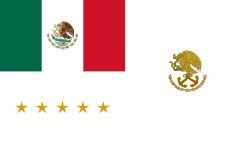
The official transition occurs at 00:00 (UTC-06:00) on October 1st, at which point the new president assumes all powers of the office, regardless of the exact timing of the swearing-in ceremony.
The Presidential Residence
The official workplace and residence is the National Palace in Mexico City's Zócalo. This site has been a center of power since the Aztec Empire and incorporates materials from the palace of Emperor Moctezuma II.
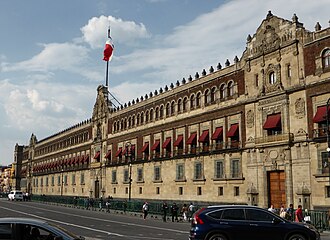
The residence has shifted over the centuries. From 1884 to 1934, presidents lived in Chapultepec Castle. From 1935 to 2018, the official residence was the Los Pinos complex, featuring the Casa Lázaro Cárdenas and the larger Casa Miguel Alemán. In 2019, President Andrés Manuel López Obrador returned the official residence to the National Palace, occupying a 300-square-meter apartment in the south wing.
| Residence | Period of Use | Notable Detail |
|---|---|---|
| National Palace | 1824–1884; 2019–Present | Located in the Zócalo; incorporates Aztec materials. |
| Chapultepec Castle | 1884–1934 | Former imperial residence of Emperor Maximilian I. |
| Los Pinos | 1935–2018 | Complex including Casa Lázaro Cárdenas and Casa Miguel Alemán. |
Post-Presidency
Former presidents retain the title of "president" for life, though they are commonly referred to as ex-presidents. While they previously received lifetime pensions and protection from the Estado Mayor Presidencial, the pension system was abolished in 2018.
Frequently Asked Questions
How long is a Mexican presidential term?
A Mexican president serves a single six-year term, known as a sexenio.
Can a Mexican president be re-elected?
No. The Constitution of Mexico strictly prohibits re-election. No person who has held the office, even temporarily, can serve as president again.
What is the significance of the presidential sash?
The sash is the official symbol of the Executive Federal Power and may only be worn by the current president.
Who succeeds the president in case of a vacancy?
If a vacancy occurs, the Secretary of Interior serves as a deputy on a temporary basis for 60 days, after which Congress appoints a presidential substitute.
Where does the President of Mexico live and work?
The current official residence and workplace is the National Palace, located in Mexico City.