Felipe Calderón: The Presidency and Political Legacy of Mexico's 63rd President
Felipe Calderón Hinojosa served as the 63rd President of Mexico from December 1, 2006, to November 30, 2012. A prominent figure in the National Action Party (PAN), Calderón's tenure was marked by significant domestic security challenges, extensive international diplomacy, and a series of economic and social reforms aimed at modernizing the Mexican state.
Before ascending to the presidency, Calderón built a robust political foundation through various legislative and executive roles. His academic background is equally diverse, holding a law degree (LLB) from the Free School of Law, a Master of Arts (MA) from the Mexico Autonomous Institute of Technology, and a Master of Public Administration (MPA) from Harvard University.
Key Facts
- Full Name: Felipe de Jesús Calderón Hinojosa.
- Presidential Term: December 1, 2006 – November 30, 2012.
- Political Party: National Action Party (PAN) until 2018.
- Predecessor: Vicente Fox.
- Successor: Enrique Peña Nieto.
- Education: Law degree, MA in Technology, and MPA from Harvard.
Political Ascent and Early Career
Calderón's rise in Mexican politics was characterized by a steady progression through the PAN. He served as a member of the Chamber of Deputies for the fifth electoral region during two separate periods: from 1991 to 1994 and again from 2000 to 2003. His leadership capabilities were further recognized when he served as the President of the National Action Party from 1996 to 1999.
In the years immediately preceding his presidency, Calderón held key executive positions under President Vicente Fox. He served as the Director General of the National Works and Public Services Bank in early 2003 and subsequently as the Secretary of Energy from September 2003 to June 2004.
The Presidency (2006–2012)
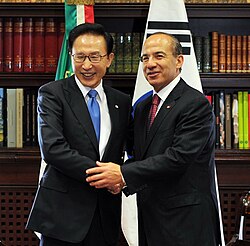
Felipe Calderón assumed office following a closely contested 2006 election. His administration focused on a wide array of domestic and international priorities, ranging from public health to global climate change.
Domestic Policy and Governance
Calderón's domestic agenda included the implementation of a public servants' salary cap and the First Employment Program. In the realm of health, his administration worked toward universal healthcare and highlighted various achievements in public health services. Economically, he navigated the challenges of the era through trade initiatives and the Tortilla Price Stabilization Pact.
Infrastructure also saw significant development during his term, most notably the construction of the Baluarte Bridge, which is recognized as the world's highest cable-stayed bridge.
Security and Controversy
A defining and controversial aspect of Calderón's presidency was his security policy. His administration faced intense challenges regarding drug violence and homicide rates. While he deployed more troops to northeastern Mexico to combat organized crime, these strategies remained a point of significant public and political debate.
International Relations and Diplomacy
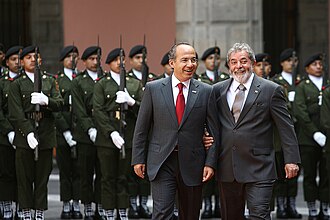
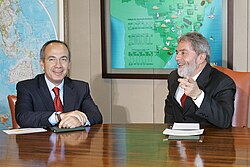
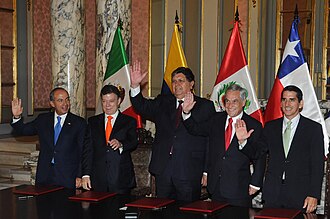
Calderón was a highly active presence on the global stage, conducting numerous official visits to strengthen ties with emerging economies and traditional allies. He coordinated meetings with leaders from India, Brazil, China, and South Africa to discuss global economic stability.
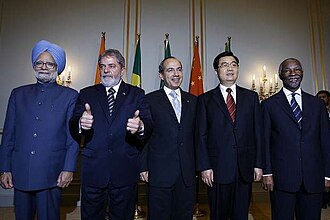
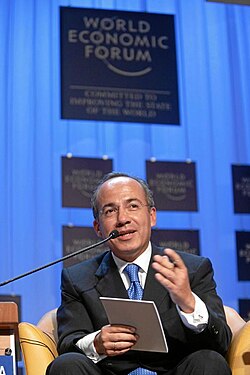
His foreign policy efforts included the promotion of the Puebla-Panama Plan and active participation in the World Economic Forum. He also focused on environmental diplomacy, contributing to climate change treaties and reducing annual deforestation in Mexico by 34%.
Presidential Administration Summary
| Category | Key Details / Figures |
|---|---|
| Political Affiliation | National Action Party (PAN) |
| Key Cabinet Members | Patricia Espinosa (Chancellor), Genaro García Luna (Public Security) |
| Major Infrastructure | Baluarte Bridge |
| Environmental Milestone | 34% reduction in annual deforestation |
| Approval Rating (2012) | 66% (per Grupo Reforma poll) |
Frequently Asked Questions
Who succeeded Felipe Calderón as President of Mexico?
Felipe Calderón was succeeded by Enrique Peña Nieto on November 30, 2012.
What was Calderón's educational background?
He holds a law degree (LLB) from the Free School of Law, a Master of Arts (MA) from the Mexico Autonomous Institute of Technology, and a Master of Public Administration (MPA) from Harvard University.
Which political party did Felipe Calderón belong to?
He was a member of the National Action Party (PAN) until his resignation from the party in 2018.
What were some of the major international awards he received?
Calderón received the WEF Global Leadership Statesmanship Award from the World Economic Forum in January 2012 and was named one of "The World's 50 Most Influential Figures 2010" by the New Statesman.
What was the significance of the Baluarte Bridge during his term?
The Baluarte Bridge, completed during his administration, is noted for being the world's highest cable-stayed bridge, representing a major infrastructure achievement for Mexico.