Power Stations: Engineering the World's Electrical Grid
A power station, also known as a power plant or generating station, is an industrial facility designed specifically for the generation of electric power. These facilities serve as the heart of the electrical grid, converting various forms of energy into electricity that can be transmitted over long distances to homes and businesses.
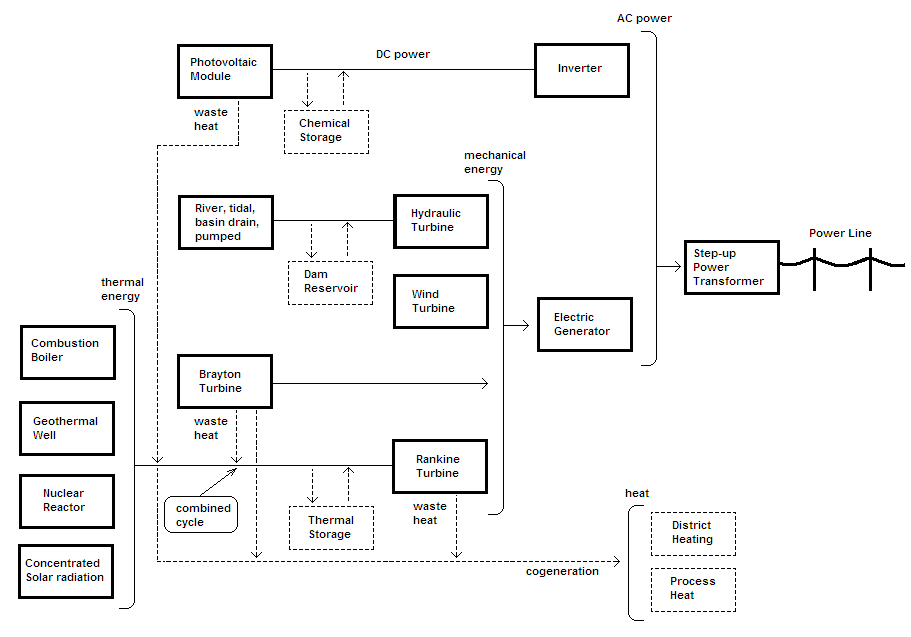
At the core of most power stations are generators—rotating machines that convert mechanical power into three-phase electric power. This process relies on the relative motion between a magnetic field and a conductor to create an electric current. While the generator remains a constant, the energy source used to drive it varies significantly, ranging from fossil fuels to sustainable natural resources.
Key Facts
- Global Energy Mix: Coal and natural gas remain dominant, but solar and wind capacities grew by 80% in 2021 alone.
- Prime Movers: Approximately 90% of the world's electricity is produced using steam turbines.
- Efficiency: Gas-fired plants are the most efficient thermal options (up to 65%), while coal and oil plants typically range between 30% and 49%.
- Scale: Power output is measured in watts, typically in megawatts (MW) or gigawatts (GW).
The Evolution of Power Generation
The journey toward modern electrification began in 1871 when Belgian inventor Zénobe Gramme developed a generator capable of commercial-scale industrial production. By 1878, William, Lord Armstrong built a hydroelectric station at Cragside, England, using Siemens dynamos to power lighting, heating, and elevators.
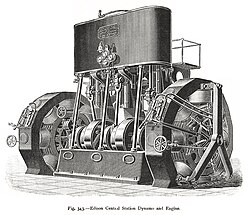
The first public coal-fired facility, the Edison Electric Light Station, opened in London in January 1882. Shortly after, Thomas Edison established the Pearl Street Station in New York. These early plants used direct-current (DC) generators, which were limited by voltage drops, restricting their service area to a radius of about one mile.
The "war of the currents" eventually saw alternating current (AC) emerge as the victor. Pioneered by George Westinghouse, AC systems used transformers to step up voltage for efficient long-distance transmission and step it down for safe indoor use. This breakthrough, combined with the introduction of the steam turbine around 1906, allowed power stations to grow to enormous sizes and move electricity from distant sources, such as waterfalls, to urban centers.
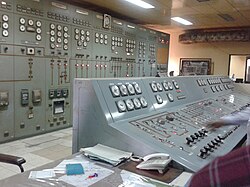
![The generator room of the Krka hydroelectric plant (1895), with one of the first polyphase AC distribution systems in the world[5]](/images/d7/9d/d79daa191a4a02553096f7f594a9470a6cbe86e5e344acfeb20a38e978d3eba5.jpg)
Thermal Power Stations
Thermal power plants generate electricity by using heat to produce steam, which then drives a turbine. These are classified by their heat source and the type of prime mover (the machine that drives the generator).
Classification by Heat Source
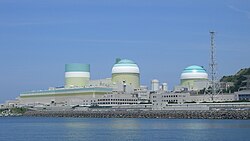
- Nuclear Power: These plants use nuclear fission in a reactor core to create heat. In the United States, nuclear power accounts for roughly 20% of electric generation.
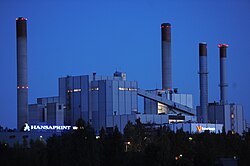
- Fossil Fuels: Coal, oil, and natural gas are burned to produce the necessary heat.
- Hydrogen: Green hydrogen produced via electrolysis can be used to balance supply and demand from variable renewable sources.
Classification by Prime Mover
- Steam Turbines: These use the dynamic pressure of expanding steam. They are the most common system for large non-hydro plants.
- Gas Turbines: These use flowing gases (air and combustion products) to operate the turbine directly. Because they can start rapidly, they are often used as "peaking" plants to meet high demand.
Waste Heat and Cooling
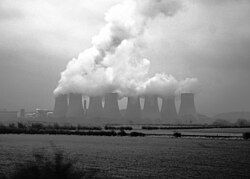
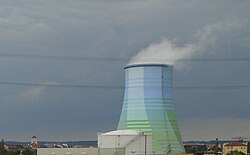
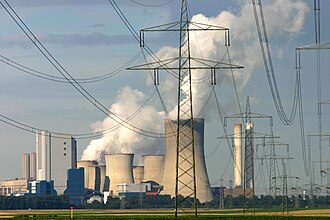
All thermal plants produce waste heat. To manage this, many facilities use natural draft wet cooling towers—large hyperboloid structures that release heat into the atmosphere through water evaporation.
Renewable Energy Power Stations
To reduce carbon emissions, many regions are shifting toward renewable energy sources that harness natural processes.
Hydroelectric Power
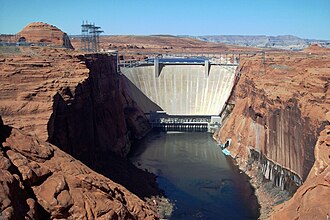
Hydroelectric stations capture the gravitational force of falling water through penstocks to spin turbines. China is currently the world's largest producer of hydroelectricity. The Three Gorges Dam stands as a massive example with a capacity of 22.5 GW.
Wind and Solar Power
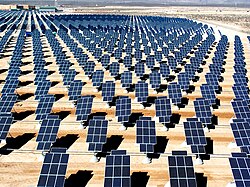
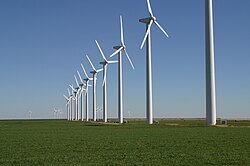
Modern wind turbines typically utilize a three-bladed, upwind design. Larger turbines (around one megawatt) are more efficient, quieter, and safer for birds than older models. Solar power is captured either through photovoltaic (PV) cells or solar thermal systems. The Bhadla Solar Park in India is one of the world's largest PV installations, rated at 2245 MW.
Alternative Renewables
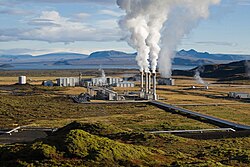
- Geothermal: Harnessing heat from the Earth's interior.
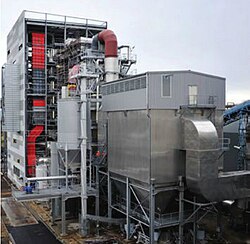
- Biomass: Using organic materials to generate power.
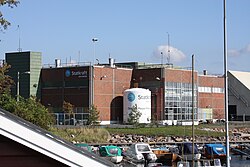
- Osmotic Power: This experimental method, known as pressure-retarded osmosis, generates energy from the salinity gradient between fresh and salt water. A prototype was tested by Statkraft in Norway, though the pilot was discontinued in 2014.
Capacity and Output Measurement
The capacity of a power station is its maximum potential output, while actual generation is the amount of electricity produced. Engineers distinguish between two types of generation:
- Gross Generation: The total electricity produced.
- Net Generation: The electricity sent to the grid after subtracting the "in-house loads" (power used to run the plant itself).
| Facility Name | Type | Capacity | Location |
|---|---|---|---|
| Three Gorges Dam | Hydroelectric | 22.5 GW | China |
| Gansu Wind Farm | Onshore Wind | 10.45 GW | China |
| Bhadla Solar Park | Photovoltaic | 2245 MW | India |
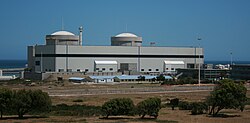
| Koeberg Station | Nuclear | 1860 MW | South Africa |
| Aswan Dam | Hydroelectric | 2.1 GW | Egypt |
| Ratcliffe-on-Soar | Coal | 2 GW | United Kingdom |
Frequently Asked Questions
What is the difference between gross and net generation?
Gross generation is the total amount of electricity a plant produces. Net generation is the amount actually delivered to the electrical grid after the plant's own internal power needs (in-house loads) are subtracted.
Why did AC power replace DC power for the electrical grid?
Alternating current (AC) allows the use of transformers to increase voltage for long-distance transmission, which significantly reduces energy loss. Direct current (DC) suffered from high voltage drops, limiting its effective range to about one mile.
What is a "peaking" power plant?
A peaking plant, often using gas turbines, is a facility that can be started quickly to provide extra electricity during periods of peak demand. While more expensive to operate than base-load plants, they provide essential grid stability.
How do cooling towers work in thermal plants?
Cooling towers remove waste heat from the power generation process. Natural draft wet cooling towers use a hyperboloid shape to create a chimney effect, releasing heat into the atmosphere through the evaporation of water.
What is osmotic power?
Osmotic power, or pressure-retarded osmosis, generates energy from the difference in salt concentration between seawater and freshwater. When these two meet across a membrane, it increases the pressure in a chamber, which can then spin a turbine.