Poverty: Global Measures, Impacts, and Strategies for Alleviation
Poverty is a complex state in which an individual lacks the financial resources and essential requirements necessary to maintain a basic standard of living. Far from being a simple lack of money, it is often the result of a convergence of environmental, legal, social, economic, and political factors. Because the experience of poverty varies so widely across different cultures and economies, experts use specific metrics to quantify and address the issue on a global scale.
In 2015, the United Nations established a comprehensive international framework to combat this crisis, summarized in Sustainable Development Goal 1: "No Poverty," which aims to end poverty in all its forms everywhere by 2030.
![Logo of the Sustainable Development Goal 1 of the United Nations, to "end poverty in all its forms, everywhere" by 2030[208]](/images/bd/b8/bdb8226b17fd77f82647124fa8f662ddd602cc07e1f6f6255f415c665fa3dd72.webp)
Key Facts
![Share in poverty relative to different poverty thresholds[13]](/images/4b/91/4b919a5744a8bfbd4b2f9e90e8f9b881b3456c0c4c8ff6f76ace4b9b8aeb26d6.png)
- Global Distribution: As of 2019, 85% of the world's population lives on less than $30 per day (PPP), and 10% live on less than $1.90 per day.
- Conflict Zones: More than 40% of the global poor reside in countries affected by conflict.
- Measurement: Poverty is measured either as absolute (basic survival needs) or relative (standard of living compared to others in the same society).
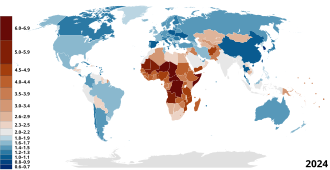
- Regional Trends: While East Asia and the Pacific have seen dramatic declines in poverty, Sub-Saharan Africa continues to face significant challenges.
- Interconnectedness: Poverty is closely linked to poor health, hunger, lack of education, and inadequate shelter.
Measuring Poverty: Absolute vs. Relative
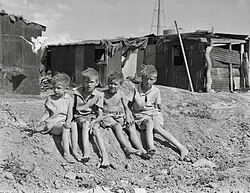
To analyze poverty statistically, economists generally use two primary lenses. The first is absolute poverty, which compares an individual's income against a fixed threshold required to meet basic personal needs, such as food, clothing, and shelter. This is often measured using Purchasing Power Parity (PPP), a metric that adjusts for the cost of living and inflation differences between countries.
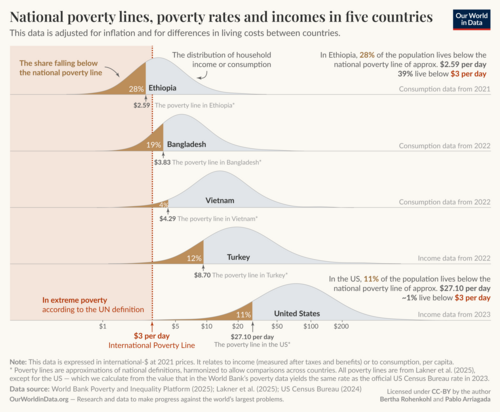
The second measure is relative poverty. This occurs when a person cannot meet the minimum living standards of the specific society in which they live. Unlike absolute poverty, the definition of relative poverty shifts depending on the country or community, as it is based on the average wealth of the surrounding population.
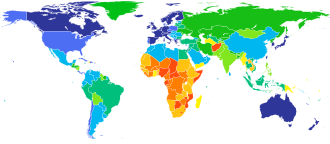
![The Gini coefficient, a measure of income inequality. Based on World Bank data ranging from 1992 to 2018.[49]](/images/6f/2e/6f2ee96eaba038f29d625db25f384265a65e3fc133e7b7dd92a7fd668b2f21e4.png)
Global Prevalence and Trends
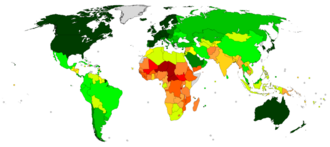
The distribution of wealth has shifted over time, but the gap remains significant. While many regions have seen a decrease in the percentage of people living under the extreme poverty line, the progress is uneven. In middle-income countries, economic growth does not always reach the poorest citizens, leaving them trapped despite national development.
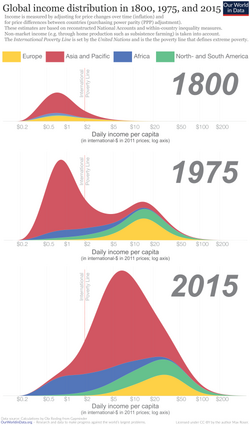
The following table illustrates the percentage of the population living on $2.15 per day across various regions from 1981 to 2019.
| Region | 1981 | 1990 | 2000 | 2010 | 2018 | 2019 |
|---|---|---|---|---|---|---|
| East Asia and Pacific | 83.5% | 65.8% | 39.5% | 13.3% | 1.6% | 1.2% |
| Europe and Central Asia | — | 9.1% | 4.1% | 2.3% | — | — |
| Latin America and Caribbean | 15.1% | 16.8% | 13.5% | 6.4% | 4.3% | — |
| Middle East and North Africa | — | 6.5% | 3.5% | 1.9% | 9.6% | — |
| South Asia | 58% | 49.8% | — | 26% | 10.1% | 8.6% |
| Sub-Saharan Africa | — | 53.8% | 56.5% | 42.2% | 35.4% | 34.9% |
| World | 43.6% | 37.9% | 29.3% | 16.3% | 9% | 8.5% |
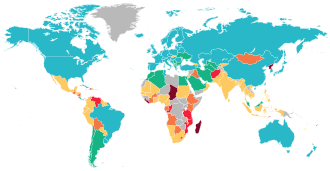
![Poverty headcount ratio at $1.90 a day (2011 PPP) (% of population). Based on World Bank data ranging from 1998 to 2018.[14]](/images/a8/19/a81908a2482f1af62b342442f1ece84565062fb9a9d9470caf4083c9d9b301a0.png)
The Characteristics and Impacts of Poverty
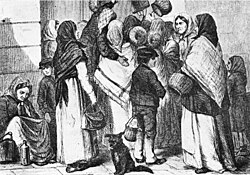
Health and Nutrition
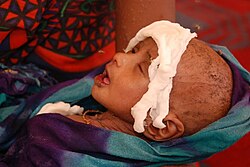
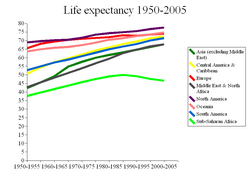
Poverty is inextricably linked to poor health outcomes. Malnourishment and hunger are prevalent in low-income regions, leading to stunted growth and increased vulnerability to disease. While global life expectancy has generally increased and converged, some regions, such as Sub-Saharan Africa, have seen declines due to epidemics like AIDS.
Living Conditions and Utilities
Lack of access to basic infrastructure is a hallmark of poverty. This includes a lack of reliable energy (electricity, heating, and cooling), inadequate sanitation, and a lack of clean drinking water. In many urban slums, the poor are forced to buy water from vendors at prices 5 to 16 times higher than the metered rate.
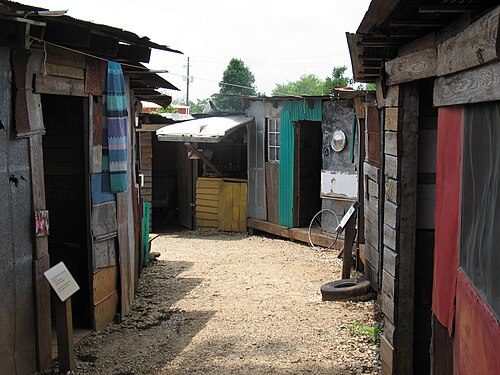
![The urban poor buy water from water vendors for, on average, about 5 to 16 times the metered price.[179]](/images/76/d8/76d8867e5fd64f3d5f2895e61ba39470647327c57a3d3e8330119bdc5c4987ae.jpg)
Education and Social Mobility
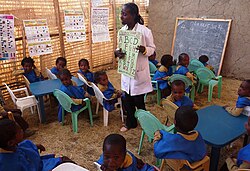
Education is both a casualty and a potential cure for poverty. Limited access to early childhood education and vocational training traps generations in low-paying work. Furthermore, social segregation often correlates with income groups; however, maintaining social connections with people of higher income levels is a strong predictor of upward mobility.
![Data shows substantial social segregation correlating with economic income groups.[334] However, social connectedness to people of higher income levels is a strong predictor of upward income mobility.[334]](/images/1f/7a/1f7a8b243f91525e9f816ec5fa15f4f3b037bfc8bbd1908bc9cfc7c2b2aba04a.webp)
Strategies for Poverty Reduction
Efforts to alleviate poverty generally fall into several strategic categories:
- Increasing Supply of Basic Needs: Improving technology and state funding to provide essential services.
- Improving Access: Implementing policies like rural electrification or "housing first" initiatives in cities.
- Increasing Personal Income: Providing income grants, expanding economic freedoms, and offering vocational training.
- Preventing Overpopulation: Implementing family planning to ensure resources are not overstretched.
Overcoming Implementation Obstacles
A common failure in poverty alleviation is the gap between "planners" and "searchers." Planners often apply global blueprints and believe outsiders have the best solutions. In contrast, "searchers" focus on local conditions, identifying actual demand and believing that sustainable solutions must be homegrown.
Frequently Asked Questions
![National homicide rates are larger in countries with lower median income.[116]](/images/23/7c/237cf74a3e83e2478b21578589d56ab6fd59caf0c6fb2f1268374dce4bbde46d.webp)

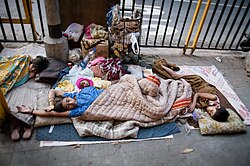
![Street child in Bangladesh. Aiding relatives financially unable to but willing to take in orphans is found to be more effective by cost and welfare than orphanages.[163]](/images/57/2a/572ae5a6353ecdb6e1e509a7029e689cdb35f127d9cb93c0ca8246a0ce0976db.jpg)

What is the difference between absolute and relative poverty?
Absolute poverty is defined by a lack of basic necessities (food, water, shelter) regardless of where a person lives. Relative poverty is defined by the inability to afford the average standard of living within one's own specific society.
How does the World Bank measure extreme poverty?
The World Bank uses a poverty headcount ratio, often based on a daily income threshold (such as $1.90 or $2.15) adjusted for Purchasing Power Parity (PPP) to account for different costs of living across countries.
Why does economic growth not always reduce poverty?
In many middle-income countries, the wealth generated by economic development is not distributed equitably. The poorest citizens may not receive an adequate share of the increased wealth to lift themselves above the poverty line.
What role does conflict play in global poverty?
Conflict is a major driver of poverty; according to 2020 data, more than 40% of the world's poor live in conflict-affected countries, where infrastructure is destroyed and economic stability is nonexistent.
How does social connectedness affect income mobility?
While economic income groups are often socially segregated, having social ties to individuals in higher income brackets is considered a strong predictor of an individual's ability to move upward economically.