Portrait of a Princess: Pisanello's Late-Gothic Masterpiece
In the halls of the Musée du Louvre hangs one of the most delicate and enigmatic works of the Italian Late-Gothic period: the Portrait of a Princess. Attributed to the master artist Pisanello, this tempera on panel painting captures a moment of ethereal beauty, blending precise naturalism with the symbolic depth characteristic of the 15th century.
Executed approximately between 1435 and 1445, the portrait presents a young woman in sharp profile, set against a lush, decorative background. While the artist's hand is certain, the identity of the woman behind the gaze remains one of art history's enduring mysteries.
Key Facts
- Artist: Pisanello (Italian Late-Gothic master)
- Date: Circa 1435–1445
- Medium: Tempera on panel
- Dimensions: 43 cm × 30 cm
- Current Location: Musée du Louvre, Paris
- Primary Subject: An unidentified young woman, possibly from the House of Este or Gonzaga
Artistic Style and Symbolism
Pisanello was renowned for his ability to combine the stylized elegance of the Gothic tradition with the emerging observational accuracy of the Renaissance. In this work, the subject's profile is sharply defined against a verdant backdrop of greenery, pinks, and columbine flowers. Her hair is styled to accentuate a high, round forehead—a specific aesthetic ideal in Renaissance Italy, often achieved by plucking the hairline to emphasize facial symmetry and nobility.
The painting is rich with symbolism. Near the princess's brow, a butterfly (specifically the Vanessa atalanta species) serves as a metaphor for the human soul. These naturalistic details were not merely decorative; they provided layers of spiritual and social meaning to the viewer.
The Mystery of the Sitter
Identifying the woman in the portrait is a complex puzzle for historians. The most significant clue lies in the embroidery on her sleeve, which depicts a two-handled vase—the heraldic emblem of the House of Este. This connection suggests the sitter may be a member of this powerful Italian family.
Several hypotheses have been proposed regarding her identity:
- Margherita Gonzaga: The wife of Leonello d'Este, who married him in 1433.
- Ginevra d'Este: Suggested by the presence of a juniper sprig on her sleeve, though some scholars argue this may simply symbolize happiness rather than a pun on her name.
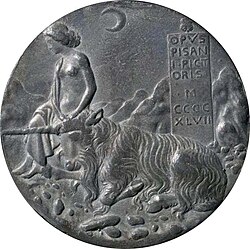
- A Gonzaga Princess: Some suggest the sitter could be Beatrice, Margherita, or the learned Cecilia Gonzaga, whom Pisanello also depicted on a commemorative medal.
Historical Provenance
The painting's journey to the Louvre began in 1860, when it surfaced during a sale and was purchased by the German Consul Felix Bamberg. It eventually made its way to the museum in 1893, when the Louvre acquired it from Charles Picard for 30,000 francs.
| Attribute | Details |
|---|---|
| Artist Attribution | Pisanello |
| Estimated Period | c. 1435–1445 |
| Material | Tempera on panel |
| Size | 43 cm × 30 cm |
| Location | Musée du Louvre, Paris |
Frequently Asked Questions
Why is the sitter's identity considered a mystery?
While the embroidery on her sleeve strongly links her to the House of Este, there are no definitive written records or contemporary labels that confirm exactly which princess is being depicted, leaving historians to rely on stylistic and heraldic clues.
What does the butterfly represent in the painting?
In the context of the era's symbolism, the butterfly (Vanessa atalanta) positioned near her brow is widely interpreted as a symbol of the soul.
What was the significance of the high forehead in Renaissance portraits?
A high, rounded forehead was considered a hallmark of beauty and intelligence in Renaissance Italy. To achieve this look, women often plucked their hairlines and eyebrows to create a more expansive facial appearance.
How do we know Pisanello painted this work?
The attribution is based on strong stylistic evidence and historical context. Pisanello was active in Ferrara during this period, where he produced other works for the House of Este, including a portrait and a medal for Marquis Leonello d'Este.
What is tempera on panel?
Tempera is a painting medium where pigments are mixed with a water-soluble binder, traditionally egg yolk. When applied to a wooden panel, it allows for fine detail and a matte, luminous finish.