International Gothic Art: The Elegant Bridge Between Medieval and Renaissance Eras
Spanning from approximately 1370 through the first half of the 15th century, International Gothic (also known as Late Gothic) represents a sophisticated era of figurative art. Unlike earlier Gothic movements that radiated from a single center like the Île-de-France, this style emerged from a vibrant, pan-European dialogue. It was fueled by the constant exchange of ideas and artists between various royal and papal courts, most notably the Avignon court, which served as a central hub for continental talent.
In Italy, this period was characterized by a fascinating tension. While the style rejuvenated the Gothic traditions established by Giotto, it also encountered the rising tide of the Renaissance. As artists traveled across the politically fragmented Italian peninsula, they created diverse regional variations, blending courtly elegance with local sensibilities.
Key Facts
![Master Wenceslas [it] (attr.), July, Cycle of Months, Trent (c. 1430).](/images/4b/73/4b73bbb0206929b147b7281d887fba3423ca1ead34468bd497bc2dab8c0292a4.jpg)
- Timeline: Roughly 1370 to the mid-15th century.
- Core Nature: A courtly, international style driven by exchange between European courts.
- Key Figures: Pisanello, Gentile da Fabriano, and Michelino da Besozzo.
- Regional Hubs: Lombardy, Venice, Verona, Florence, and Siena.
- Stylistic Traits: Linear elegance, naturalistic detail, and decorative preciousness.
Regional Variations and Artistic Centers
Lombardy: Courtly Elegance and the Grotesque
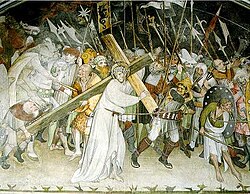
Under the rule of Gian Galeazzo Visconti, Lombardy became a major center for artistic innovation. The Visconti atelier of miniaturists (artists specializing in small-scale, highly detailed illustrations) developed a refined fusion of Giottesque color and chivalric themes. Artists like Giovannino de' Grassi emphasized linear elegance and naturalistic accuracy.
The next generation, led by Michelino da Besozzo, introduced a more imaginative approach. His work featured flowing lines, soft colors, and a rhythmic quality that prioritized decorative beauty over strict spatial accuracy. Conversely, a "grotesque" strand emerged through artists like Belbello da Pavia, who utilized deforming lines, imposing figures, and iridescent colors to create high-impact, expressive works.


Venice and Verona: Architectural Grandeur and Sinuous Lines
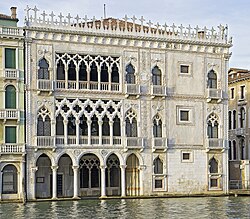
Venice developed a unique architectural identity during this period. The city's style was characterized by elegant poliforas (multi-light windows) and ornate arches, seen in structures like the Ca' d'Oro. These buildings often featured ground-floor porticos for maritime access and upper floors illuminated by intricate, lace-like window patterns.
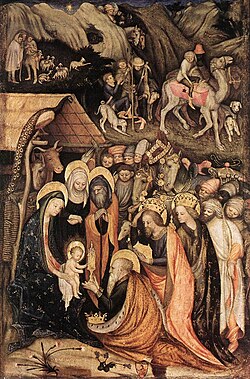
Florence: The Intersection of Tradition and Innovation
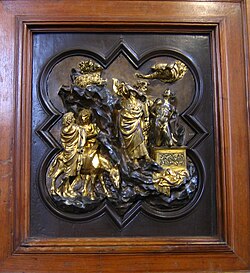
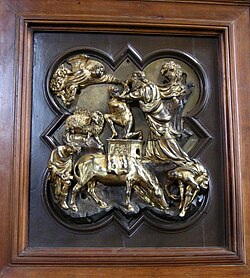
In Florence, International Gothic existed in a state of early competition with the nascent Renaissance. While the city's elite often favored the prestige of the International Style, there was a strong underlying commitment to classical roots and the traditions of Giotto. This tension is most famously captured in the 1401 competition for the Florence Baptistery doors.
The competition between Lorenzo Ghiberti and Filippo Brunelleschi showcased two different paths: Ghiberti’s winning design embraced a more rhythmic, decorative approach, while Brunelleschi’s panel introduced a revolutionary, expressive use of perspective and pyramidal composition that pointed toward the future of the Renaissance.
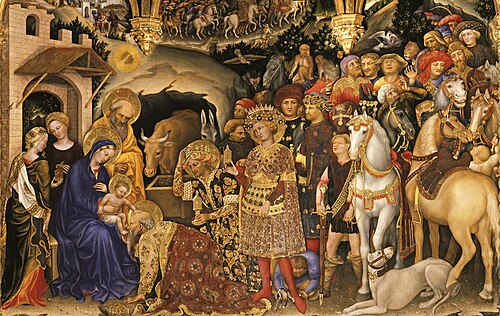
Painting in Florence also saw significant shifts. Artists like Lorenzo Monaco utilized elongated figures and bright, refined hues, while Gentile da Fabriano brought a sense of opulent detail to the city, exemplified by his masterpiece, the Adoration of the Magi.
Siena and the South
Sienese art, led by figures like Sassetta, was known for its clear light and measured compositions. Over time, the distinction between the Sienese Gothic and the emerging Renaissance became increasingly blurred as artists like Giovanni di Paolo integrated new techniques like perspective into their traditional frameworks.
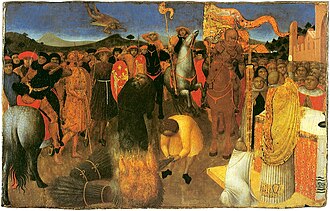
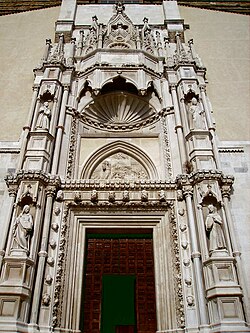
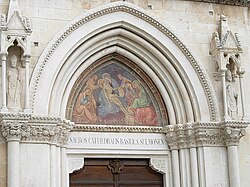
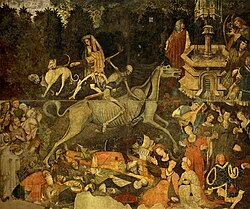
In the southern regions, including Naples and Sicily, the style was heavily influenced by Aragonese patronage. In Sicily, a rapid artistic flowering occurred due to intense cultural exchanges with Catalonia, Valencia, and the Netherlands.

Summary of Regional Styles
| Region | Primary Characteristics | Notable Artists/Examples |
|---|---|---|
| Lombardy | Courtly themes, miniaturist refinement, and grotesque styles. | Michelino da Besozzo, Belbello da Pavia |
| Venice | Ornate poliforas and maritime-influenced architecture. | Ca' d'Oro, Doge's Palace |
| Florence | Tension between decorative Gothic and classical Renaissance. | Ghiberti, Brunelleschi, Gentile da Fabriano |
| Siena | Elongated silhouettes and clear, sharp light. | Sassetta, Giovanni di Paolo |
Frequently Asked Questions

What makes the International Gothic style "international"?
It is called "international" because it was not the product of a single geographic center. Instead, it was a shared aesthetic language created through the constant movement of artists and the exchange of ideas between various European royal and papal courts.
How did the Renaissance affect International Gothic art?
The Renaissance acted as a competing force. In some cities, like Florence, the two styles existed in tension, with artists choosing between the decorative elegance of the Gothic tradition and the new, mathematically driven classicism of the Renaissance.
Who were the most influential artists of this period?
Key figures included Pisanello, known for his versatility; Gentile da Fabriano, famous for his opulent detail; and Michelino da Besozzo, a master of the graceful Lombard style.
What is the difference between the Lombard and Grotesque styles?
The Lombard style, exemplified by Michelino da Besozzo, focused on grace, soft colors, and flowing lines. The grotesque style, seen in the works of Belbello da Pavia, utilized more aggressive, deforming lines and intense, iridescent colors.
Why was the 1401 Baptistery competition important?
The competition between Ghiberti and Brunelleschi is a landmark moment because it highlighted the diverging paths of art: Ghiberti's successful, rhythmic Gothic approach versus Brunelleschi's innovative, expressive, and classically-inspired style.