Pisanello: The Master of International Gothic and Renaissance Medals
Antonio di Puccio Pisano, known to history as Pisanello, was a towering figure of the early Italian Renaissance and the Quattrocento (the 15th century in Italian art). A virtuoso of both the brush and the casting mold, Pisanello bridged the gap between the ornate, courtly elegance of the International Gothic style and the emerging humanism of the Renaissance. His work was so highly regarded by the humanists of his era that he was compared to legendary artists such as Phidias and Praxiteles.
While many of his grand frescoes have been lost to time, Pisanello's legacy survives through his exquisite drawings and his revolutionary contribution to medallic art. He was not merely a painter but a chronicler of the nobility, serving the most powerful courts of Italy, including those of the Doge of Venice, the Pope, and the influential Gonzaga and Este families.
Key Facts
- Full Name: Antonio di Puccio Pisano (also known as Antonio di Puccio da Cereto).
- Active Period: Approximately 1380/1395 – 1450/1455.
- Primary Styles: International Gothic and early Italian Renaissance.
- Major Innovation: Credited with originating the commemorative portrait medal.
- Key Patronage: Worked for the courts of Mantua, Ferrara, Venice, Milan, and the Kingdom of Naples.
- Notable Work: St. George and the Princess.
Early Life and Artistic Training
Pisanello's origins are somewhat mysterious, but he was born in Pisa and spent his formative years in San Vigilio sul Lago, near Verona. His early style suggests training under Veronese painters, possibly Altichiero or Stefano da Verona. However, his most significant influence came between 1415 and 1420, when he served as an assistant to Gentile da Fabriano, a renowned painter and illuminator.
From da Fabriano, Pisanello adopted a refined, detailed style and a lifelong passion for precious materials and luxurious fabrics. This influence is evident in his early signed work, the Madonna of the Quail (c. 1420), which blends the styles of his mentors.
Throughout the 1420s, Pisanello's career expanded rapidly. He worked for the young Ludovico Gonzaga in Mantua and was commissioned by Duke Filippo Maria Visconti of Milan to paint frescoes of hunting, fishing, and jousting in Pavia. Although these works have perished, they established his reputation as a painter of courtly life.
The Evolution of Style and Subject
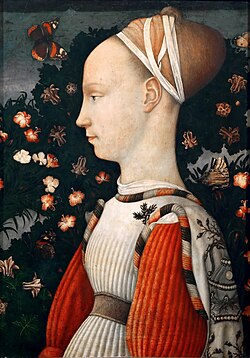
Pisanello is celebrated for his poetic naturalism, particularly in his drawings. Unlike many of his contemporaries who used sketches as mere drafts for paintings, Pisanello created autonomous works of art. His studies of flora and fauna, found in collections like the Codex Vallardi at the Louvre, are prized for their scientific accuracy and elegance.
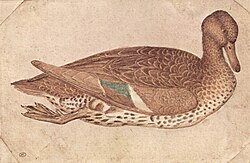
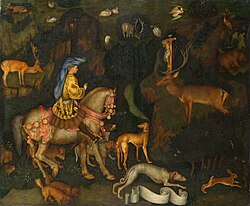
His mastery of animal anatomy, especially horses, may have been influenced by his association with Paolo Uccello. This obsession with nature and nobility is perfectly captured in The Vision of Saint Eustace, a panel painting where the animals are rendered with miniature-like delicacy, serving as a backdrop to the nobility of the hunting courtier.
The Masterpiece of Verona
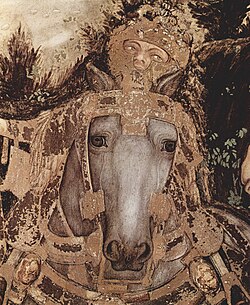
Between 1433 and 1438, Pisanello produced one of his most enduring frescoes: Saint George and the Princess of Trebizond in the church of Sant'Anastasia, Verona. This work exemplifies his ability to blend narrative storytelling with meticulous detail, supported by extensive preparatory drawings.
The Invention of the Portrait Medal
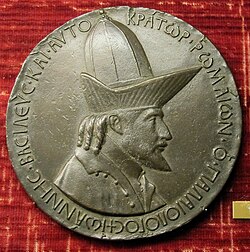
From 1435 onward, Pisanello shifted his focus toward portraiture and the creation of medals. He is credited with reinventing the commemorative medal as a distinct genre. Unlike previous medals that were struck like coins, Pisanello cast his in bronze as low-relief sculptures, signing them Opus Pisani pictoris ("made by the painter Pisano").
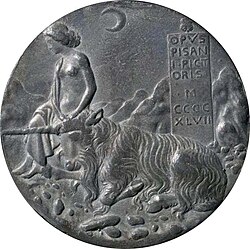
His medals followed a specific formula: a realistic profile portrait on the obverse (front) and a symbolic or allegorical scene on the reverse. These works were highly sought after by the Italian nobility, including the Malatesta and the Crown of Aragon.
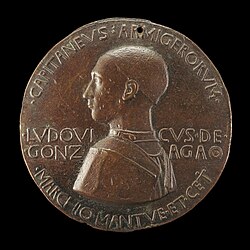
One of his most historic achievements was the 1439 medal of the Byzantine Emperor John VIII Palaeologus, created during the Council of Florence. This is considered the earliest portrait medal of the post-classical era.
Pisanello used these medals to convey the character of his subjects. For example, in the medal of Cecilia Gonzaga, he included a unicorn on the reverse to symbolize the princess's innocence.
Later Years and Political Turmoil
Pisanello's career was not without conflict. In 1438, during a war between Milan and Venice, Pisanello's alignment with Gianfrancesco Gonzaga during the capture of Verona led the Venetian government to label him a rebel. He narrowly avoided a severe sentence thanks to the intervention of a powerful friend.
In his final years, from 1448 until his death (c. 1450–1455), Pisanello lived in Naples under the patronage of the Aragon court, where he remained highly esteemed until his passing.
Summary of Pisanello's Artistic Contributions
| Category | Key Characteristics | Notable Examples/Locations |
|---|---|---|
| Painting | International Gothic, detailed fabrics, courtly themes | St. George and the Princess (Verona) |
| Medals | Bronze low-relief, profile portraits, allegorical reverses | Medal of John VIII Palaeologus |
| Drawings | Poetic naturalism, autonomous studies of fauna/flora | Codex Vallardi (Louvre) |
| Patrons | High nobility and religious leaders | Gonzaga, Este, and the Papacy |
Frequently Asked Questions
What is the International Gothic style?
The International Gothic style was a courtly artistic movement characterized by elegant, flowing lines, rich colors, and a high level of detail, often focusing on aristocratic life and nature before the full transition to the classical realism of the Renaissance.
Why is Pisanello important to the history of medals?
Pisanello is considered the inventor of the modern commemorative portrait medal. He moved away from coin-striking techniques to bronze casting, allowing for greater artistic expression and the addition of complex allegorical symbols on the reverse side.
Which of Pisanello's works are still available to see today?
While many frescoes were destroyed, you can see his paintings in the National Gallery in London (such as The Vision of Saint Eustace) and the church of Sant'Anastasia in Verona. His drawings are housed in the Louvre and the Biblioteca Ambrosiana in Milan.
Who were Pisanello's primary influences?
His most significant influence was Gentile da Fabriano, from whom he learned his delicate style and love for precious materials. He was also likely influenced by Stefano da Verona and the classical art he encountered while working in Rome.
How did Pisanello's reputation change after his death?
Though he was a celebrity in his own time, Pisanello was quickly overshadowed by the rise of humanistic and classical Renaissance culture. He is now remembered as the final and greatest master of the International Gothic style.