Polar Regions: The Science and Geography of Earth's Frigid Zones
The polar regions, often referred to as the frigid zones, are the areas of Earth that surround the geographical North and South Poles. Located within the polar circles, these high-latitude regions are defined by their extreme cold and vast ice covers. While the north is dominated by floating sea ice across the Arctic Ocean, the south is characterized by the massive Antarctic ice sheet covering the continent of Antarctica and the surrounding Southern Ocean.
Defining the Arctic and Antarctic
Defining the boundaries of the polar regions can vary depending on the criteria used. The Arctic is commonly defined as the region north of the Arctic Circle (approximately 66°33'44" N as of Epoch 2010), though some definitions extend it to everything north of 60° north latitude or the area from the North Pole south to the timberline.
In contrast, the Antarctic is generally defined as the region south of 60° south latitude or simply as the continent of Antarctica itself. This specific boundary—south of 60° south—is the definition utilized by the 1959 Antarctic Treaty.
These two zones are distinct from the other major climatic belts of the planet: the tropical belt near the equator and the two middle latitude regions that separate the tropics from the poles.
The Science of Polar Climate
The extreme cold of the polar regions is primarily caused by the way Earth receives solar radiation. Because of the planet's curvature, sunlight arrives at an oblique angle, meaning the energy is spread over a larger area and is less concentrated. Additionally, this light must travel a longer distance through the atmosphere, where it is more likely to be absorbed, scattered, or reflected.
Earth's axial tilt of 23.5° further influences this climate. Even during the summer, the tilt is not sufficient to compensate for the high latitude, meaning the midday sun never reaches a high enough declination to provide significant warmth, except for brief periods near the polar circles. This effect is amplified by the presence of snow and ice, which reflect sunlight away from the surface.
Key characteristics of the polar climate include:
- Extremely low temperatures year-round.
- Heavy glaciation in areas with enough precipitation to form permanent ice.
- Short, cold summers.
- Extreme daylight variations, ranging from 24 hours of sunlight in summer to total darkness in mid-winter.
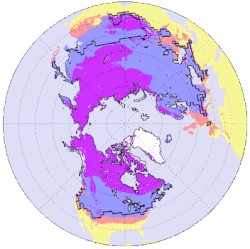
The Circumpolar Arctic Region
Unlike the south, the North Pole region is home to various human settlements. Several countries maintain claims to Arctic regions, including the United States (Alaska), Canada (Yukon, Northwest Territories, and Nunavut), Denmark (Greenland), Norway, Finland, Sweden, Iceland, and Russia.
Although the circumpolar populations are small, they often share more cultural similarities with one another than with populations in the southern parts of their own respective nations, creating a diverse but interconnected network of Arctic cultures.
Antarctica and the Southern Ocean
The southern polar region has no permanent indigenous human habitation. Instead, it is used primarily for scientific research. The United States operates the largest research facility, McMurdo Station, along with Palmer Station and the Amundsen–Scott South Pole Station. Other significant bases include Vostok Station (Russia), Scott Base (New Zealand), and the Marambio and Esperanza bases (Argentina).
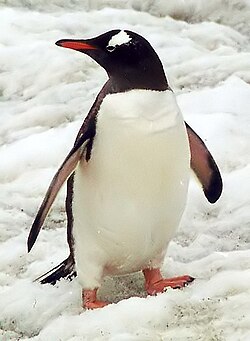
While humans are only temporary visitors, the region supports a complex ecosystem. Coastal upwelling brings nutrient-rich waters to the surface, supporting massive populations of krill (small marine crustaceans). These creatures serve as the foundation of the food chain, feeding everything from penguins to blue whales.
Key Facts
- Axial Tilt: Earth's 23.5° tilt prevents high-latitude regions from receiving concentrated solar energy.
- Arctic Boundary: Often defined as north of 66°33'44" N or 60° N.
- Antarctic Boundary: Defined by the 1959 Antarctic Treaty as south of 60° S.
- Daylight: Polar regions experience 24-hour daylight in summer and total darkness in winter.
- Biodiversity: Antarctic coastal ecosystems rely heavily on krill as a primary food source.
| Feature | Arctic (North) | Antarctic (South) |
|---|---|---|
| Primary Geography | Floating sea ice / Arctic Ocean | Ice sheet / Continent of Antarctica |
| Human Habitation | Indigenous populations and settlements | Temporary research stations only |
| Key Treaty/Boundary | Various (e.g., Arctic Circle) | Antarctic Treaty (60° S) |
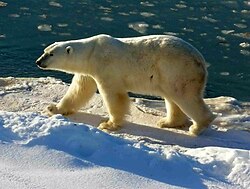
| Major Wildlife | Polar bears | Penguins, Blue whales, Krill |
Frequently Asked Questions
Why are the polar regions so cold?
They receive less intense solar radiation because sunlight hits the Earth at an oblique angle, spreading energy over a larger area. Additionally, the axial tilt is not enough to provide significant warmth, and ice reflects much of the remaining sunlight.
What is the difference between the Arctic and the Antarctic?
The Arctic consists largely of sea ice covering an ocean and has indigenous human populations. The Antarctic is a continent covered by a massive ice sheet, has no permanent human residents, and is governed largely for scientific research.
How does the axial tilt affect polar daylight?
The tilt causes extreme seasonal variations, leading to periods of 24-hour daylight during the summer and complete darkness during the mid-winter.
What role does krill play in the Antarctic ecosystem?
Krill are marine crustaceans that feed on nutrients brought up by coastal upwelling. They act as a primary food source for a wide variety of larger animals, including penguins and blue whales.
Which countries have claims in the Arctic?
Claims to Arctic regions are held by the United States, Canada, Denmark (via Greenland), Norway, Finland, Sweden, Iceland, and Russia.