Argentine Antarctica
Argentine Antarctica is a designated department of the province of Tierra del Fuego, Antarctica, and South Atlantic Islands. Argentina's presence in the region is one of the longest-standing in the world, rooted in a continuous occupation of the South Orkney Islands since 1904. Today, the territory is managed through a network of permanent and seasonal bases, coordinated by the Instituto Antártico Argentino (IAA) and the Argentine Antarctic Program.
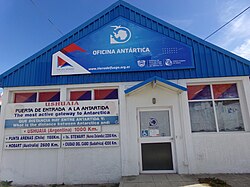
Administratively, the provincial authorities are based in Ushuaia, and the region operates under the UTC-3 time zone. While the area is subject to the Antarctic Treaty—an international agreement that manages the continent for peaceful and scientific purposes—Argentina maintains a structured administrative presence and a population of researchers, military personnel, and their families.
Key Facts
- First Base: Orcadas Base, established in 1904, is the world's first continuously operating Antarctic base.
- Total Area: Approximately 1,461,597 km², with 965,597 km² of land.
- Infrastructure: 13 bases in total, consisting of 6 permanent and 7 seasonal stations, plus 64 huts, refuges, and camps.
- Population: Recorded at 469 people in the 2010 census, with provisional 2022 data indicating 130 inhabitants.
- Governance: Managed as a department of the Tierra del Fuego province.
History of Exploration and Occupation
Early Expeditions and the South Orkney Islands
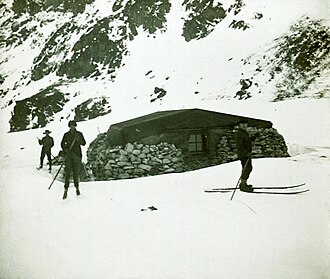
Argentina's Antarctic journey began with early 20th-century expeditions. In 1902, a hut was built on Snow Hill Island, which the Argentine Navy later took possession of in 1954, naming it Refugio Suecia. Another historical hut was established in Hope Bay, now under the control of Esperanza Station.
The establishment of Orcadas Base in 1904 marked the beginning of permanent occupation. In 1905, the corvette ARA Uruguay assisted the French Antarctic Expedition led by Jean-Baptiste Charcot. In gratitude, Charcot named a group of islands the "Argentine Islands," including Galindez Island and Uruguay Island.
The Formulation of Territorial Claims
In 1940, the National Commission of the Antarctic was made a permanent body to expand research. By 1941, Argentina began publishing maps defining its sector between 75° W and 25° W, south of 60° S. This claim was further formalized in 1942 based on the theory of polar areas.
The mid-20th century saw diplomatic tensions. In 1942, an Argentine expedition placed a flag and report on Deception Island, which was subsequently removed by the British HMS Carnarvon Castle, only for the Argentine vessel ARA 1° de Mayo to remove the British flag shortly after. By 1948, administration of the sector was placed under the maritime Governor of the National Territory of Tierra del Fuego.
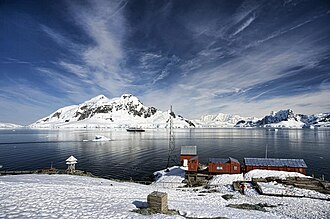
The Antarctic Treaty and Modern Era
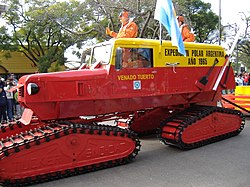
On December 1, 1959, Argentina signed the Antarctic Treaty, which entered into force in 1961. This treaty shifted the focus toward international scientific cooperation. During the 1960s, Argentina expanded its activities to include ecological tourist cruises and passenger flights between Ushuaia and Sydney via Marambio Base. The era also saw the launch of domestically designed meteorological and radiation-sensing rockets.
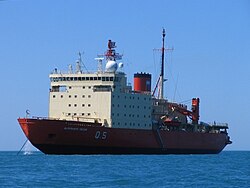
Bases and Infrastructure
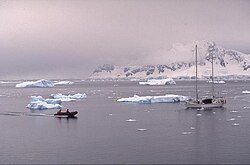
Permanent Stations
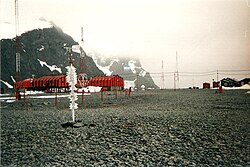
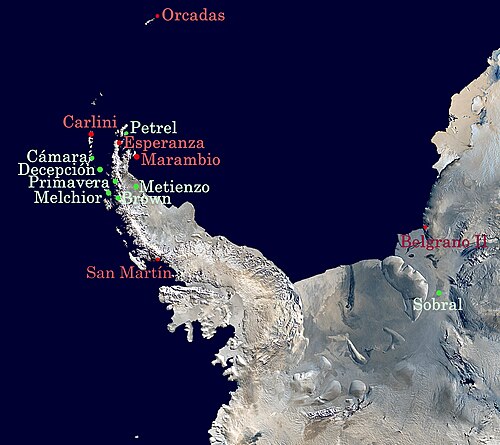
Argentina operates six permanent bases that serve as hubs for science and logistics. Marambio Base is critical for air transport, featuring a 1.2 km runway. Esperanza Base is unique for its civilian infrastructure, including a school, a Catholic chapel, and a civil registry office.
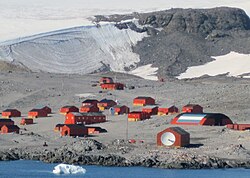
The southernmost permanent installation is Belgrano II, located at approximately 77° S. Other permanent stations include Carlini, San Martín, and the historic Orcadas Base.
Seasonal and Auxiliary Sites
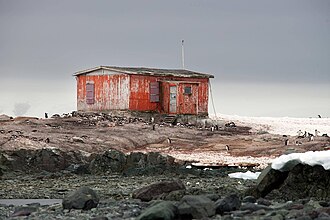
Beyond permanent stations, Argentina maintains seven seasonal bases, such as Base Deception and Almirante Brown. There are also numerous huts and refuges, including the Refugio Suecia and the jointly administered Refuge Abrazo de Maipú.
Demographics and Society

One of the most distinctive aspects of Argentine Antarctica is the presence of families. In 1977, Esperanza Base was designated to house families during the winter. This led to the birth of the first Antarctic children; Emilio Palma was the first boy born in 1978, followed by María de las Nieves Delgado. The base continues to support a small community with a school and civil registry.
Regional Summary
| Category | Details |
|---|---|
| Administrative Status | Department of Tierra del Fuego Province |
| Total Land Area | 965,597 km² |
| Primary Coordinating Body | Instituto Antártico Argentino (IAA) |
| Permanent Bases | 6 (Belgrano II, Esperanza, Carlini, Marambio, Orcadas, San Martín) |
| Seasonal Bases | 7 |
| Time Zone | UTC-3 |
Frequently Asked Questions
What is the significance of Orcadas Base?
Orcadas Base is historically significant as the world's first Antarctic base, having operated continuously since 1903 on the South Orkney Islands.
Can people live permanently in Argentine Antarctica?
While most personnel are researchers or military on rotation, Esperanza Base has historically hosted families, including the birth of several children since 1978.
How is the territory governed?
It is administratively a department of the province of Tierra del Fuego, Antarctica, and South Atlantic Islands, with provincial authorities located in Ushuaia.
What is the role of the Antarctic Treaty?
The Antarctic Treaty, signed in 1959, ensures that the region is used exclusively for peaceful purposes and scientific cooperation, effectively freezing territorial disputes.
Which base serves as the main air gateway?
Marambio Base Station is the primary aviation hub, featuring a 1.2 km long runway used for logistics and transport.