Point-tailed Palmcreeper
The point-tailed palmcreeper (Berlepschia rikeri), often referred to simply as the palmcreeper, is a distinctive bird belonging to the ovenbird family, Furnariidae. This specialized species is found across the vast landscapes of South America, where it has evolved to thrive in specific palm-dominated environments.
Unlike many of its relatives, the point-tailed palmcreeper is the sole member of its genus, making it a unique subject of study for ornithologists interested in the biodiversity of the Amazon basin and surrounding regions.
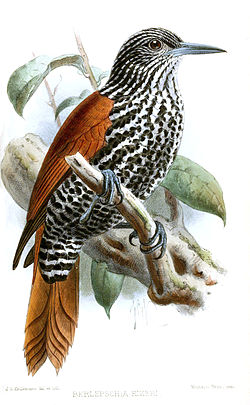
Key Facts
- Scientific Name: Berlepschia rikeri
- Conservation Status: Least Concern (IUCN 3.1)
- Primary Habitat: Mauritia palm swamps and forests
- Diet: Arthropods, including beetles and ants
- Distribution: Found across nine South American countries, including Brazil, Peru, and Colombia
- Distinctive Feature: Pointed tail feathers with stiffened bases used for bracing
Taxonomy and Systematics
The point-tailed palmcreeper occupies its own genus, Berlepschia, and has no recognized subspecies. The genus was established by Robert Ridgway, who originally placed the bird in the genus Picolaptes. After the ornithologist Hans von Berlepsch identified significant differences between this species and others in Picolaptes, Ridgway created the new genus to honor him.
The species name, rikeri, serves as a tribute to C.B. Riker, the individual who collected the type specimen used for the bird's formal scientific description.
Physical Description
The point-tailed palmcreeper is a striking bird, measuring between 18 and 22 cm (7.1 to 8.7 in) in length and weighing between 32 and 37 g (1.1 to 1.3 oz). Both males and females share the same appearance.
Adults are characterized by a face, crown, and upper back featuring thin black and white streaks, with the back streaks forming "teardrop" shapes. Their lower back, rump, and uppertail coverts are a vibrant chestnut color. The tail is also bright chestnut, featuring pointed feathers with stiffened bases that assist in climbing. Their wings consist of chestnut coverts and blackish fuscous flight feathers, with rufous edges on the secondaries.
The underparts are equally detailed: the throat is white with long black streaks, and the breast displays wide black and white streaks that fade toward the belly. The undertail coverts are barred in black and white. Adults possess orange-brown irises and gray to dark gray bills and legs. Juveniles differ slightly, exhibiting small black dots on the throat and a spotted rather than streaked breast.
Distribution and Habitat
This species has a wide distribution across South America. Its range extends from southern Venezuela through the Guianas and into northeastern Brazil, stretching south through southeastern Colombia, eastern Ecuador, and eastern Peru into northern Bolivia, and across Amazonian Brazil to the Atlantic coast, reaching as far south as the states of Mato Grosso and Goiás.
The point-tailed palmcreeper is highly specialized, primarily inhabiting Mauritia palm swamps and forests, though it occasionally visits other palm varieties. These swamps can be found within both savanna and evergreen forest ecosystems. While typically found below 400 m (1,300 ft), the species has been recorded at elevations up to 650 m (2,100 ft) in Ecuador.
Behavior and Ecology
Movement and Feeding
The point-tailed palmcreeper is a year-round resident in its habitat. It is almost always seen foraging in pairs, exhibiting acrobatic movements as it gleans arthropods from palm branches and fronds. It frequently hangs upside down, using its stiffened tail as a brace against the vegetation.
Its diet consists of various arthropods, with documented prey including members of the following groups:
- Coleoptera (Beetles)
- Hemiptera (True bugs)
- Formicidae (Ants)
- Araneae (Spiders)
Breeding and Vocalization
Believed to be monogamous, the point-tailed palmcreeper has a breeding season that appears to run from July to November in parts of Brazil. Evidence of their nesting habits includes a nest made of sticks constructed within the dead fronds of a Mauritia palm. However, specific data regarding clutch size, incubation, and fledging periods remain unknown.
The bird's song is a loud, strident series of 20–30 staccato notes. The pitch typically remains constant or ascends slightly before descending at the end, often described phonetically as "ka-koo, didididididididididi" or "weet-weet-witwitwit---".
Conservation Status
The IUCN classifies the point-tailed palmcreeper as Least Concern. Although the species is considered rare to uncommon and its exact population size is unknown, the population is believed to be stable. Because it is restricted to palm swamps—habitats that are relatively immune to most human-driven disturbances—there are no immediate threats to its survival. Additionally, the species is protected within several designated areas.
| Feature | Details |
|---|---|
| Length | 18–22 cm |
| Weight | 32–37 g |
| Primary Diet | Arthropods (Beetles, Ants, Spiders) |
| Key Habitat | Mauritia palm swamps |
| IUCN Status | Least Concern |
| Range | Bolivia, Brazil, Colombia, Ecuador, French Guiana, Guyana, Peru, Suriname, Venezuela |
Frequently Asked Questions
What makes the point-tailed palmcreeper unique among birds?
It is the only member of its genus (Berlepschia) and possesses a highly specialized morphology, including stiffened tail feathers used as a brace for acrobatic foraging in palm trees.
Where can the point-tailed palmcreeper be found?
It is found throughout the Amazonian region of South America, specifically in Mauritia palm swamps across countries such as Brazil, Peru, Colombia, and Venezuela.
What do point-tailed palmcreepers eat?
They feed on arthropods, specifically targeting insects like beetles, ants, and true bugs, as well as spiders.
Is the point-tailed palmcreeper an endangered species?
No, it is listed as Least Concern by the IUCN. Its specialized habitat in palm swamps provides a natural buffer against most human-caused disturbances.
How does the song of the palmcreeper sound?
Its song consists of 20 to 30 loud, strident, staccato notes that may rise slightly in pitch before descending at the end.