Cinnamon-throated Woodcreeper
The Cinnamon-throated Woodcreeper (Dendrexetastes rufigula) is a distinctive sub-oscine passerine—a group of songbirds with a simpler vocal apparatus than true oscines—belonging to the ovenbird family, Furnariidae. As the sole member of its genus, this bird is a specialized inhabitant of the vast South American tropical landscapes, ranging from the humid forests of the Amazon to the foothills of the Andes.
Key Facts
- Scientific Name: Dendrexetastes rufigula
- Conservation Status: Least Concern (IUCN 3.1)
- Distribution: Found across Bolivia, Brazil, Colombia, Ecuador, French Guiana, Guyana, Peru, Suriname, and Venezuela.
- Habitat: Prefers humid forests, palm forests, and secondary forests, typically below 500 meters.
- Diet: Primarily arthropods (insects and spiders) and some fruit.
- Unique Status: The only species within the genus Dendrexetastes.
Taxonomy and Systematics
The cinnamon-throated woodcreeper occupies a unique position in avian taxonomy as the only representative of the genus Dendrexetastes. Genetically, it is most closely related to the long-billed woodcreeper (Nasica longirostris). There are four recognized subspecies:
- D. r. rufigula (The nominate subspecies)
- D. r. devillei
- D. r. moniliger
- D. r. paraensis
While D. r. devillei has been suggested as a separate species by some researchers, it remains classified as a subspecies due to its vocal similarities to the others.
Physical Description
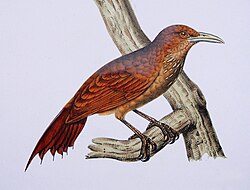
This species is among the larger woodcreepers, characterized by a heavy body, short wings, and a short, stout bill with a slightly hooked tip. Adults typically measure between 22.5 and 27 cm (8.9 to 11 in) in length. Females are slightly heavier on average, weighing 66 to 77 g, compared to males at 64 to 74 g. The sexes are visually similar.
The nominate subspecies, D. r. rufigula, features medium brown upperparts, a paler crown, and rufous-chestnut wings, rump, and tail. Its underparts are a paler cinnamon-brown, with a bright rusty buff throat and wide, black-edged whitish streaks on the breast. Depending on the individual, the lower belly may show faint darker bars.
Other subspecies vary slightly: D. r. devillei has a fainter breast pattern and lacks belly bars; D. r. paraensis possesses a bold white supercilium (the stripe above the eye); and D. r. moniliger is duller and less rufescent but exhibits bolder streaking on the neck and breast.
Distribution and Habitat
The cinnamon-throated woodcreeper is widely distributed across South America, with subspecies occupying specific regions:
- D. r. devillei: Western Amazonia, spanning central Colombia, eastern Ecuador, eastern Peru, northern Bolivia, and into Brazil.
- D. r. rufigula: Northeastern Amazonia, including eastern Venezuela, the Guianas, and northern Brazil.
- D. r. moniliger: Amazonian Brazil south of the Amazon River, between the Rio Madeira and Rio Tocantins.
- D. r. paraensis: Amazonian Brazil south of the Amazon and east of the Rio Tocantins.
These birds primarily inhabit humid forests, including terra firme (non-flooded) and várzea (seasonally flooded) forests. They are particularly fond of palm forests, the edges of evergreen forests, and mid- to late-age secondary forests. While they usually stay below 500 m (1,600 ft), they have been recorded as high as 950 m (3,100 ft) in the Andean foothills.
Behavior and Ecology
Movement and Feeding
A year-round resident in its range, the cinnamon-throated woodcreeper forages either alone or as part of mixed-species feeding flocks. It employs a "hitching" motion to move along trunks and branches from the mid-level of the forest up to the canopy. It is known to probe among epiphytes (plants that grow on other plants) and clusters of living or dead leaves to find arthropods, though it also consumes some fruit.
Breeding and Vocalization
Breeding data is limited, though in the Guianas, the species breeds during the dry season. They nest in tree cavities—either natural holes or those excavated by woodpeckers—and occasionally in thatched roofs. A typical clutch consists of two or three eggs.
Their vocalizations are most prominent at dawn and dusk. The song is described as a fast series of loud, rattled notes that ascend and then trail off, ending with a distinctive lower-pitched "tchew" or "trreew" note. Others describe the sound as a high, ringing trill.
Conservation Status
The IUCN classifies the cinnamon-throated woodcreeper as Least Concern. It possesses a vast range and a stable population. However, the species is noted for being highly sensitive to habitat modification; it has been observed disappearing from forests that have undergone selective logging.
| Feature | Details |
|---|---|
| Length | 22.5 to 27 cm |
| Weight | 64 to 77 g |
| Primary Habitat | Humid forest, palm forest, secondary forest |
| Diet | Arthropods and fruit |
| Nesting | Tree cavities or thatched roofs |
| IUCN Status | Least Concern |
Frequently Asked Questions
What makes the cinnamon-throated woodcreeper unique among woodcreepers?
It is the only member of its genus, Dendrexetastes, and is genetically most closely related to the long-billed woodcreeper.
Where can the cinnamon-throated woodcreeper be found?
It is found across several South American countries, including Brazil, Colombia, Peru, Venezuela, and the Guianas, primarily in humid Amazonian forests.
What do cinnamon-throated woodcreepers eat?
Their diet consists mainly of arthropods, which they find by probing leaf clusters and epiphytes, supplemented by some fruit.
Is the cinnamon-throated woodcreeper an endangered species?
No, it is listed as Least Concern by the IUCN due to its large range and stable population, although it is sensitive to habitat changes like selective logging.
How do the subspecies differ from one another?
Differences are primarily visual: D. r. devillei has fainter streaks, D. r. paraensis has a bold white stripe above the eye, and D. r. moniliger is duller with bolder breast streaking.