Plaza 25 de Mayo: The Civic Heart of Rosario, Argentina
Located in the province of Santa Fe, Plaza 25 de Mayo serves as the civic center and the historical core of the original settlement of Rosario. This urban square is more than just a public space; it is a symbol of Argentine identity and governance, reflecting the city's evolution from its earliest days to the present.
The plaza's name commemorates the May Revolution of May 25, 1810, a pivotal event that led to the creation of the first local government in Buenos Aires. While it was known simply as the Plaza Principal (Main Square) for many years, it officially adopted its current name in 1852.
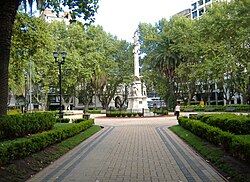
Location and Surrounding Landmarks
Plaza 25 de Mayo is situated on the eastern edge of downtown Rosario, positioned near the Paraná River. The square is bounded by four major streets: Santa Fe, Buenos Aires, Laprida, and Córdoba.
The area surrounding the plaza is home to some of the city's most significant institutional buildings. To the east, visitors will find the Palacio de los Leones, which houses the executive branch of Rosario's municipal government, and the Basilica Cathedral of Our Lady of the Rosary, the seat of the Archdiocese of Rosario.
Connecting these two landmarks is the Pasaje Juramento, a pedestrian passage that leads toward the National Flag Memorial. From the plaza, the Memorial's stone tower and propylaeum—a monumental gateway—are clearly visible, linking the civic center to one of Argentina's most important national sites.
The Columna a la Libertad
At the center of the plaza stands the Columna a la Libertad (Column to Liberty), a monumental tribute to national freedom. Sculpted in 1883 by Alejandro Biggi using Carrara marble, the monument features a statue of Liberty at its peak.
The base of the column is surrounded by statues of prominent national figures who shaped Argentina's history:
- José de San Martín and Manuel Belgrano: Key military and political leaders of the independence movement.
- Mariano Moreno: A journalist and activist for independence.
- Bernardino Rivadavia: The first president of Argentina.
Interestingly, this monument replaced an earlier structure. From May 25, 1855, until the installation of the current column, the site was occupied by Argentina's first monument dedicated to the national constitution of 1853.
Mothers of the Plaza 25 de Mayo
Beyond its architectural and political significance, the square is a site of ongoing social struggle. Every Thursday, the Mothers of the Plaza 25 de Mayo gather to demonstrate. This human rights group, named after the square, advocates for justice for their children and other victims of forced disappearances that occurred during the Dirty War within the Santa Fe Province.
Key Facts
- Official Name: Plaza 25 de Mayo (formerly Plaza Principal).
- Significance: Civic center and original core of Rosario.
- Commemoration: Named after the May Revolution of 1810.
- Central Monument: Columna a la Libertad, sculpted by Alejandro Biggi in 1883.
- Key Neighbors: Palacio de los Leones and the Basilica Cathedral of Our Lady of the Rosary.
- Human Rights: Site of weekly Thursday demonstrations by the Mothers of the Plaza 25 de Mayo.
| Landmark | Description | Significance |
|---|---|---|
| Palacio de los Leones | Municipal building | Seat of the executive branch of Rosario |
| Basilica Cathedral | Religious building | Seat of the Archdiocese of Rosario |
| Columna a la Libertad | Carrara marble monument | Tribute to national freedom and heroes |
| Pasaje Juramento | Pedestrian passage | Path to the National Flag Memorial |
Frequently Asked Questions
Why is the plaza named Plaza 25 de Mayo?
The plaza is named in honor of the May Revolution, which took place on May 25, 1810, leading to the establishment of the first local government in Buenos Aires.
Who is depicted on the Columna a la Libertad?
The monument features a statue of Liberty at the top, surrounded by figures of national heroes José de San Martín, Manuel Belgrano, Mariano Moreno, and Bernardino Rivadavia.
What is the significance of the Mothers of the Plaza 25 de Mayo?
They are a human rights group that demonstrates every Thursday in the square to demand justice for victims of forced disappearances during the Dirty War in Santa Fe Province.
Which major buildings are located next to the plaza?
The plaza is flanked by the Palacio de los Leones (the municipal government seat) and the Basilica Cathedral of Our Lady of the Rosary.
Where is the plaza located in Rosario?
It is located on the eastern edge of the downtown area, bounded by Santa Fe, Buenos Aires, Laprida, and Córdoba streets, near the Paraná River.