The Platypus: Exploring the Biology and Evolution of a Unique Mammal
The platypus (*Ornithorhynchus anatinus*) is one of nature's most extraordinary creatures. As a member of the order Monotremata—a group of mammals that lay eggs rather than giving birth to live young—the platypus defies many of the standard expectations we have for mammalian life. This unique combination of traits has made it a subject of intense scientific fascination for centuries.
Physical Characteristics and Adaptations
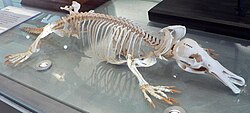
Platypuses exhibit notable differences in size between the sexes. On average, males reach a length of 50 cm (20 in) and weigh approximately 1,700 g (3.7 lb). Females are generally smaller, averaging 43 cm (17 in) in length and weighing about 900 g (2.0 lb). Interestingly, the species follows Bergmann's rule, a biological principle suggesting that animals in colder climates tend to be larger; consequently, platypuses found further south in colder regions often exhibit larger body sizes.
Their internal biology is also distinct. The platypus maintains an average body temperature of roughly 32 °C (90 °F), which is notably lower than the 37 °C (99 °F) typically seen in placental mammals. Research indicates this lower temperature is likely a gradual adaptation to harsh environmental conditions among surviving monotreme species.
Sensory Capabilities
Electroreception: A Specialized Hunting Tool
To navigate and hunt in murky freshwater environments, the platypus has developed a remarkable sense known as electroreception. This is the ability to detect the minute electrical fields generated by the muscular contractions of living prey. Their receptors are arranged in distinctive stripes across their bill, providing high sensitivity to the sides and underside of the snout. As they swim, they make quick, rhythmic turns of their head to scan the environment and locate prey.
![The platypus has secondarily acquired electroreception. Its receptors are arranged in stripes on its bill, giving it high sensitivity to the sides and below; it makes quick turns of its head as it swims to detect prey.[41]](/images/6b/ec/6bec152c8eaa7f93351894a0481fb5c1b3daebc945327e541b0e314033bea6b7.webp)
Venom and Defense
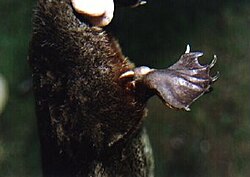
While not all mammals possess chemical defenses, the male platypus is uniquely equipped with venom. Males have a calcaneus spur located on their hind limbs, which they use to inject venom. This biological feature serves as a specialized defense mechanism.
Evolutionary History and Genetics
The Mammalian Tree
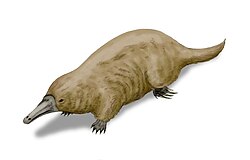
The evolutionary lineage of the platypus is a key piece of the puzzle in understanding mammalian history. While older theories suggested monotremes, marsupials, and placental mammals diverged in a different sequence, modern research and fossil evidence confirm that monotremes represent an early branching of the mammal tree. Molecular and fossil dating suggest that the platypus split from its relative, the echidna, approximately 19 to 48 million years ago.
A Complex Genome
Because they diverged so early from therian mammals (the group containing both marsupials and placental mammals), the platypus genome is a treasure trove for evolutionary biologists. One of its most striking features is its sex-determination system. Unlike most mammals, which have two sex chromosomes (XY), the platypus possesses ten sex chromosomes. This results in five unique pairs of XY in males and XX in females.
The genome also reveals a fascinating blend of traits. It contains both reptilian and mammalian genes associated with egg fertilization. While it lacks the standard mammalian sex-determining gene (SRY), research has identified that the AMH gene on the oldest Y chromosome serves as the mechanism for sex determination. Furthermore, one of the platypus's X chromosomes shows a close similarity to the Z chromosome found in birds.
Reproduction and Life Cycle
As monotremes, platypuses do not undergo live birth. Instead, they lay eggs, a trait that links them to the ancestral characteristics of early amniotes (vertebrates that produce an embryo with a protective membrane). The maternal care involved in raising these young is a critical component of their life cycle.
Habitat and Distribution
The platypus is native to the freshwater systems of eastern Australia, spanning from Queensland to Tasmania. They thrive in various habitats, including rivers, streams, lakes, and lagoon-like pools. Their terrestrial surroundings can range from tropical rainforests to colder alpine regions. While they were once thought to be extinct on the South Australian mainland, sightings and captive breeding efforts have provided new insights into their resilience.
Conservation Status and Threats
Currently, the International Union for Conservation of Nature (IUCN) categorizes the platypus as Near Threatened. Some biologists express even greater concern, suggesting that populations may have declined by as much as 50% since European settlement. The species faces a variety of modern pressures:
- Habitat Disruption: The construction of dams, pollution, and urban expansion.
- Water Management: Droughts and the extraction of water for human use, particularly in the Murray–Darling Basin.
- Human Activity: Drowning in the nets of inland fisheries and the use of "opera house traps" for catching yabbies.
- Climate Change: Projections suggest that climate-driven droughts could significantly reduce habitat and abundance over the coming decades.
- Invasive Species: Competition and pressure from non-native species.
Key Facts
- Classification: Monotreme (egg-laying mammal).
- Native Range: Eastern Australia (Queensland to Tasmania).
- Sex Chromosomes: Ten (five unique pairs).
- Primary Sense: Electroreception via the bill.
- Defense: Venomous spurs on male hind limbs.
- Conservation Status: Near Threatened (IUCN).
| Feature | Male | Female |
|---|---|---|
| Average Length | 50 cm | 43 cm |
| Average Weight | 1,700 g | 900 g |
Frequently Asked Questions
Are platypuses venomous?
Only the males are venomous. They possess a calcaneus spur on their hind limbs used to inject venom.
How do platypuses find food in dark or murky water?
They use electroreception, a specialized sense located in their bill that allows them to detect the electrical signals produced by the movements of their prey.
What is a monotreme?
A monotreme is a unique type of mammal that lays eggs instead of giving birth to live young.
Where can you find platypuses in the wild?
They are native to the freshwater habitats of eastern Australia, including parts of Queensland, New South Wales, and Tasmania.
Why is the platypus genome so important to scientists?
Because they diverged early from other mammals, their genome contains a unique mix of reptilian and mammalian genetic elements, providing vital clues about mammalian evolution.