Plant Ecophysiology: How Plants Adapt to Environmental Stress
Plant ecophysiology examines the mechanisms plants use to sense and respond to environmental changes and how these responses are integrated across varying conditions. Unlike animals, which can move to escape unfavorable conditions like extreme heat or drought, plants are stationary. This necessity to "grow where they are" has led to the evolution of phenotypic plasticity—the ability of an organism to change its phenotype in response to the environment—supported by a vast array of genes that allow plants to acclimate to diverse habitats.
Key Facts
- Stationary Adaptation: Plants rely on genetic plasticity and acclimation because they cannot move to avoid environmental stress.
- Light Dynamics: Photosynthesis is governed by the light response curve, which identifies the quantum efficiency and the light compensation point.
- Temperature Control: Plants produce specific proteins (antifreeze, dehydrins, and heat shock proteins) to survive temperature extremes.
- Water Management: The Soil-Plant-Atmosphere Continuum allows some plants to lift water up to 120 meters via transpiration.
- CO2 Trade-off: Plants must balance the intake of CO2 for growth against the loss of water through stomatal pores.
- Wind Response: Thigmomorphogenesis allows plants to grow shorter and stockier to withstand wind force.
The Role of Light in Plant Growth
Light serves as the primary energy source for plants, which they convert into biomass through photosynthesis in their leaves. This process is measured by the light response curve of net photosynthesis (PI curve), typically shaped as a non-rectangular hyperbola. Three critical metrics define this curve:
- Quantum Efficiency: The slope of the inclined asymptote, representing how efficiently a plant uses light.
- Light Compensation Point: The x-intercept where gross biochemical assimilation equals leaf respiration, resulting in zero net CO2 exchange.
- Maximum Assimilation Rate: The horizontal asymptote representing the peak rate of photosynthesis.
When light intensity is too high, plants may experience photoinhibition (a decline in assimilation) or photodestruction. Conversely, shade-tolerant plants have evolved specific adaptations to survive in suboptimal light, such as the forest understory.
Temperature Regulation and Survival
Temperature extremes can disrupt enzyme function and membrane integrity. To counter this, plants synthesize protective proteins: antifreeze proteins and dehydrins for cold, and heat shock proteins for heat. To manage the build-up of reactive oxygen species caused by metabolic imbalances, plants employ antioxidant systems.
Cell membranes are also modified to maintain fluidity. In cold conditions, plants incorporate more unsaturated fatty acids; in hot conditions, they use more saturated fatty acids to prevent the membrane from becoming too leaky.
To avoid overheating, plants use reflective waxes, scales, and hairs to scatter light. Some species, like Macroptilium purpureum, exhibit paraheliotropism, moving their leaves to avoid direct sunlight. In cold climates, plants like the New Zealand Raoulia form cushion-like clumps to insulate themselves from wind and cold.
Water Relations and the Soil-Plant-Atmosphere Continuum
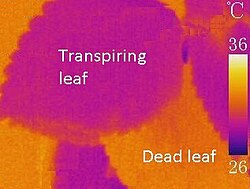
Water availability is a critical determinant of plant survival. Too little water leads to dehydration, while waterlogged soil becomes anoxic (oxygen-poor), which can kill roots. Plants manage water movement through the Soil-Plant-Atmosphere Continuum, using water potential gradients to lift water—sometimes up to 120 meters—from the soil to the leaves.
During drought, plants close their stomata (small pores on the leaf surface) to prevent water loss, a process often triggered by the hormone abscisic acid. If drought persists, plants may undergo osmotic adjustment (altering water potential) or increase root growth. Specialized plants adapted to dry environments are known as xerophytes.
To survive waterlogging, some species develop aerenchyma—specialized tissues that allow oxygen to diffuse from the shoots to the roots. Mangroves, for example, use aerial roots to maintain oxygen levels in submerged environments.
Carbon Dioxide and Global Productivity
CO2 is the essential substrate for photosynthesis, but its intake requires opening stomata, which leads to water loss. The enzyme Rubisco is only efficient at high CO2 concentrations. While most plants use C3 carbon fixation, some have evolved C4 carbon fixation or Crassulacean acid metabolism (CAM) to concentrate CO2 more effectively.
Research using Free-Air Concentration Enrichment (FACE) shows that elevated atmospheric CO2 can increase photosynthetic efficiency, boosting above-ground tissue growth by an average of 17% and below-ground tissue by 30%. However, these gains may be offset by the increased heat and drought stress associated with global warming.
The Impact of Wind on Plant Development
Wind affects plants through three primary channels: mass and energy exchange, growth signaling, and physical damage.
Mass and Energy Exchange
Leaves are surrounded by a boundary layer of still air that insulates them. Wind strips this layer away, increasing the rate of convection. While this can lead to excessive moisture loss, it also helps plants cool their leaves in full sunlight. Some plants grow trichomes (fine hairs) to increase the boundary layer and reduce vulnerability to wind.
Thigmomorphogenesis
Plants sense wind through tissue deformation, triggering a response called thigmomorphogenesis. This process inhibits shoot elongation and stimulates radial expansion and root development, resulting in shorter, stockier plants with stronger anchorage.
Physical Damage
High winds can cause leaf abrasion, branch breakage, or complete uprooting (windthrows). This is a significant pressure in forestry and agriculture, particularly in hurricane-prone regions like the Caribbean banana plantations.
| Factor | Stress/Condition | Plant Adaptation/Response |
|---|---|---|
| Light | Excessive Light | Photoinhibition, reflective waxes, paraheliotropism |
| Temperature | Extreme Cold | Antifreeze proteins, unsaturated fatty acids, cushion growth |
| Temperature | Extreme Heat | Heat shock proteins, saturated fatty acids, transpiration |
| Water | Drought | Stomatal closure (abscisic acid), osmotic adjustment |
| Water | Waterlogging | Aerenchyma, aerial roots, anaerobic respiration |
| Wind | Mechanical Stress | Thigmomorphogenesis (shorter, thicker stems) |
Frequently Asked Questions
What is the difference between wilting and epinasty?
Wilting is caused by a loss of turgor pressure due to dehydration (drought). Epinasty is the drooping of leaves often seen in flood-sensitive plants as an initial symptom of waterlogging.
How do plants lift water to great heights?
Plants use the Soil-Plant-Atmosphere Continuum, harnessing a gradient created by transpiration from the leaves to pull water upward, sometimes reaching heights of 120 meters.
What is thigmomorphogenesis?
It is the growth response of a plant to mechanical sensation (like wind), which leads to inhibited elongation and increased radial expansion, making the plant shorter and sturdier.
How does CO2 affect plant growth rates?
Increased CO2 generally increases photosynthetic efficiency, with studies showing average growth increases of 17% for above-ground and 30% for below-ground tissues, though climate-driven stress may negate these benefits.
Why do some plants have "silvery" leaves?
Plants in warm, dry regions often have reflective leaf hairs, scales, and waxes that scatter light to prevent overheating, creating a silvery appearance across the landscape.