Placozoans: The Enigmatic Simplest Animals
In the vast diversity of the animal kingdom, few creatures are as mysterious as the Placozoans. These tiny, flattened organisms challenge our traditional understanding of animal complexity. Lacking tissues, organs, and a manifest body symmetry, they represent one of the most primitive lineages of multicellular animals (metazoans) on Earth.
For decades, these creatures were overlooked or misclassified. However, the advent of electron microscopy in the mid-20th century sparked a scientific renaissance. In 1971, Karl Gottlieb Grell of the University of Tübingen formally established the phylum Placozoa, drawing inspiration from the "placula hypothesis"—a theory regarding the origin of all metazoans.
![A placozoan is a small, flattened animal, typically about one mm across and about 25 μm thick. Like the amoebae they superficially resemble, they continually change their external shape. In addition, spherical phases occasionally form which may facilitate movement. Trichoplax adhaerens lacks tissues and organs. There is no manifest body symmetry, so it is not possible to distinguish anterior from posterior or left from right. It is made up of a few thousand cells of six types in three distinct layers.[50]](/images/0e/06/0e063c3c722b8ac5ce5bb8a53222f2d423113e4c004987363cbe40e231ce1bf5.png)
Key Facts
- Simplest Body Plan: Placozoans lack true tissues, organs, and a nervous system.
- Physical Dimensions: Typically about 1 mm across and 25 μm thick.
- Cellular Structure: Composed of a few thousand cells divided into six types across three distinct layers.
- Morphology: They are asymmetrical and can change their external shape, occasionally forming spherical phases to aid movement.
- Classification: Belong to the subkingdom Eumetazoa and the clade ParaHoxozoa.
Anatomy and Biological Structure
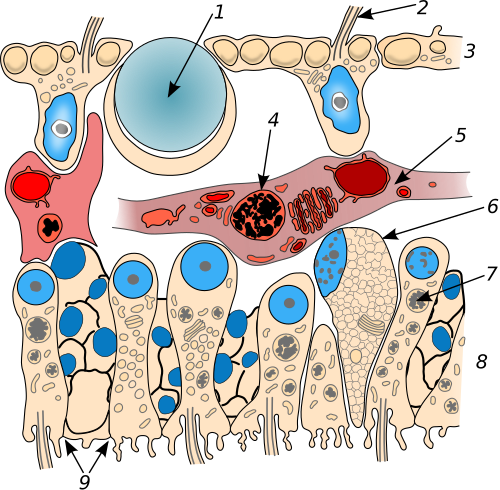
The anatomy of a placozoan, specifically the type species Trichoplax adhaerens, is a marvel of biological minimalism. Because they lack a defined anterior (front) or posterior (back), they operate as a living sheet of cells.
Their body is organized into three layers. The ventral layer (bottom) is primarily used for movement and feeding, while the dorsal layer (top) provides protection and sensory interaction. Between these layers lies a fibrous syncytium—a network of fused cells—and various vacuoles and glandular cells that facilitate biological functions.
The Proto-Nervous System
While placozoans are technically "nerveless," research has revealed a proto-nervous system. They possess cells that can generate sodium action potentials, which are electrical impulses typically associated with neurons. This allows them to integrate behavioral responses despite the absence of a centralized brain or nerve cords.
Taxonomy and Classification
Recent phylogenomic research has expanded the classification of Placozoa beyond a single species. The phylum is now divided into two primary classes, reflecting a more complex evolutionary history than previously thought.
| Class | Orders | Key Families |
|---|---|---|
| Polyplacotomia | Polyplacotomea | Polyplacotomidae |
| Uniplacotomia | Trichoplacea, Cladhexea, Hoilungea | Trichoplacidae, Cladtertiidae, Hoilungidae |
Evolutionary Relationships
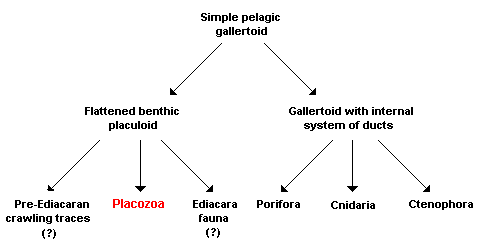
Determining where placozoans fit on the tree of life is a subject of ongoing scientific debate. Several hypotheses exist regarding their ancestry:
- Functional-morphology hypothesis: Suggests they are a sister group to both sponges (Porifera) and animals with tissues (Eumetazoa).
- Epitheliozoa hypothesis: Proposes they are the sister group specifically to the Eumetazoa.
- Sister to Cnidaria: Some genomic evidence suggests a closer relationship with jellyfish and corals.
Distribution and Ecology
Placozoans are found globally in marine environments. Their distribution is widespread, though their small size and transparency make them difficult to detect in the wild without specialized sampling techniques.
![Global distribution [45]](/images/2f/9d/2f9d86ca807d9a08b8630ce24f90f705db7d28e221523a88c5c1233cda25a74a.webp)
Beyond their own biology, placozoans interact with other marine life in surprising ways. For instance, they are known to host endosymbionts—bacteria that live inside their cells—and are preyed upon by certain specialized gastropods, such as Rhodope placozophagus.
Frequently Asked Questions
Are placozoans considered animals?
Yes, they are classified within the kingdom Animalia. Despite their simplicity and lack of organs, they are multicellular heterotrophs that fit the biological definition of an animal.
Do placozoans have a brain?
No, they do not have a brain or a traditional nervous system. However, they use sodium action potentials to coordinate movement and behavior, acting as a primitive precursor to neural systems.
How do placozoans move?
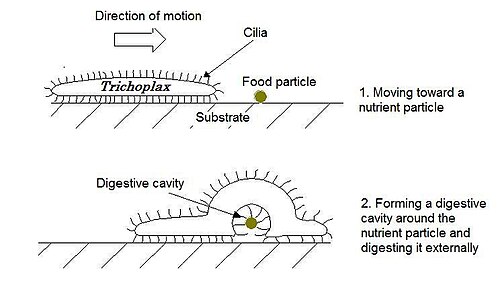
They move using cilia on their ventral surface. They can also change their overall body shape and occasionally form spherical phases to facilitate movement across surfaces.
What is the difference between Polyplacotomia and Uniplacotomia?
These are the two main classes of Placozoa identified through modern phylogenomics. They differ in their genetic makeup and specific cellular arrangements, indicating that the phylum is more diverse than the original single-species classification suggested.
What is the "placula hypothesis"?
The placula hypothesis, proposed by Otto Bütschli, suggests that all complex animals evolved from a simple, plate-like ancestor similar to modern placozoans.