Pittas: The Vibrant Ground-Dwellers of the Old World
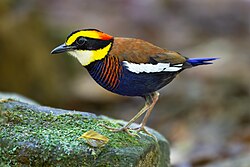
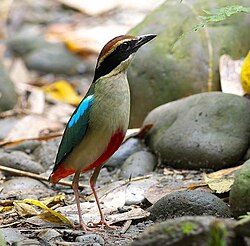
Pittas are a family of colorful, medium-sized passerine birds known as Pittidae. Found across Asia, Australasia, and Africa, these birds are characterized by their stocky build, short tails, and striking plumage. While they are capable fliers, they are behaviorally reluctant to take to the air, preferring to navigate the forest floor with their strong, long legs.
With 46 recognized species, pittas share similar habits and appearances. They are classified as suboscines—birds with a simpler vocal organ (syrinx) than the oscines—and are most closely related to broadbills in the genera Smithornis and Calyptomena.
Key Facts
- Distribution: Found throughout Africa, Asia, and Australasia.
- Physical Traits: Stocky bodies, short tails, and strong legs for ground movement.
- Taxonomy: Divided into three genera: Pitta, Erythropitta, and Hydrornis.
- Habitat: Primarily tropical forests, scrub, and mangroves.
- Diet: Heavily reliant on earthworms and small invertebrates.
- Conservation: Several species, such as the Gurney's pitta and blue-headed pitta, face threats from deforestation.
Taxonomy and Evolutionary History
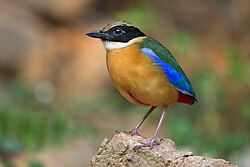
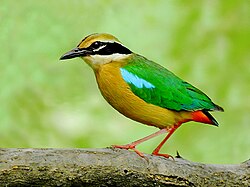
The scientific journey of the pitta began in 1764 when George Edwards described the Indian pitta. Over the centuries, their classification has shifted significantly. Initially grouped with crows (Corvidae) and later with thrushes (Turdidae), they were eventually placed in their own genus, Pitta, in 1816. The name originates from the Telugu word pitta, meaning "small bird."
Modern DNA studies from 2015 and 2016 have refined our understanding of their phylogeny. Research suggests that pittas and certain broadbills diverged approximately 24 to 30 million years ago during the Oligocene epoch. Evidence indicates that the ancestral home of this group was likely Africa.
While historical classifications varied wildly—ranging from a single genus to as many as nine—current consensus splits the family into three distinct genera: Pitta, Erythropitta, and Hydrornis.
Physical Characteristics

Pittas range in size from the small blue-banded pitta (15 cm) to the giant pitta (29 cm), with weights between 42 and 210 grams. Their anatomy is specialized for a terrestrial lifestyle, featuring long tarsi (lower leg bones) and stout, slightly decurved bills.
Their plumage is often brilliantly colored, though some species exhibit sexual dimorphism, where males and females differ in appearance.
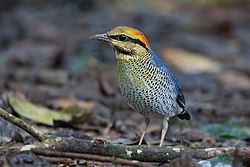
Anatomically, pittas differ from typical perching birds by having large temporal fossae in their skulls. Their wings are generally short and rounded, though the four migratory species possess more pointed wings to facilitate long-distance travel.
Distribution and Habitat
Pittas are primarily inhabitants of tropical forests, semi-forests, and scrublands. They thrive in environments with dense cover, rich understories, and ample leaf litter, which provides essential foraging grounds. Many species are found near waterways, while specialists like the mangrove pitta inhabit coastal mangrove forests.
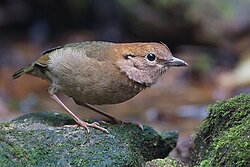
Altitudinal preferences vary by species. The rainbow pitta is a lowland specialist, rarely found above 400 meters, whereas the rusty-naped pitta can be found at elevations up to 2,600 meters.
Some species are migratory. For instance, the fairy pitta travels from East Asia (Korea, Japan, Taiwan, and China) to Borneo.
Behavior and Ecology
Sociality and Territoriality
Pittas are strongly territorial. Territory sizes vary significantly, from 3,000 square meters for the African pitta to 10,000 square meters for the rainbow pitta. They defend these areas through frequent vocalizations and visual displays. The rainbow pitta, for example, performs a bowing display while emitting a purring call to warn off rivals.
Diet and Feeding
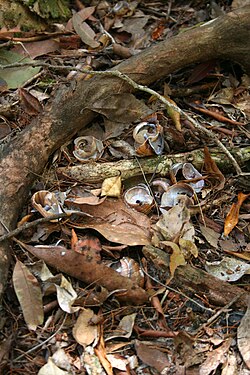
These birds are primarily insectivores. Earthworms are a critical food source, particularly for nestlings. Some species exhibit unique feeding behaviors; the noisy pitta uses an "anvil" (a hard surface) to smash snails and remove their shells.
Breeding and Life Cycle
Both parents share the responsibilities of incubating the eggs and rearing the chicks. The incubation period typically lasts between 14 and 18 days. In some species, such as Gurney's pitta, parents consume the eggshells after hatching to reclaim calcium.
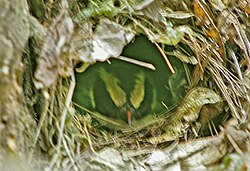
Pitta chicks are altricial, meaning they are born blind, naked, and entirely dependent on their parents. Feeding is an intensive process; one study of Gurney's pittas recorded 2,300 feeding visits over the nestling stage, covering an estimated 460 km. While earthworms dominate the diet, parents also provide skinks and snakes to older chicks.
Conservation Status
Habitat loss is the primary threat to pitta populations. The blue-headed pitta, once considered secure, is now listed as vulnerable due to rapid deforestation in Borneo.
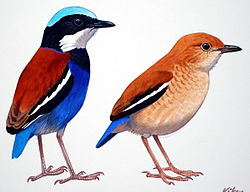
The Gurney's pitta provides a dramatic example of conservation volatility. After being unseen for 34 years, a tiny population was found in Thailand, leading to a critically endangered status. However, a subsequent discovery of thousands of pairs in Burma revealed the species was less threatened than previously feared, though it remains a concern due to ongoing deforestation.
Pitta Species Summary
| Genus | Key Characteristics | Example Species |
|---|---|---|
| Hydrornis | Includes larger species and various banded pittas | Giant pitta, Blue-headed pitta |
| Erythropitta | Often smaller, brightly colored species | Philippine pitta, Blue-banded pitta |
| Pitta | Diverse group including many migratory species | Indian pitta, Fairy pitta, Rainbow pitta |
Frequently Asked Questions
What makes pittas different from other passerine birds?
Pittas are suboscines with a simpler syrinx and unique skull anatomy (large temporal fossae). They are also highly terrestrial, possessing strong legs and short tails compared to typical perching birds.
Do all pittas migrate?
No, most pittas are sedentary. However, four species are migratory, such as the fairy pitta, which travels between East Asia and Borneo.
What do pittas eat?
Their diet consists mainly of invertebrates found in leaf litter. Earthworms are particularly important, and some species also eat snails, skinks, and snakes.
Why are some pitta species endangered?
The primary cause is the loss of their specific habitat. Rapid deforestation in regions like Borneo and Burma destroys the tropical forest understories they need for feeding and nesting.
How do pittas defend their territory?
They use a combination of loud, frequent territorial calls and physical displays, such as bowing or purring, to maintain boundaries and ward off rivals.