Bird Migration: The Incredible Seasonal Journeys of Avian Species
Every year, millions of birds undertake one of nature's most demanding feats: migration. This seasonal movement involves traveling between breeding grounds and wintering grounds, typically between northern and southern regions. While these journeys are essential for survival, they are fraught with inherent risks, including predation and various environmental hazards encountered en route.

Key Facts

- Migration is a seasonal movement occurring twice a year between breeding and wintering grounds.
- The Arctic tern holds the record for the longest migration, traveling between the Arctic and Antarctic.
- Birds navigate using celestial cues, the Earth's magnetic field, and mental maps.
- Migration timing is primarily controlled by changes in day length.
- Some species perform altitudinal migration, moving up and down mountain ranges rather than across latitudes.
Patterns and Scales of Migration
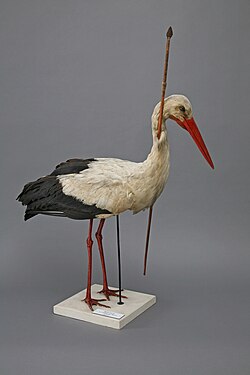
Migration is not a one-size-fits-all phenomenon. The distance and method of travel vary significantly depending on the species.
Long-Distance Migration
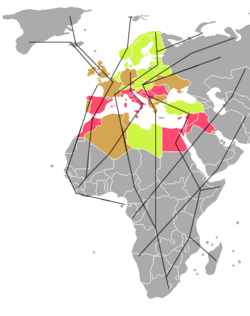
Some birds perform extraordinary feats of endurance. The Arctic tern travels between its Arctic breeding grounds and the Antarctic every single year. Other species, such as certain tubenoses like albatrosses, circle the globe by flying over southern oceans. Manx shearwaters are also notable, migrating approximately 14,000 km (8,700 mi) between northern breeding grounds and the Southern Ocean.
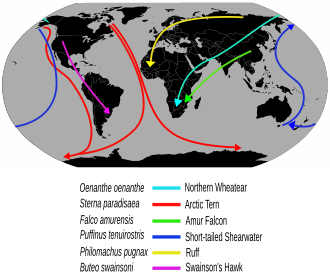
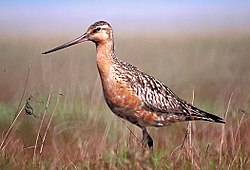
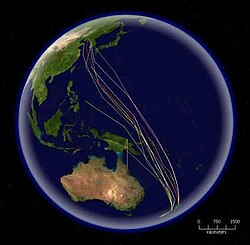
The bar-tailed godwit is a champion of non-stop flight. This species can complete a migration of up to 10,200 km (5,500 nmi) without stopping.

Short-Distance and Altitudinal Migration
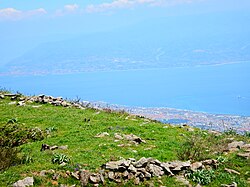
Not all migrations span hemispheres. Many birds engage in shorter journeys, including altitudinal migration. In this pattern, birds move between different elevations on mountains, such as the Andes or the Himalayas, to find optimal conditions.
Navigation and Timing
How do birds find their way across thousands of miles of ocean and land? The process involves a sophisticated combination of biological tools.
Orientation and Navigation
Migrating birds utilize several complex systems to navigate. They rely on celestial cues from the Sun and stars, as well as the Earth's magnetic field to maintain direction. Additionally, many birds appear to use mental maps to guide their journeys.
The Role of Day Length
The timing of these massive movements is not random. It is primarily controlled by changes in day length, which serves as a biological trigger for the birds to begin their journey.
Diverse Migratory Behaviors

Birds exhibit a wide variety of behaviors during their travels, from soaring on warm air currents to traveling in massive, synchronized flocks.
Diurnal and Nocturnal Flight
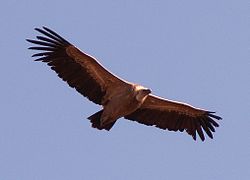
Some large birds utilize thermals—columns of rising warm air—to soar during the day, conserving energy while moving long distances. Conversely, many smaller birds engage in nocturnal migration, flying under the cover of darkness.

Waders and Seabirds
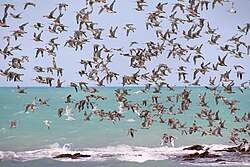
Waders and seabirds often follow specific coastal or oceanic routes. In places like Roebuck Bay in Western Australia, migrating waders can be seen in large numbers.
Summary of Migration Types

| Migration Type | Description | Example Species/Context |
|---|---|---|
| Long-Distance | Travel between hemispheres or across oceans | Arctic tern, Bar-tailed godwit |
| Altitudinal | Movement between different elevations | Mountain-dwelling species (Andes/Himalayas) |
| Diurnal | Daytime flight using thermals | Large soaring birds like vultures |
| Nocturnal | Nighttime flight | Many songbird species |
Frequently Asked Questions

![Differences in an Arctic shorebird species' phenology between a normal year and a hotter year.[106]](/images/80/ab/80ab905be7461efbd4ae0592d8a6acfeae3cc350b65585d470de16a393d71428.png)


Which bird has the longest migration?
The Arctic tern holds the record for the longest migration, traveling between its breeding grounds in the Arctic and its wintering grounds in the Antarctic.
How do birds know when to migrate?
The timing of migration is primarily controlled by changes in day length, which acts as a biological signal to the birds.
What tools do birds use to navigate?
Birds use a combination of celestial cues (the Sun and stars), the Earth's magnetic field, and internal mental maps to find their way.
What is altitudinal migration?
Altitudinal migration is a type of short-distance migration where birds move up and down mountain slopes to find suitable habitats or food.
Are all bird migrations long-distance?
No. While some species travel thousands of kilometers, many birds engage in much shorter migrations, including moving only between different elevations on a mountain.