Pitcher Plants: Nature's Sophisticated Pitfall Traps
Pitcher plants are fascinating carnivorous organisms that have evolved a unique survival strategy: the pitfall trap. These specialized leaves form deep cavities filled with digestive liquid, designed to lure, capture, and consume prey. By supplementing their diet with insects, these plants can thrive in nutrient-poor or highly acidic environments where most other vegetation would perish.
The mechanism is elegant in its simplicity. Using a combination of nectar, visual lures, and sometimes scent, the plant attracts foraging insects. Once the prey steps onto the slippery rim, it falls into the reservoir below, where it is drowned and digested to provide the plant with essential minerals.
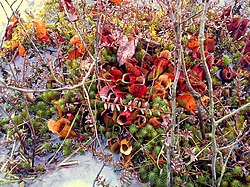
Key Facts
- Dietary Purpose: They capture prey to obtain nitrogen and phosphorus in mineral-poor soils.
- Trap Mechanism: Modified leaves create a pitfall trap with a slippery rim (peristome) and digestive fluid.
- Diverse Families: Primarily found in the Nepenthaceae and Sarraceniaceae families, but also in Cephalotaceae and some Bromeliaceae.
- Convergent Evolution: The pitcher form evolved independently across four different plant lineages.
- Mutualism: Some species have evolved symbiotic relationships with mammals, such as bats and tree shrews.
Major Types of Pitcher Plants
Nepenthaceae (Old World Pitcher Plants)
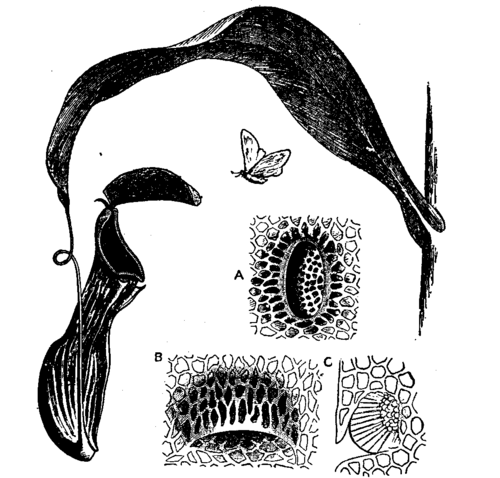
The family Nepenthaceae consists of a single genus, Nepenthes, which includes over 100 species. These plants are typically climbers that use tendrils extending from the midrib of their leaves to reach the forest canopy, though some grow on the ground or as epiphytes (plants that grow on other plants). Their pitchers are symmetrical and feature a comprehensive waxy coating on the inner walls to prevent prey escape.
Sarraceniaceae (New World Pitcher Plants)
Unlike the Old World variety, New World pitcher plants are ground-dwelling herbs that grow from a horizontal rhizome (an underground stem). In this family, the entire leaf is modified into a pitcher. This family includes three distinct genera:
- Heliamphora: Known as marsh pitchers, these are found in high-rainfall areas of South America and feature a spoon-like nectar-secreting structure.
- Sarracenia: The trumpet pitchers of North America, which often possess an operculum (a lid) to prevent rainwater from overfilling the trap.
- Darlingtonia: The cobra plant of California, distinguished by a forked "tongue" and an inflated lid with false exits to confuse prey.
Cephalotaceae and Bromeliaceae
The Cephalotaceae family is monotypic, containing only one species: Cephalotus follicularis. Found exclusively in southwestern Australia, it produces small pitchers (2–5 cm) where the petiole attaches to the rear of the upper rim. Additionally, a few species of bromeliads (Bromeliaceae), such as Brocchinia reducta, are known or suspected to be carnivorous.
How Pitcher Plants Feed
Attraction and Capture
Pitcher plants employ various lures to attract insects. Many use anthocyanin pigments for visual appeal or ultraviolet coloration. Some, like Cephalotus follicularis, use camouflage to blend into the substrate. Olfactory cues are also used; for instance, Nepenthes rafflesiana mimics the scent of flowers to deceive insects.
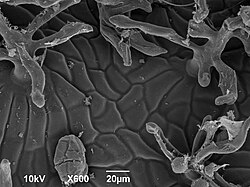
The capture process begins at the peristome (the rim), which becomes slippery when wet. Once an insect slips, it enters the phytotelmata (the small body of liquid). To prevent escape, the inner walls may be lined with waxy scales, downward-pointing hairs, or aldehyde crystals.
Digestion and Nutrient Absorption
Prey is dissolved either through bacterial action or enzymes secreted by the plant. The fluid's acidity and viscoelasticity vary by species to target specific prey; higher viscoelasticity helps capture flying insects, while higher acidity speeds up the killing of crawling insects. The resulting solution of amino acids, peptides, phosphates, ammonium, and urea provides the plant with vital nitrogen and phosphorus.
Symbiotic Relationships
Some pitcher plants have moved beyond insectivory to form mutualistic bonds with animals. Nepenthes lowii attracts tree shrews with nectar; the plant's rim is not slippery, allowing the shrew to perch and defecate into the pitcher, providing the plant with nitrates.
Similarly, Nepenthes rafflesiana var. elongata provides roosting space for Hardwicke's woolly bats. These bats live inside the elongated pitchers, and the plant absorbs nitrogen from the bats' feces.
Evolutionary Origins
Botanists believe pitfall traps evolved through epiascidiation, a process where the leaf infolds, turning the upper surface into the interior of the pitcher. This is a classic example of convergent evolution, as the trait appeared independently in three eudicot and one monocot lineage. Some evidence suggests pitchers may have evolved from flypaper traps through the loss of mucilage.
| Family | Region | Pitcher Origin | Key Characteristic |
|---|---|---|---|
| Nepenthaceae | Old World | End of leaf tendril | Waxy inner walls; often climbers |
| Sarraceniaceae | New World | Entire leaf | Rhizome-based; includes trumpet and cobra shapes |
| Cephalotaceae | Australia | Modified leaf | Monotypic; petiole attached to rear rim |
| Bromeliaceae | Various | Leaf base/center | Some species suspected carnivores |
Frequently Asked Questions
Why do pitcher plants eat insects if they can photosynthesize?
While they can produce energy from sunlight, pitcher plants typically live in soils that are too acidic or nutrient-poor to provide enough nitrogen and phosphorus. They digest insects to supplement these essential minerals.
What is the difference between Old World and New World pitcher plants?
Old World pitcher plants (Nepenthaceae) produce traps at the end of tendrils and are often climbers. New World pitcher plants (Sarraceniaceae) are ground-dwelling herbs where the entire leaf forms the pitcher.
How do pitcher plants prevent prey from climbing out?
They use several mechanisms, including a slippery peristome, waxy scales, downward-pointing hairs, and cuticular folds that make it nearly impossible for an insect to regain its footing.
Do all pitcher plants use enzymes to digest food?
No. While many secrete their own digestive enzymes, some rely on bacterial action—where bacteria are washed into the pitcher by rain—to break down the prey.
What is convergent evolution in the context of pitcher plants?
Convergent evolution occurs when unrelated species independently evolve similar traits. Pitcher traps evolved separately in four different plant lineages to solve the same problem: surviving in nutrient-poor soil.