Phytogeography and Phytochoria: Mapping the World's Plant Distributions
In the study of phytogeography—the branch of science dealing with the geographic distribution of plant species—scientists seek to understand why certain plants grow in specific locations. One of the fundamental concepts used to organize this knowledge is the phytochorion. A phytochorion is a geographic area characterized by a relatively uniform composition of plant species.
It is important to note that nature rarely follows strict lines. Adjacent phytochoria typically do not have sharp boundaries; instead, they feature a soft transition known as a vegetation tension zone, or ecotone. In these zones, species from both neighboring regions overlap, creating a complex mosaic of life.
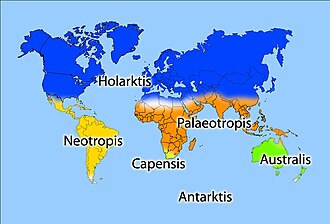
Key Facts
- Phytochorion: A geographic area with a uniform plant species composition.
- Ecotone: A transitional area (tension zone) where different plant regions overlap.
- Hierarchical Classification: Plant areas are often ranked from large kingdoms down to specific provinces.
- Endemism: The degree of uniqueness in a region is often measured by endemic taxa (species found nowhere else).
- Classification Methods: Systems can be based on floristic relationships (shared species) or physiognomic-environmental parameters (physical appearance and climate).
Hierarchical Systems of Classification
Traditional phytogeographic schemes organize the world into a hierarchy. This ranking is often determined by the presence of endemic taxa—species, genera, or families that are unique to a specific area. The hierarchy generally follows this structure:
- Floristic Kingdoms: The largest units, characterized by a high degree of endemic families.
- Floristic Regions: Subdivisions of kingdoms, defined by high generic endemism.
- Floristic Provinces: Smaller areas defined by high species endemism.
While some researchers use these hierarchical ranks, others prefer to refer to these areas simply as "regions" or "phytochoria" without implying a specific order. It is also worth noting that these systems differ from zoogeographic provinces (which focus on mammal families) and terrestrial ecoregions (which integrate both plant and animal data).
Historical Developments in Floristic Mapping
The effort to map the world's flora has evolved significantly since the 19th century. Adolf Engler was a pioneer in this field, producing one of the first world maps of floral distribution limits. His work laid the foundation for subsequent botanists like Augustin de Candolle and others to refine our understanding of plant realms.
The Good and Takhtajan Models
In 1947, botanist Ronald Good identified six major floristic kingdoms for flowering plants: Boreal (Holarctic), Neotropical, Paleotropical, South African, Australian, and Antarctic. His system subdivided these into 37 floristic regions.
Building upon Good's work, Armen Takhtajan developed a widely used scheme in 1978 and 1986. Takhtajan identified 35 floristic regions, which were further subdivided into 152 floristic provinces, providing a much more granular view of global plant distribution.
| System/Author | Primary Focus | Key Characteristics |
|---|---|---|
| Ronald Good (1947) | Flowering plant kingdoms | 6 kingdoms, 37 regions |
| Armen Takhtajan (1978/86) | Hierarchical floristic units | 35 regions, 152 provinces |
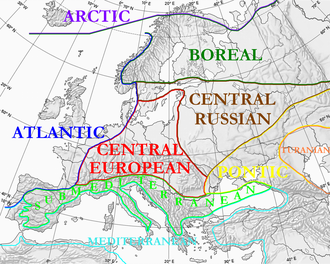
| Frey & Lösch (2004/10) | European regionalization | Focus on climatic and weather barriers |
| Liu et al. (2023/24) | Phylogenetic relationships | 8 realms organized into 2 super-realms |
Modern Approaches: Phylogeny and Data Refinement
Recent advancements have moved toward incorporating phylogenetic relationships—the evolutionary history and connections between species—into regionalization. In 2023 and 2024, Liu et al. proposed a new classification consisting of eight realms organized into two super-realms: the Gondwanan super-realm and the Laurasian super-realm.
This modern approach differs from Takhtajan's work by emphasizing the evolutionary uniqueness of certain areas. For example, the Paleotropical and Antarctic kingdoms were separated into distinct realms due to their long-term evolutionary divergence. Additionally, the Saharo-Arabian realm was separated from the Holarctic kingdom to better reflect distinct biological trajectories.
This new methodology also faced scientific scrutiny. After criticisms regarding the inclusion of nonnative (exotic) species, the researchers cleaned their datasets. They found that removing nonnative ranges did not significantly alter the resulting floristic realms, reinforcing the stability of their findings.
Frequently Asked Questions
What is the difference between a phytochorion and an ecotone?
A phytochorion is a distinct geographic area with a uniform plant composition. An ecotone is the transitional zone where two different phytochoria meet and overlap.
How are floristic kingdoms different from floristic provinces?
They are different levels of a hierarchy. Kingdoms are the largest units and are defined by unique plant families, while provinces are much smaller areas defined by unique individual species.
What determines the boundaries of plant regions in Europe?
According to researchers like Frey and Lösch, boundaries in Europe often align with climatic barriers, such as the tree line, temperature averages, or precipitation limits.
Why is phylogeny important in modern phytogeography?
Phylogeny allows scientists to group plants based on their actual evolutionary history rather than just their physical appearance or current location, leading to more accurate biological maps.
What is endemism in plant science?
Endemism refers to the state of a species being unique to a defined geographic location. High endemism in a region means many of its plants are found nowhere else on Earth.