Personification in Art, Literature, and Culture
Personification is the artistic and literary representation of a thing, being, or abstract concept as a person or as possessing human-like qualities. While often confused with anthropomorphism—which attributes human traits to non-human entities—personification specifically transforms an abstraction into a human figure to make complex ideas more tangible and relatable.
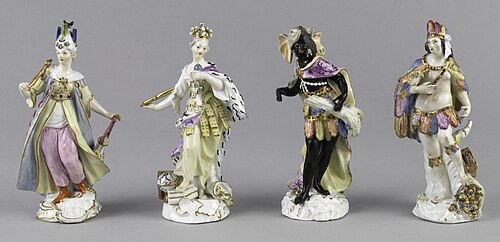
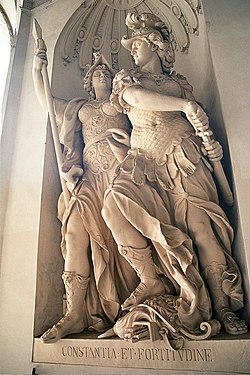
This device is widely used to represent geographical locations (such as cities, countries, and continents), natural elements (the seasons, the four elements, and the five senses), and abstract concepts (death, the cardinal virtues, and the seven deadly sins). In many polytheistic religions, deities serve as the ultimate personifications of natural forces or intellectual concepts, such as the Greek and Roman gods of the sea, sun, and victory.
Key Facts
- Definition: The representation of an abstraction or non-human entity as a person.
- Common Subjects: Virtues, vices, seasons, continents, and national identities.
- Rhetorical Term: In classical rhetoric, this device is known as prosopopoeia.
- Evolution: Once dominant in medieval and Renaissance art, it transitioned into modern popular culture through superhero figures.
- Distinction: Personification is a component of allegory, though the two terms are frequently used interchangeably in art history.
The Evolution of Personification in Literature
In Middle English literature, personification was often the driving force of entire works, creating what are known as personification allegories. A primary example is William Langland's Piers Plowman (c. 1370–90), where characters are named directly after their qualities. Geoffrey Chaucer also utilized the device in The House of Fame, though he often developed his personifications into more complex, nuanced characters.
During the Renaissance and Elizabethan eras, personification remained a staple. Edmund Spenser's The Faerie Queene used figures to represent various virtues, and John Bunyan's The Pilgrim's Progress (1678) stands as one of the last great personification allegories in English literature. However, by the 19th century, Romantic writers—with the notable exception of William Blake—began to avoid the device, viewing it as a "hollow" version of characterization that depleted the depth of fiction.
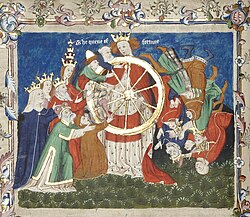
Personification in the Visual Arts
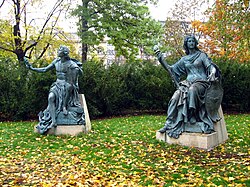
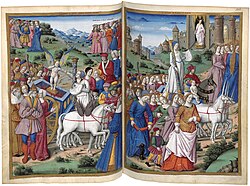
Visual personifications frequently appear in sets, particularly in medieval and Renaissance art. The most common subjects were the virtues and vices, which decorated the exteriors of the Chartres and Amiens Cathedrals. In painting, Giotto's Scrovegni Chapel (c. 1305) and Ambrogio Lorenzetti's Allegory of Good and Bad Government (1338–39) used human figures to represent concepts like Tyranny, Avarice, and Justice.
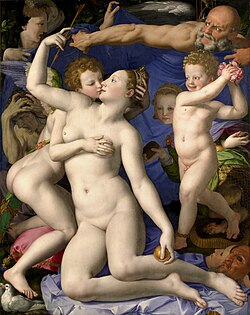
While many personifications are static and symbolic, artists like Sandro Botticelli created more complex compositions. In works such as Primavera and The Birth of Venus, multiple personified figures interact to form intricate allegories. Other masters, such as Albrecht Dürer in Melencolia I (1514), created powerful single figures that continue to be debated by scholars today.
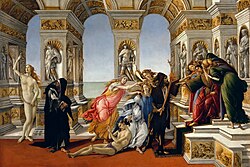
Theoretical Foundations
The study of personification dates back to 300 BC with Demetrius of Phalerum, who described prosopopoeia. Later, Quintilian provided a comprehensive taxonomy of the device in Institutio Oratoria. During the Renaissance, Cesare Ripa's Iconologia (1593) became the definitive guide for the attributes used to identify personified figures in art until the 19th century.
Innovation and National Identity
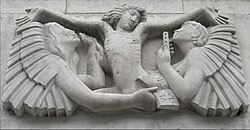
As the world expanded, new personifications were created. The 16th century introduced the personification of the Americas, completing a set of four continents. In the industrial era, new concepts required human forms; for example, the "Spirit of Communication" statue atop the AT&T headquarters in New York and Eric Gill's use of Ariel to personify broadcasting at Broadcasting House in London (1932).
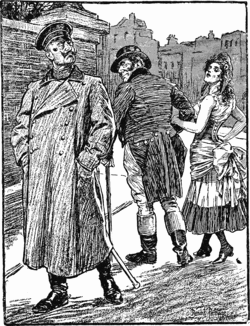
National personifications often blend classical imagery with political satire. While the Statue of Liberty draws from the Roman goddess Libertas, figures like John Bull (UK) and Uncle Sam (USA) originated in satirical literature before becoming global symbols. France's Marianne represents a hybrid style, alternating between a classical goddess and a common woman of Paris.
| Category | Common Examples | Notable Representation |
|---|---|---|
| Abstract Concepts | Justice, Death, Hope, Time | Dürer's Melencolia I |
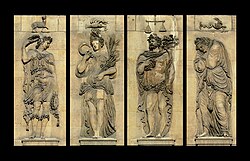
| Natural World | The Four Seasons, The Elements | Jean Goujon's reliefs |
| National/Political | Liberty, Marianne, Uncle Sam | Statue of Liberty |
| Moral Qualities | Seven Deadly Sins, Cardinal Virtues | Chartres Cathedral sculptures |
Frequently Asked Questions
What is the difference between personification and anthropomorphism?
Personification is the representation of an abstract quality or a non-human thing as a person (e.g., Justice as a blindfolded woman). Anthropomorphism is the attribution of human traits, emotions, or intentions to non-human entities, such as animals or objects, making them behave like humans.
How does personification differ from allegory?
Personification is a specific device where a single concept is given human form. Allegory is a broader narrative or artistic work where characters and events symbolically represent deeper meanings. While a personification can be part of an allegory, not every allegory relies on personification.
What is prosopopoeia?
Prosopopoeia is the classical rhetorical term for personification. It refers to the act of giving a voice or a face to an inanimate object or an abstract concept in speech or writing.
Why did personification decline in literature during the 19th century?
Critics and Romantic writers began to view personification as too rigid or "frozen," arguing that it lacked the psychological depth of literal characters and depleted the fictional quality of a story.
Who is Marianne in the context of personification?
Marianne is the national personification of the French Republic. She represents a mixture of styles, appearing sometimes as a classical goddess and other times as a revolutionary woman of the streets of Paris.