Per Capita Income: Measuring Average Wealth and Living Standards
Per capita income (PCI), commonly referred to as average income, is a fundamental economic metric used to determine the average amount of money earned per person within a specific area. Whether applied to a city, a region, or an entire country, this figure provides a snapshot of economic performance for a given year.
Because it simplifies complex economic data into a single per-person figure, PCI is frequently used to assess a sector's average earnings, compare the wealth of different populations, and gauge a nation's general standard of living. Furthermore, it serves as one of the three critical components used to calculate a country's Human Development Index (HDI).
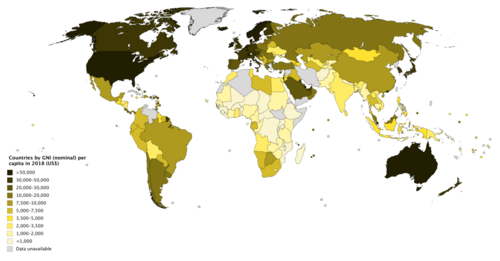
How Per Capita Income is Measured
The methods for calculating per capita income vary depending on the scope of the study. In many nations, governments rely on regular population surveys to gather data. For example, the United States utilizes the American Community Survey to calculate PCI for the entire country as well as for specific demographic groups and regions.
Comparing these figures across international borders can be challenging due to differences in data quality, definitions, and methodologies. To address this, the OECD (Organisation for Economic Co-operation and Development) has implemented a standardized set of questions and methodologies for its 38 member countries since the 1990s. When comparing different nations, economists typically convert local earnings into a common international currency, such as the United States dollar or the euro, to ensure consistency.
Key Facts
- Definition: The average income earned per person in a specific area during a specified year.
- Global Standard: The OECD uses standardized methodologies across 38 member countries to improve international comparability.
- HDI Component: Per capita income is one of three pillars of the Human Development Index.
- Currency: International comparisons usually rely on the US dollar or the euro.
- Alternative Metrics: Median income is often preferred over PCI to avoid the distorting effects of extreme wealth outliers.
Limitations of Per Capita Income
While per capita income is a valuable tool for economic study, it has several inherent limitations that can lead to misleading conclusions if not properly adjusted.
Inflation and Purchasing Power
When tracking income over time, figures must be adjusted for inflation (the general increase in prices and fall in the purchasing value of money). Without this adjustment, economic growth may appear higher than it actually is. Additionally, exchange rates do not always reflect the actual cost of living. To get a more accurate picture of what people can actually afford, economists use purchasing power parity (PPP), which adjusts for price differences between countries.
Income Distribution and Inequality
PCI is a mean value, meaning it is an average that does not show how income is distributed. In countries with high income inequality, a small group of extremely wealthy individuals can significantly raise the per capita income, even if the majority of the population sees no financial improvement. In such cases, median income—the middle value of the data set—is a more reliable measure of general prosperity.
Excluded Economic Activity
PCI typically only tracks monetary earnings. It ignores non-monetary activities, such as the barter system or unpaid services provided within a family. The impact of these exclusions varies significantly across different types of economies.
Development and Investment
A high per capita income does not guarantee a high quality of life. The metric does not track whether that income is being invested in essential development factors, such as infrastructure, education, or healthcare.
Summary of Economic Income Metrics
| Metric | Primary Use | Main Limitation |
|---|---|---|
| Per Capita Income | General wealth and standard of living comparisons | Skewed by extreme wealth (outliers) |
| Median Income | Measuring typical prosperity of the population | Less useful for total economic output analysis |
| PPP Adjusted Income | Comparing actual buying power between countries | More complex to calculate than nominal rates |
| Real Income | Tracking economic growth over time | Requires accurate inflation data |
Frequently Asked Questions
What is the difference between per capita income and median income?
Per capita income is an average (mean) of all incomes in a group, which can be heavily influenced by a few very wealthy people. Median income is the middle point of the distribution, meaning half the population earns more and half earns less, making it a better reflection of the typical person's experience.
Why is Purchasing Power Parity (PPP) important?
PPP is important because the cost of goods and services varies by country. A dollar in one country may buy more than a dollar in another; PPP adjusts for these differences to show the actual standard of living.
How does inflation affect per capita income data?
Inflation erodes the purchasing power of money. If per capita income rises by 5% but inflation also rises by 5%, the actual standard of living has not improved. Adjusting for inflation allows economists to see "real" growth.
Is per capita income the same as GDP per capita?
While closely related, per capita income specifically measures the average income earned by individuals, whereas GDP per capita measures the total economic output of a country divided by its population.
Does a high per capita income always mean a country is developed?
Not necessarily. Per capita income does not account for how wealth is distributed or whether the money is invested in public health, education, and infrastructure, which are critical for true development.