People's Volunteer Army: The History and Impact of China's Expeditionary Forces in Korea
The People's Volunteer Army (PVA), also known as the Chinese People's Volunteers (CPV), was the expeditionary force deployed by the People's Republic of China during the Korean War. While the troops were transferred from the People's Liberation Army (PLA) under the orders of Chairman Mao Zedong, the PVA was established as a separate entity to avoid an official declaration of war with the United States. Entering Korea on October 19, 1950, these forces played a decisive role in the conflict until their complete withdrawal by October 1958.

Key Facts
- Active Period: 1950–1958 (combat troops); 1954–1994 (delegation).
- Total Personnel: Approximately 3 million Chinese civilian and military personnel served in Korea.
- Primary Motto: "Resist U.S. and aid Korea, to defend our homeland."
- Nickname: "Most Beloved People" (最可爱的人).
- Commanders: Notable leaders included Peng Dehuai, Chen Geng, and Deng Hua.
Formation and Strategic Context
The decision to intervene in Korea was driven by the rapid collapse of the North Korean Korean People's Army (KPA) following the Battle of Inchon and the subsequent UN counteroffensive. The PRC government viewed the movement of non-South Korean forces across the 38th parallel as a direct threat to national security. Consequently, the PVA was mobilized to defend North Korea and Northeast China.

Major Military Campaigns
The PVA's involvement in the Korean War was characterized by several intense phases of combat, ranging from massive offensives to grueling stalemates.
The Initial Assault and Second Phase Campaign
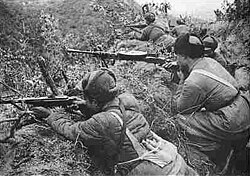
On October 19, 1950, as UN forces captured Pyongyang, the PVA began crossing the Yalu River in secrecy. The first major assault commenced on October 25, 1950, involving 270,000 troops under the command of Peng Dehuai. By late November, the PVA launched a massive strike along the entire Korean front.
In the west, the Battle of the Ch'ongch'on River saw the PVA overrun several UN divisions, leading to the longest retreat of an American unit in history. In the east, the Battle of Chosin Reservoir saw the PVA 80th and 81st Divisions surround Task Force Faith. While the PVA suffered casualties, the destruction of the 3,000-man unit was considered one of their greatest successes.
The Fifth Phase Campaign and Stalemate
The conflict saw extreme fluctuations in momentum. During the UN's May-June 1951 counteroffensive, the PVA suffered a significant defeat, most notably the destruction of the 180th Division. Following these intense periods of maneuvering, the war entered a long stalemate. Fighting eventually ceased on July 27, 1953, following an armistice agreement, which established a demilitarized zone near the 38th parallel.

Logistics and Equipment
The effectiveness of the PVA was heavily dependent on their ability to manage supplies under combat conditions. Their equipment and rations were essential for sustaining long campaigns in harsh environments.

| Category | Details |
|---|---|
| Allegiance | Chinese Communist Party |
| Primary Role | Combined arms, Expeditionary warfare |
| Official Colors | Red |
| Estimated Casualties (Official) | 390,000 (including KIA, wounded, and MIA) |
| Estimated Casualties (Western) | ~400,000 KIA/disease; ~486,000 wounded |
Prisoners of War and the Armistice
One of the most complex issues during the Panmunjom Truce negotiations was the exchange of prisoners. Under the 1949 Geneva Conventions, prisoners were to be exchanged immediately. However, complications arose because many North Korean and Chinese prisoners expressed a desire not to return to their homelands. Some Chinese POWs were anti-communists who had been forcibly inducted into the PLA during the Chinese Civil War.

Legacy and Aftermath
The legacy of the PVA remains significant in both China and Taiwan. In China, the soldiers are remembered for their "international heroism." In Taiwan, the 14,235 PVA POWs who were transported to the island in 1954 were honored as "Anti-Communist Heroes," leading to the designation of January 23 as World Freedom Day.
Frequently Asked Questions
Why was the army called the "People's Volunteer Army" instead of the PLA?
The name was chosen to maintain the appearance of a volunteer force rather than an official military intervention, thereby helping to prevent an all-out declared war between the United States and the People's Republic of China.
Who was the commander of the PVA?
Peng Dehuai served as the nominal commander and political commissar until his illness. Following April 1952, Chen Geng and Deng Hua served as acting commanders and commissars.
What was the "Most Beloved People" nickname?
The nickname "Most Beloved People" (最可爱的人) was used to honor the soldiers of the PVA for their perceived bravery and spirit during the conflict.
How did the war end?
The fighting ended on July 27, 1953, following an armistice agreement accepted by both the UN and the PVA, which established a demilitarized zone near the 38th parallel.
What happened to the Chinese POWs captured by UN forces?
While many were exchanged, a significant number of Chinese POWs chose not to return to mainland China. Approximately 14,235 of these prisoners were transported to Taiwan in early 1954.