Paul Ehrenfest: The Master Teacher of Theoretical Physics
Paul Ehrenfest (1880–1933) was a towering figure in the world of theoretical physics, renowned not only for his profound contributions to statistical mechanics—the study of how macroscopic properties of a system emerge from the microscopic behavior of its atoms—but also for his extraordinary ability to teach and mentor. A close confidant of Albert Einstein and Niels Bohr, Ehrenfest spent the bulk of his career at Leiden University, where he became a catalyst for the development of modern quantum theory.
Key Facts
- Primary Field: Statistical physics and its relationship to quantum mechanics.
- Major Contributions: The Ehrenfest theorem, the Ehrenfest paradox, and the theory of adiabatic invariants.
- Academic Legacy: Succeeded Hendrik Lorentz as Professor of Theoretical Physics at Leiden University (1912–1933).
- Notable Mentorship: Taught and influenced future luminaries including Enrico Fermi, George Uhlenbeck, and Samuel Goudsmit.
- Terminology: Coined the term "ultraviolet catastrophe" in 1911.
Early Life and Academic Foundations
Born in Vienna, Austria-Hungary, to Jewish parents, Paul Ehrenfest showed an early aptitude for mathematics. His academic journey took him through the Vienna Institute of Technology and the University of Göttingen, a global hub for mathematics and physics. While in Vienna, he studied under Ludwig Boltzmann, whose work on the kinetic theory of thermodynamics deeply influenced Ehrenfest's lifelong research focus.
In 1904, Ehrenfest earned his Ph.D. from the University of Vienna with a dissertation titled Die Bewegung starrer Körper in Flüssigkeiten und die Mechanik von Hertz (The Motion of Rigid Bodies in Fluids and the Mechanics of Hertz). During his studies in Göttingen, he met Tatyana Afanasyeva, a talented mathematician who became his wife and frequent scientific collaborator.
The Path to Leiden
Ehrenfest's early career was marked by both scientific brilliance and personal struggle. After a period of scientific isolation in St. Petersburg, where his refusal to declare a religious affiliation barred him from a professorship, he sought positions across Europe. During a visit to Prague in 1912, he met Albert Einstein, sparking a lifelong friendship.
Although Einstein recommended him for a position in Prague, Ehrenfest's steadfast atheism again proved a hurdle. However, following the resignation of Hendrik Lorentz, Ehrenfest was appointed as the Professor of Theoretical Physics at Leiden University in 1912, a position he held until his death.
A Legacy of Teaching and Mentorship
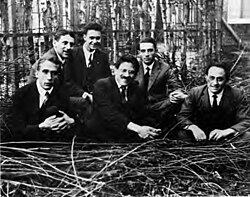
At Leiden, Ehrenfest was celebrated as one of the finest teachers in the history of physics. He eschewed overly abstract methods, preferring simple models and transparent examples to clarify complex assumptions. He founded the study association De Leidsche Flesch ("The Leyden jar") to encourage interaction among students.
His influence extended to a generation of physicists. He mentored students such as George Uhlenbeck and Samuel Goudsmit, who proposed the concept of electron spin, and Jan Tinbergen, who later won the first Nobel Memorial Prize in Economic Sciences. His laboratory also hosted visiting giants of the field, including Werner Heisenberg, Paul Dirac, and J. Robert Oppenheimer.
Scientific Contributions and Research
Ehrenfest's research focused on the fundamentals of physics, seeking to resolve paradoxes through lucidity and directness. His most significant work between 1912 and 1933 involved adiabatic invariants—concepts from classical mechanics used to refine atomic models and link atomic mechanics with statistical mechanics.
His name is attached to several critical concepts in physics:
- Ehrenfest Theorem: Demonstrates that the expectation values of a quantum system follow the laws of classical mechanics.
- Ehrenfest Paradox: A thought experiment regarding the relativity of rotating disks.
- Ehrenfest Model: A model used in statistical physics.
- Ehrenfest Time: The timescale at which quantum dynamics for observables diverge from classical dynamics.
Beyond physics, Ehrenfest explored the analogy between thermodynamics and economic processes, encouraging Jan Tinbergen to apply these mathematical theories to economics.
The Great Debates: Einstein and Bohr
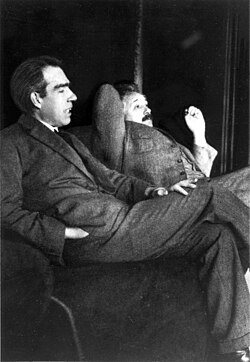
Ehrenfest served as a bridge between the two most influential figures of the quantum revolution: Albert Einstein and Niels Bohr. He frequently hosted Einstein at his home in Leiden, providing a sanctuary during times of political unrest in Germany.
In December 1925, Ehrenfest invited both Bohr and Einstein to Leiden in an attempt to reconcile their differing views on quantum theory. Despite his efforts to mediate, Ehrenfest eventually found himself siding with Bohr's arguments during the famous 1927 Solvay Conference.
Final Years and Tragedy
Despite his professional success, Ehrenfest struggled with severe depression starting around 1931. His mental health declined to the point that Albert Einstein wrote to the University of Leiden requesting a reduction in Ehrenfest's workload.
The tragedy culminated on 25 September 1933, in Amsterdam, when Ehrenfest killed his younger son, Wassik, who had Down syndrome, and then took his own life.
| Category | Details |
|---|---|
| Education | TU Wien, University of Göttingen, University of Vienna (PhD) |
| Key Position | Professor of Theoretical Physics, Leiden University (1912–1933) |
| Major Theorem | Ehrenfest Theorem (Quantum-Classical correspondence) |
| Key Term Coined | Ultraviolet Catastrophe (1911) |
| Notable Students | Enrico Fermi, Samuel Goudsmit, George Uhlenbeck, Jan Tinbergen |
Frequently Asked Questions
What is the Ehrenfest theorem?
The Ehrenfest theorem is a fundamental principle in quantum mechanics stating that the expectation values of position and momentum operators evolve over time in a manner that conforms to classical Newtonian mechanics.
What was the "ultraviolet catastrophe"?
The "ultraviolet catastrophe" is a term coined by Ehrenfest in 1911 to describe the failure of classical physics to predict the energy emitted by a black body, which incorrectly suggested that an infinite amount of energy would be radiated at very short wavelengths (ultraviolet).
How did Ehrenfest influence the field of economics?
While he did not publish economic papers himself, Ehrenfest believed there was a mathematical analogy between thermodynamics and economic processes. He encouraged his student, Jan Tinbergen, to pursue this research, leading Tinbergen to become a pioneer in econometrics.
Who were Ehrenfest's most famous students?
Among his most notable students and associates were George Uhlenbeck and Samuel Goudsmit (who proposed electron spin), Jan Tinbergen (Nobel laureate in Economics), and Enrico Fermi.
What is the Ehrenfest paradox?
The Ehrenfest paradox is a thought experiment in special relativity involving a rotating disk, which highlights the contradictions that arise when applying Lorentz contraction to a rotating object.